
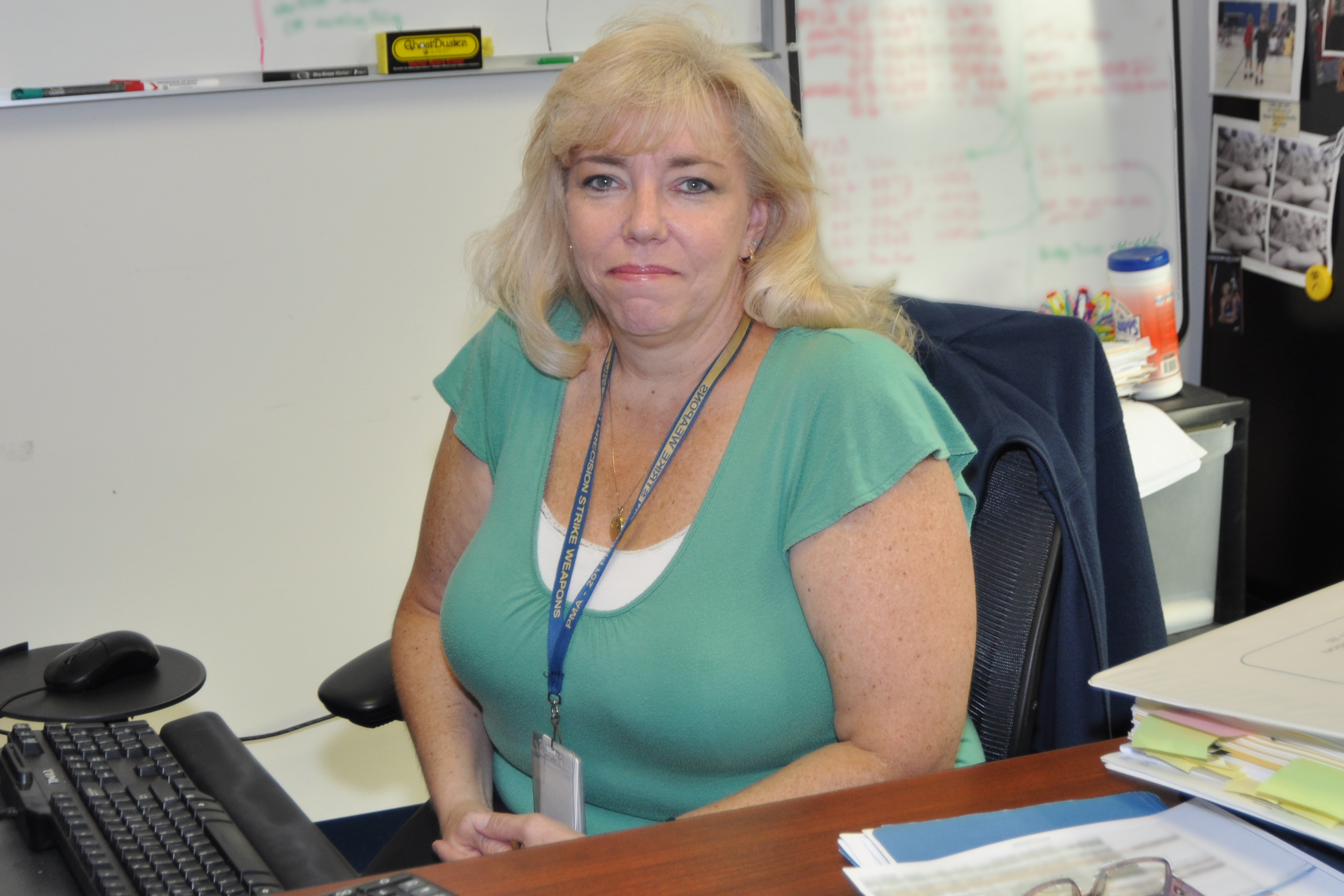
Karin Branch, business financial manager with the Precision Strike Weapons Program Office at Naval Air Station Patuxent River, Md., marked the one-year anniversary this summer of the call that identified her as a potential genetic match for a man diagnosed with acute myeloid leukemia in need of a bone marrow transplant. (US Navy photo)
Pax River civilian provides new hope to her “blood brother”
NAVAL AIR SYSTEMS COMMAND, Patuxent River, Md. --Getting married, the birth of twin boys, work promotions and sending her kids to college were just a few of Karin Branch’s unmatched milestones; she had no idea that a five-minute cheek swab more than 10 years ago would make the cut too.
One year ago, Branch, a NAVAIR business financial manager with the Precision Strike Weapons Program Office (PMA-201) at Pax River, was identified as a potential genetic match for a man diagnosed with acute myeloid leukemia, or AML, in need of a bone marrow transplant. Three months later, she donated the blood-forming cells that may have saved his life or at least given him more time to fight his disease.
It Began With a Swab
While working in a division of NAVAIR’s test and evaluation competency in 2002, Branch and other teammates joined together to support an ailing colleague who had been diagnosed with AML and needed a bone marrow donor to increase her chances of survival.
The drive was sponsored by the C.W. Bill Young DoD Marrow Donor Program that strives to meet the special needs of the military. Donors through the DoD program join the national “Be The Match” Registry automatically and the DoD program also provides a separate donor management system that securely facilitates the process. The Be The Match Registry is run by the National Marrow Donor Program/Be The Match, a non-profit organization that provides bone marrow and umbilical cord blood to patients in need.
To join, teammates completed a simple registration form and then had four oral swabs collected from inside his/her cheeks. The cells collected were sent for tissue typing, a process in which the potential donor’s human leukocyte antigen, or HLA, type is identified and saved in the national registry.
“Sadly, no one in our office was a match, and eventually our colleague lost her battle with AML,” Branch said.
Against the Odds
According to Be The Match’s website, more than 14,000 U.S. and international searches of the Be The Match Registry were conducted in 2012. Of those searches, only 1 in 40 registry members were called as a potential match and only 1 in 300 were actually confirmed as a perfect match. Based on statistics alone, Branch’s chances of being a match for someone were low.
Since her initial registration in 2002, Branch has had multiple positions within the Department of the Navy and admittedly, she had not been updating her contact information with Be The Match.
“I had almost forgotten that I signed up,” Branch said. “I was shocked they tracked me down.”
An added benefit of joining the registry through the C.W. Bill Young DoD Marrow Donor Program is their ability to locate registry members.
“The program can utilize multiple locator programs” said Eddy Medina, senior recruiter for the C.W. Bill Young DoD Marrow Donor Program, “such as the DEERS [the Defense Enrollment Eligibility Reporting System] to track down potential matches.”
Hurry Up, Wait, Hurry Up
A few days after the initial phone call, Branch was asked to provide additional blood work at a local lab to verify that she was indeed a genetic match. After the tests, she had to wait another six to eight weeks for her results.
In the meantime, she was informed that her brother had been diagnosed with cancer. Already hoping to be a match, the news of her brother’s illness increased her desire to be a marrow donor even more.
“I couldn’t help my brother [with a donation], so at least I could help somebody,” she said. “I was determined to be physically fit enough to be able to undergo the peripheral blood stem cell procedure.”
Donors have two options of donating; the marrow donation is a surgical, outpatient procedure that extracts marrow from a donor’s pelvic bone, while under anesthesia. The other option, and Branch’s preference, is the peripheral blood stem cell donation, a nonsurgical, outpatient procedure that’s similar to donating plasma or platelets.
Finally, on Sept. 5, 2012, Branch was confirmed as a lifesaving match for her “blood brother,” as she would later nickname him. She knew nothing about the recipient other than his age, gender and that he lives in the U.S.
From that point forward, the donation process moved very quickly.
Two days later, Branch drove to Georgetown University Hospital for further testing to ensure she was healthy enough to donate. She was required to have a full physical including more blood work, chest X-rays, electrocardiogram and a full health history review.
Approved for the peripheral blood stem cell procedure, Branch was sent back to Georgetown two weeks later for the final steps before her donation. For five days leading up to the procedure, Branch was given injections of a drug called filgratim, used to increase the number of blood-forming cells in her bloodstream.
Branch was provided a hotel room in the area for the week and was joined by her family for support. After her shot each morning, she moved forward with the rest of the day, taking her sons to local museums and working from her hotel room. However, a few days into the injection process, she began experiencing common side effects of the injections, flu-like symptoms such as muscle aches and headaches, of which she is already prone.
“That was the part [the headaches] that was the worst for me,” Branch said, “but I knew it would pass and I knew it was worth it.”
Finally, on the day of the peripheral blood stem cell procedure, she was admitted into an outpatient facility for the donation, done through a process called apheresis.
During apheresis, a needle is placed into each arm of the donor; blood is removed from a vein in one arm and passed through tubing into a blood cell separator machine. The blood is spun at high speed and the cells separate into layers, collecting what is needed for the recipient and returning what is not, to the donor.
Branch was joined by a longtime friend during the five-hour procedure to help pass the time. Branch noted that the nursing staff at the outpatient facility was exceptional, making her laugh and keeping her entertained throughout the day. She also met another donor in the bed next to her, a recent Harvard graduate.
“His recipient was a 3-year-old little girl who lived overseas,” Branch said. “The recipient may not be someone from the United States, she or he may not be an adult, she may be a child.”
According to Be The Match, the program facilitated more than 5,800 U.S. and international marrow, peripheral blood stem cell and umbilical cord blood transplants in 2012, an average of 490 transplants each month.
Connecting with New Family
Once the procedure was complete, Branch wrote a note to send along with her donation to who she considers to be her newest family member.
“Basically, I told my blood brother, ‘good luck,’” Branch said, “and not to blame me if he suddenly had chocolate cravings, it’s in the blood!”
Within days of the procedure, Branch felt back to normal and returned to work the following Monday. She was greeted with enthusiasm from her colleagues and church community.
“To me, donating was as natural as giving my sons a hug,” Branch said.
A few months later, during the winter holiday season, Branch received a card from the recipient in which he reported doing well.
Donors and recipients must wait at least one year after the transplant to meet, if both parties agree. Branch is interested in meeting her recipient and says she would treat him like a brother, starting with a hug.
“I would just treat him like family because to me he is,” said Branch. “We are now linked.”
Today, one year after the phone call that changed her life and that of the recipient’s, Branch reports that her biological brother is cancer-free and she hopes that somewhere in the U.S., her other “brother” can say the same thing.
For more information about the C.W. Bill Young Department of Defense Marrow Donor Program or to join the Be The Match Registry, visit http://www.dodmarrow.org/index.htm.