
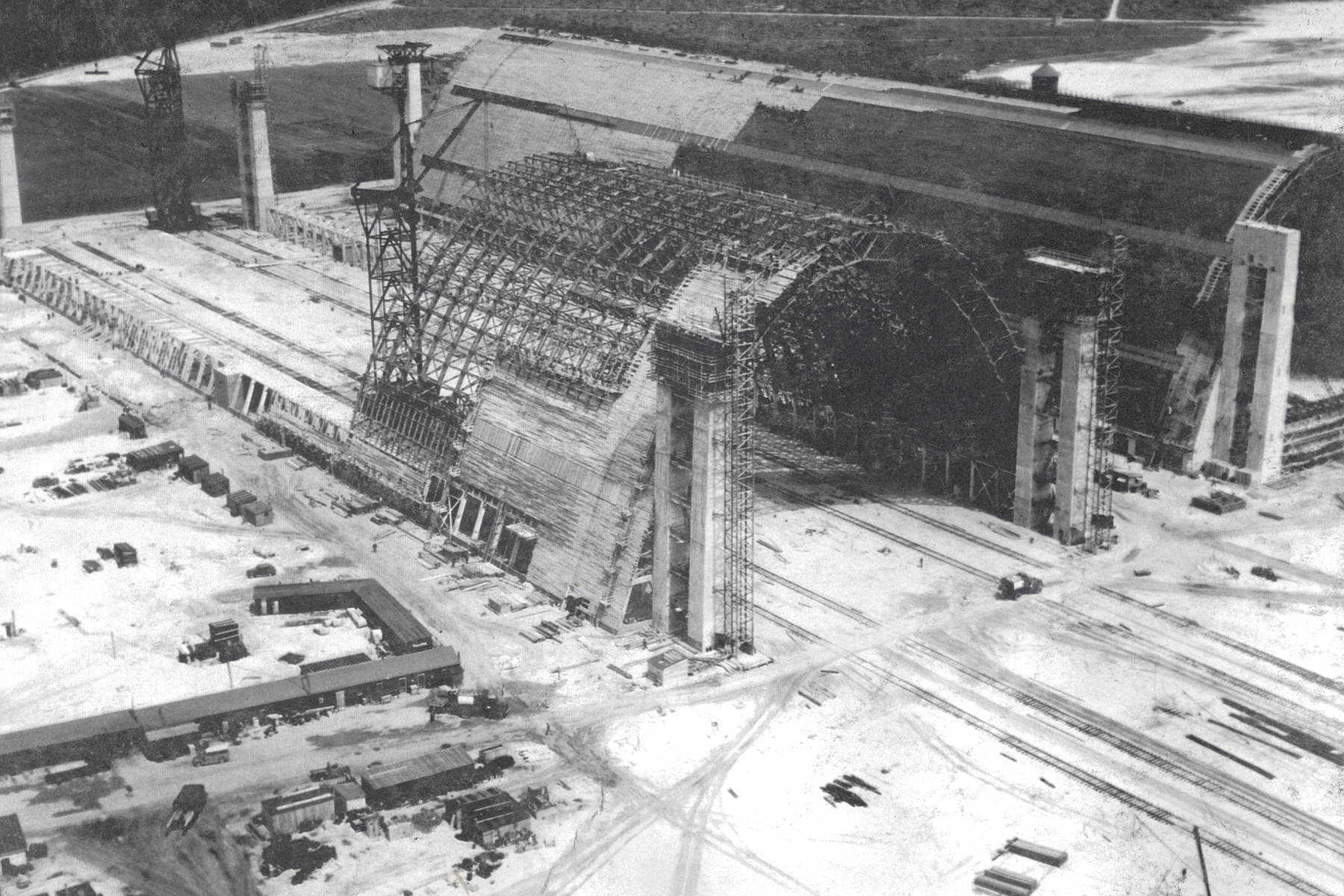
Hangars 5 and 6 under construction in 1943 at Lakehurst, N.J. They each contain 241,000 square feet of floor space and were originally designed to house the Navy’s expanding fleet of antisubmarine patrol blimps of the WWII era.
Navy History and Tradition Lives on at Joint Base McGuire-Dix-Lakehurst
Joint Base McGuire-Dix-Lakehurst, N.J. - Lakehurst today is an integral part of the burgeoning military complex known as Joint Base McGuire-Dix-Lakehurst. It retains its naval traditions and historical roots dating back to 1921.
Military operations at Lakehurst began in 1916 when the Eddystone Chemical Corporation bought the first parcel of land from the Manchester Land Company with the intent of using it as an ammunition testing Ground for the Imperial Russian Army.
The U.S. Army purchased the property and named it Camp Kendrick and continued to use the facility for testing munitions shortly after entering World War I. The Navy purchased an additional 1,499 acres of the property for $14,190 for use as an airship station following the war. The base was renamed Naval Air Station (NAS) Lakehurst in 1921.
Hangar One, now a registered historical landmark, was constructed between 1917 and 1921 at a cost of $4 million dollars. All of the Navy’s four rigid air ships, USS Shenandoah, USS Los Angeles, USS Akron and USS Macon, were housed at one time or another in Hangar One. The Hindenburg also was housed in Hangar One with only an 18 inch clearance at the bow and stern. Its early transcontinental passenger trips established NAS Lakehurst as the country’s first international airport. However, on May 6, 1937, the Hindenburg thrust NAS Lakehurst into history forever, as the airship dramatically burned and crashed in the open field just west of Hangar One.
Hangars 5 and 6, completed in 1943 are the largest, single arch wooden structures in the world, each with 241,000 square feet of floor space. They were constructed to house the Navy’s greatly expanding fleet of antisubmarine patrol blimps of the World War II era which numbered six in 1940 and rose to 130 by the war’s end.
In 1951, the Naval Air Technical Training Center (NATTC), now called Center for Naval Aviation Technical Training (CNATT), was established at Lakehurst. Its mission over the years included training sailors to serve as Aviation Boatswain’s Mates, Aircrew Survival Equipment Men, Aerographer’s Mates, Naval Security Guards, and Marine Corps Expeditionary Airfield Technicians. CNATT also houses within Hangar One, the largest training aid in the Navy: The Carrier Aircraft Launch and Support System/Equipment Simulator (CALASSES), a one-third scale model aircraft carrier. CALASSES provides realistic training on catapults, arresting gear assemblies, and other equipment with which the Aviation Boatswain’s Mate must be familiar.
In 1957, the station received another new tenant, the Naval Air Test Facility (NATF). Its mission was to test and evaluate aircraft launch and recovery systems and aviation support equipment. By 1962, all lighter than air operations were discontinued by the Navy. From 1965 to 1973 antisubmarine helicopter squadrons became a part of the station’s mission. In 1973, the Naval Aircraft Factory, renamed the Naval Air Engineering Center (NAEC), moved from Philadelphia to Lakehurst. In 1977, NATF and NAS Lakehurst were merged to become NAEC.
In 1994, the station was renamed the Naval Air Engineering Station (NAES) and served as the host command to the Lakehurst contingent of the Naval Air Warfare Center, Aircraft Division (NAWCAD), Naval Air Systems Command (NAVAIR). In 2003, NAES was realigned to Commander, Navy Region Northeast and in 2006, consolidated to Commander, Navy Region Mid-Atlantic. Most recently, in 2009, Lakehurst became a part of the first tri-service joint base – JB MDL under the management of the Air Force, while NAVAIR continued its Navy mission at the base.
The mission of NAVAIR Lakehurst is to serve as the critical link between Naval Aviation support and the Navy Aircraft Carrier (CV) Battle Groups worldwide. It is the Navy’s engineering support activity for Aircraft Launch and Recovery Equipment (ALRE) and Naval Aviation Support Equipment (SE), and is responsible for maintaining fleet support and infusing modern technology across the entire spectrum of equipment needed to launch, land and maintain aircraft from ships at sea. NAVAIR Lakehurst is the only activity responsible for this specialized element of Naval Aviation in the world.
The unique facilities in the NAVAIR test complex include: a 12,000-foot dedicated Research, Development, Test & Engineering runway with two fleet representative aircraft carrier steam catapults, the CVN-78 Class new generation electromagnetic catapult, two fleet representative arresting gears, a full scale fleet representative Jet Blast Deflector site and three active mile-long jet car test tracks used to propel dead loads weighing up to 100,000 lbs into arresting gear including the new generation Advance Arresting Gear (AAG). Additionally, advanced engineering laboratories, an engineering campus and a 5.7 acre complex of manufacturing and prototyping shops comprise the NAVAIR facilities at Lakehurst that directly support Naval Aviation.
In December 2010, NAVAIR Lakehurst launched the first aircraft, an F/A-18E, from the Electromagnetic Aircraft Launch System (EMALS); and in November 2011, continued testing by launching the next generation fighter, the F-35C from EMALS. Testing and development continues on EMALS and with the next generation shipboard recovery system, the AAG Program.
The Navy at Lakehurst, New Jersey remains a key player in the performance of the many critical missions necessary for the defense of our nation. The joining of Army, Navy and Air Force facilities to more effectively and efficiently serve the needs of our national defense is demonstrated daily by the cooperation and “can do” spirit of the men and women serving at JB MDL.
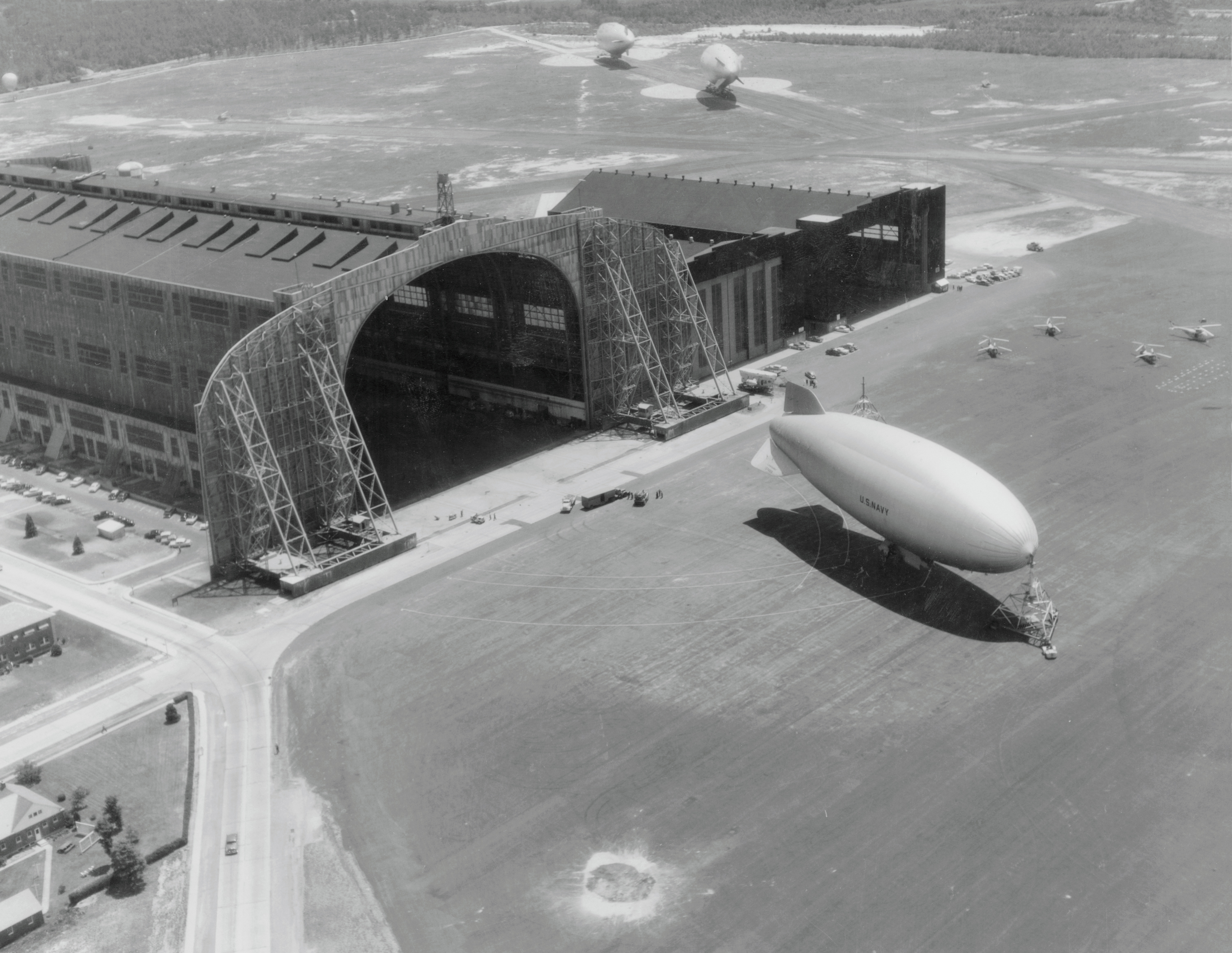
Navy blimp outside of Hangars 1, 2 and 3 at Lakehurst, N.J. in an undated 1950s photo.
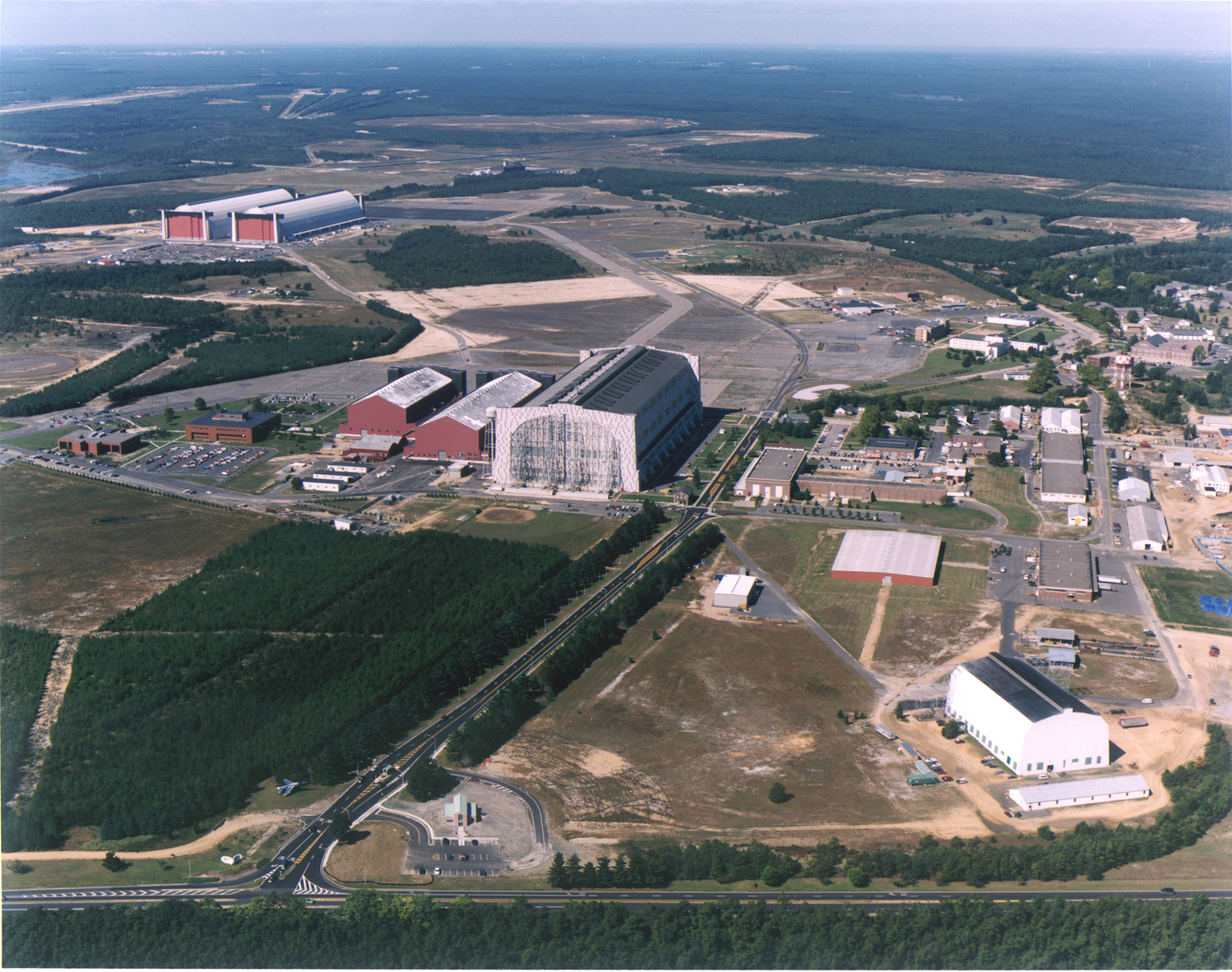
An aerial view of the Lakehurst portion of Joint Base McGuire-Dix-Lakehurst today.