
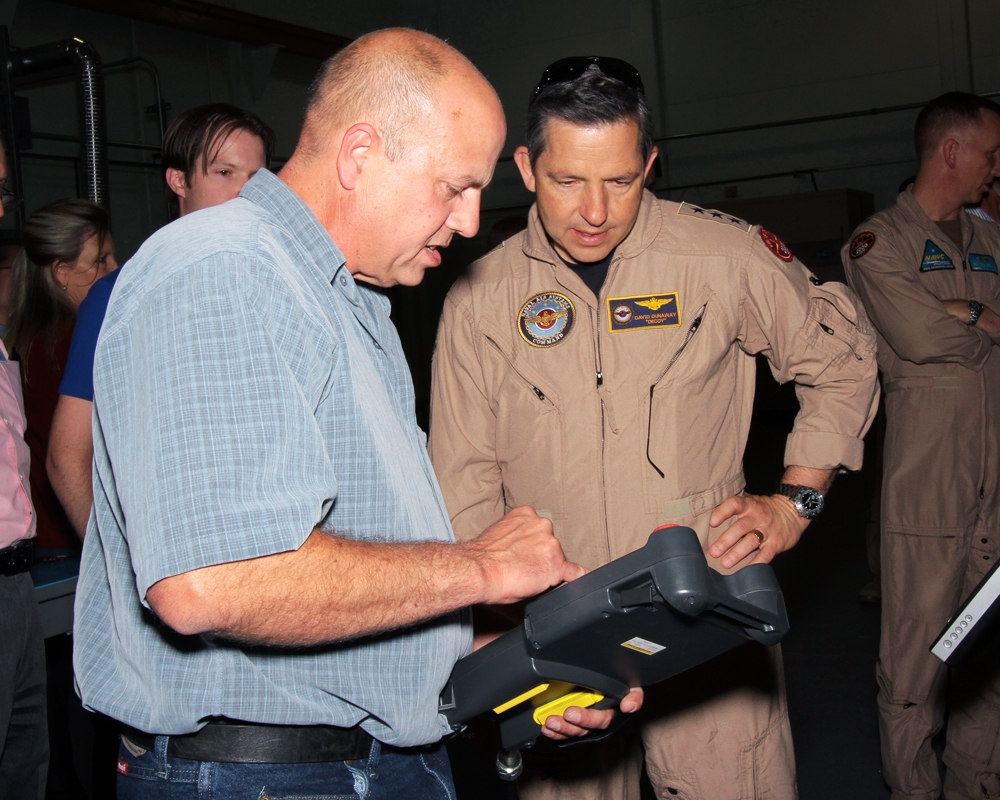
Ron Pruitt, of the Naval Air Warfare Center Weapons Divison Weapons and Energetics Department, shows Vice Adm. David Dunaway, commander of the Naval Air Systems Command, how robotic programming and logic work the robot pendant inside the Applied Manufacturing Technology Division at China Lake. (U.S. Navy photo)
NAVAIR commander visits NAWCWD
NAVAL AIR WARFARE CENTER WEAPONS DIVISION CHINA LAKE, Calif. - Vice Adm. David Dunaway, commander of the Naval Air Systems Command, spent three days at China Lake and Point Mugu, May 20-22, his second visit to NAWCWD since assuming command of NAVAIR six months ago.
Dunaway was accompanied by his flag aide, Lt. Jonathan Norris, and hosted by NAWCWD Commander Rear Adm. Paul Sohl and Executive Director Scott O’Neil.
First on the vice admiral’s agenda was a conference with members of NAWCWD’s senior leadership team: Sohl, O’Neil, Capt. Karl Andina, NAWCWD vice commander; Dr. Ron Smiley, director of electronic warfare combat systems and the Avionics Department; Terry Clark, director of NAVAIR ranges; Dave Janiec, director of the Software Engineering Department; Joan Johnson, director of the Weapons and Energetics Department; and Tom Dowd, director of the Threat and Target Systems Department.
During his visit, Dunaway took more than a dozen briefings beginning with an update on the Network Enabled Weapons Controller Interface Module (NEWCIM) at China Lake and closing with a walk-through of VX-30’s unmanned aircraft systems hangar at Point Mugu. He also made time to meet with military personnel at both sites.
HMC Curtis Trull Jr., VX-31’s aircrew leading chief petty officer, said Dunaway spent about an hour in Hangar 3 talking to Sailors and Marines. “Vice Admiral Dunaway said when it comes to the programs we manage, the decisions we make, and our mission supporting the warfighter to keep three things in mind: be right, stay relevant, and have perseverance,” Trull said. “His talk was inspiring.”
Four town hall meetings were also part of the vice admiral’s West Coast agenda — three at China Lake and one at Point Mugu, reaching about 1,300 employees, roughly 20 percent of the NAWCWD workforce.
Dunaway’s visit comes just six days after Defense Secretary Chuck Hagel announced plans for 11 furlough days for the majority of DoD civilians.
In his May 14 memo to all DoD personnel, Hagel said, “As you are fully aware, the Department of Defense is facing a historic shortfall in our budget for the current fiscal year. This is the result of current law that went into effect March 1. It imposes deep across-the-board cuts on DoD and other federal agencies. Combined with higher than expected wartime operating costs, we are now short more than $30 billion in our operation and maintenance (O&M) accounts — which are the funds that we use to pay most civilian employees, maintain our military readiness, and respond to global contingencies.
“The Department has been doing everything possible to reduce this shortfall while ensuring we can defend the nation, sustain wartime operations, and preserve DoD's most critical asset — our world-class civilian and military personnel. To that end, we have cut back sharply on facilities maintenance, worked to shift funds from investment to O&M accounts, and reduced many other important but non-essential programs,” Hagel said.
At each of his town hall meetings, Dunaway expressed disappointment in the decision made to furlough and conveyed deep concern for the workforce, predicting that the 11-day, 20-percent pay cut to civilians will “crater” productivity and morale and be a setback in readiness for warfighters.
“You’re watching all the politics happen right on the front page of your lives and I apologize for that but it is what it is and we’re going to have to deal with it,” Dunaway said.
To counter the pain of furlough and sequestration, he reminded the workforce of the positive attributes affecting the direction he believes NAVAIR is headed, despite budget downturns, and that it’s times like these when the intellectual capital in the warfare centers make a big difference.
“There’s things happening right now that I see as a big positive for our future that I think are going to make us more relevant than we’ve ever been before,” he said, citing NEWCIM, a working example of Integration and Interoperability (I&I) that catches interoperability issues at earlier stages, helping developers save time and money.
“That’s what integrated warfighting capability is about,” Dunaway said. “Looking at the outcome and making sure you are doing your work across a multitude of systems to connect them to create that outcome as cheaply as you possibly can.”
He also mentioned being well capitalized. “Every one of our platforms – Super Hornet, Growler, E-2D, P-8, 60s – Sierras and Romeos – they’ve got hot production lines. We’re buying up new UAVs. We’re in pretty darn good shape,” he said, crediting that good position to Navy leadership.
Dunaway saved half of his one-hour town halls for questions from employees. Most of the 25 questions they asked him centered on sequestration, how furlough days would impact day-to-day operations, and updates to training and travel approval processes.
More than once Dunaway expressed his concern for employees and the impending furlough days they face. He encouraged people to start saving now for smaller paychecks slated to begin midsummer, and to let their leadership and lenders know if and when they encounter financial hardship due to furlough days.
He reassured employees saying they would get through these furlough days and, as an organization, NAWCWD would remain relevant as providers of naval aviation capabilities. Part of that overall relevancy ties to one of the CNO’s top priorities: delivering Integrated Warfighting Capability, or IWC.
NAVAIR recently established an IWC Enterprise Team, known as the IWC-ET. In his May 16 all hands message to the NAVAIR workforce, Dunaway explained how this team works.
He wrote, “The IWC-ET will include representatives from our engineering, test and evaluation, and logistics community, with ‘reach back’ to the competencies as they develop the people, processes, tools and technical authority for mission area capabilities within each of their organizations. The team will help integrate our independent pockets of great work into a common environment to capitalize on best practices so we (the government) can uniformly create, own and enforce capability-focused technical standards for IWC. Essentially, the SYSCOM becomes the lead “capability” integrator, which is the only way to create environments that will enable the critical technical interaction required to create a Systems of Systems (SoS) approach.”
The IWC-ET includes member Wayne Willhite, NAWCWD’s I&I chief engineer.
Dunaway encouraged his town hall audiences to watch the video he made about the IWC-ET: www.navair.navy.mil/DunawayVBlog .
The vice admiral then circled back to his top priorities — the mission of supporting the warfighter and the people doing the work — both priorities facing challenges in today’s unique environment.
Naming countries facing far more unrest, Dunaway encouraged the workforce saying the work they are doing at NAWCWD has never been more relevant to the stabilization of the world than it is now.
“The way we live today is not free,” Dunaway said. “It does not come easily. It comes from hard work. It comes from using our heads. And I think that we are very well poised to do that as a systems command.”
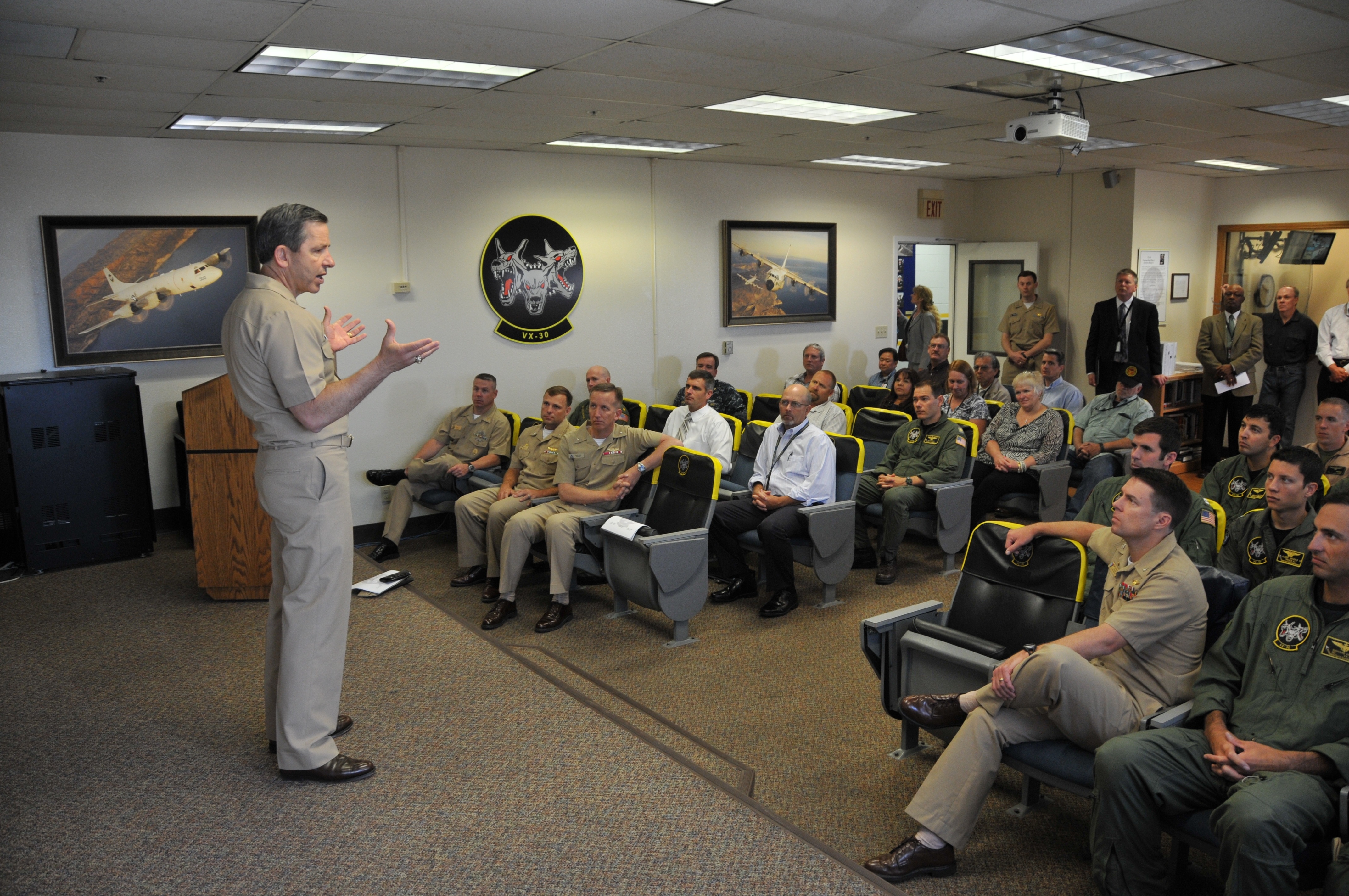
Vice Adm. David Dunaway, commander of the Naval Air Systems Command, talks with military personnel in the Air Test and Evaluation Squadron 30 Ready Room about the importance of their support to Naval Air Warfare Center Weapons Division and the U.S. Navy. (U.S. Navy photo)
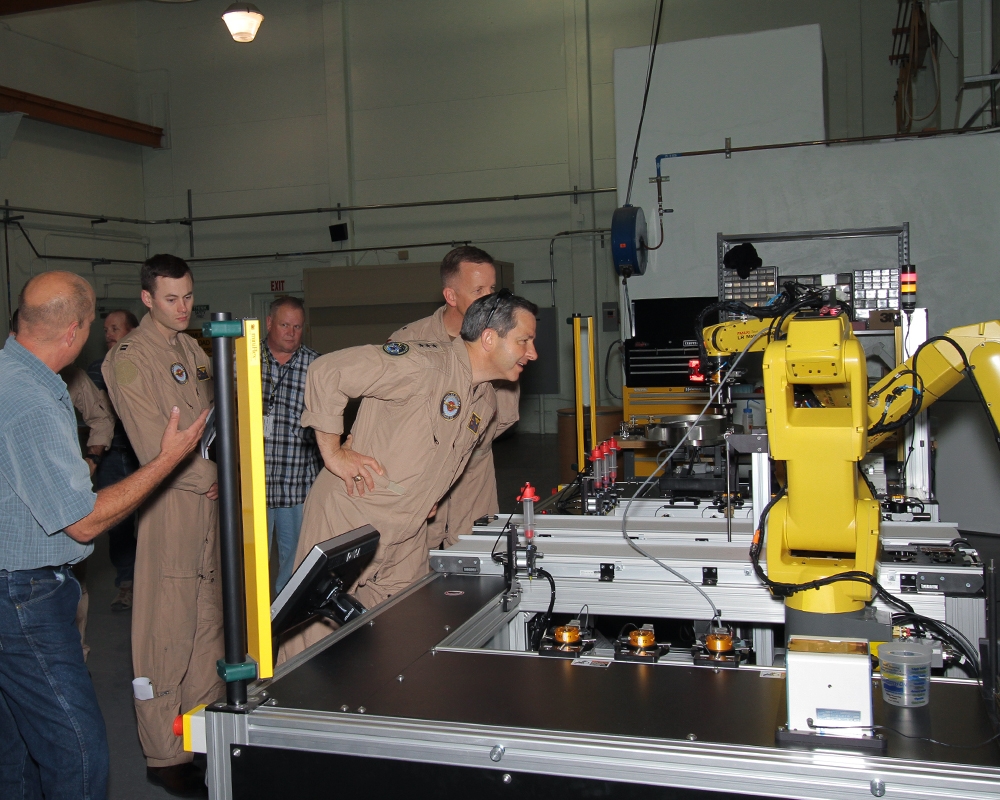
Vice Adm. David Dunaway, commander of the Naval Air Systems Command, watches all three robots working simultaneously to assemble circuit boards on the SPIKE CAS inside the Applied Manufacturing Technology Division at Naval Air Warfare Center Weapons Division China Lake. (U.S. Navy photo)
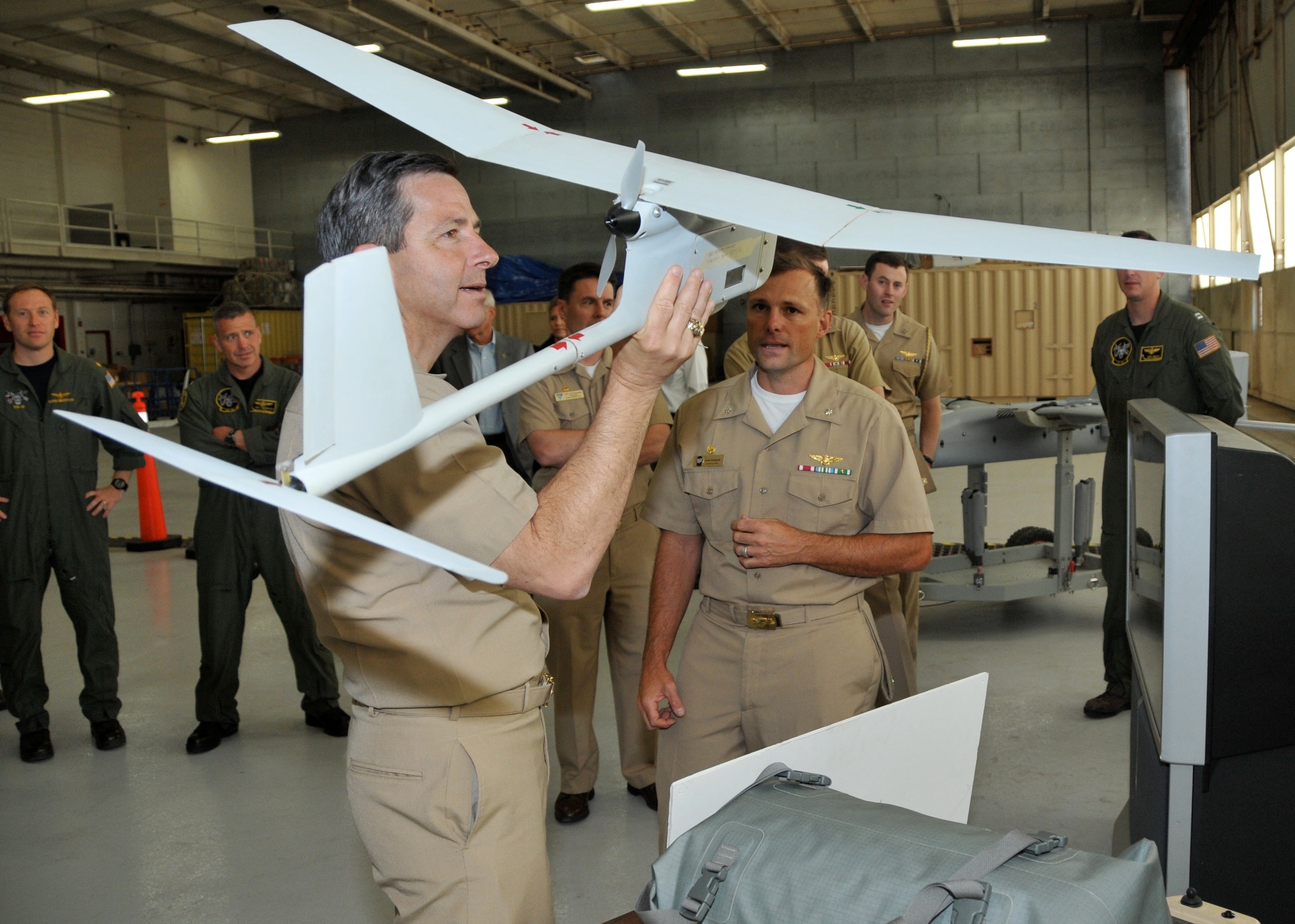
Air Test and Evaluation Squadron (VX) 30 Commanding Officer Cmdr. James Borghardt, center, discusses capabilities of the Raven (RQ-11B), held by Vice Adm. David Dunaway, commander of the Naval Air Systems Command, while touring the unmanned aerial systems hangar at Naval Air Warfare Center Weapons Division Point Mugu. (U.S. Navy photo)
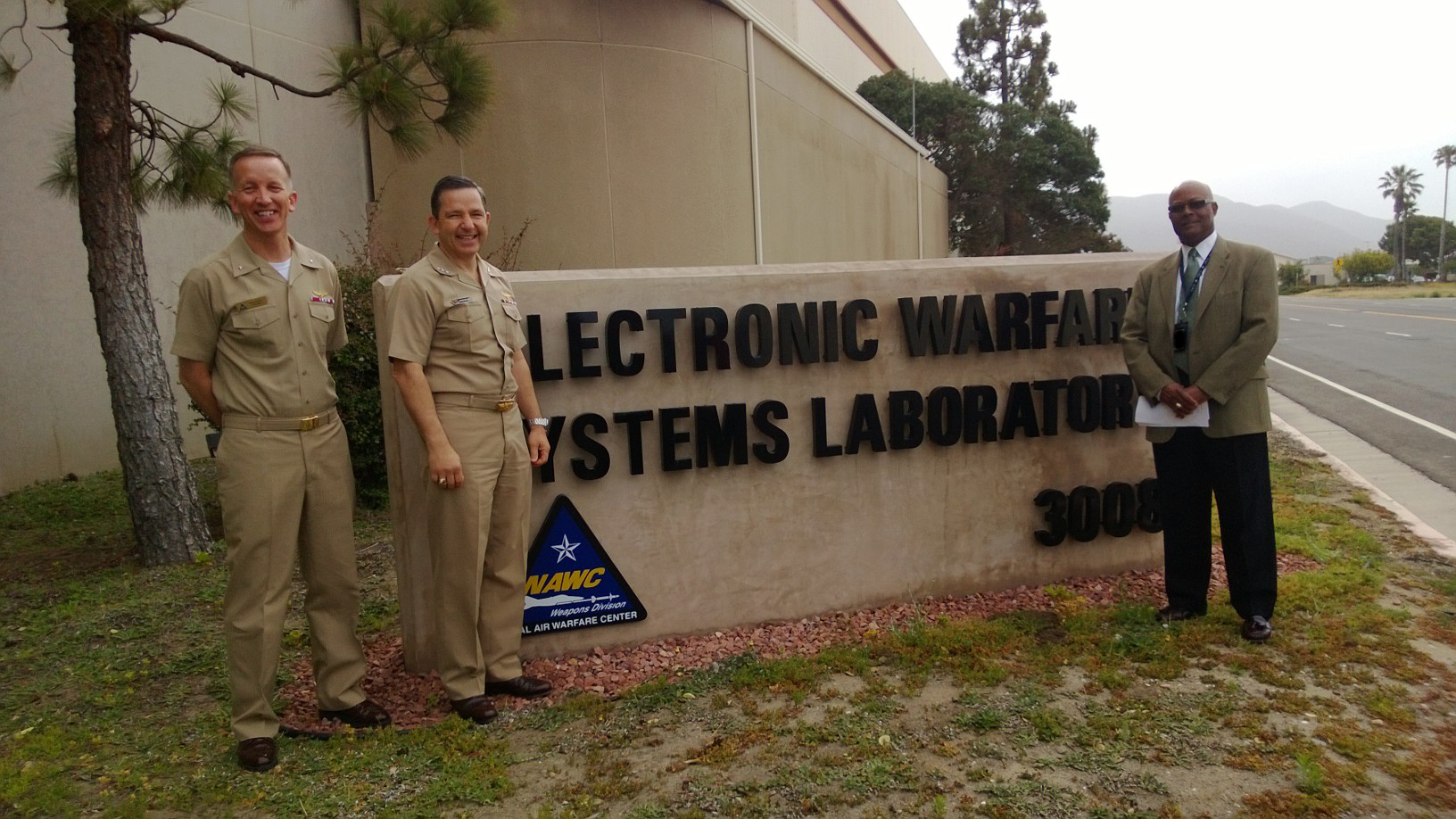
Dr. Ron Smiley, the Naval Air Systems Command‘s director for Electronic Warfare/Combat Systems, welcomes Vice Adm. David Dunaway, second from left, NAVAIR commander, to Naval Air Warfare Center Weapons Division Point Mugu. Rear Adm. Paul Sohl, NAWCWD commander, joined Dunaway during his visit. (U.S. Navy photo)