
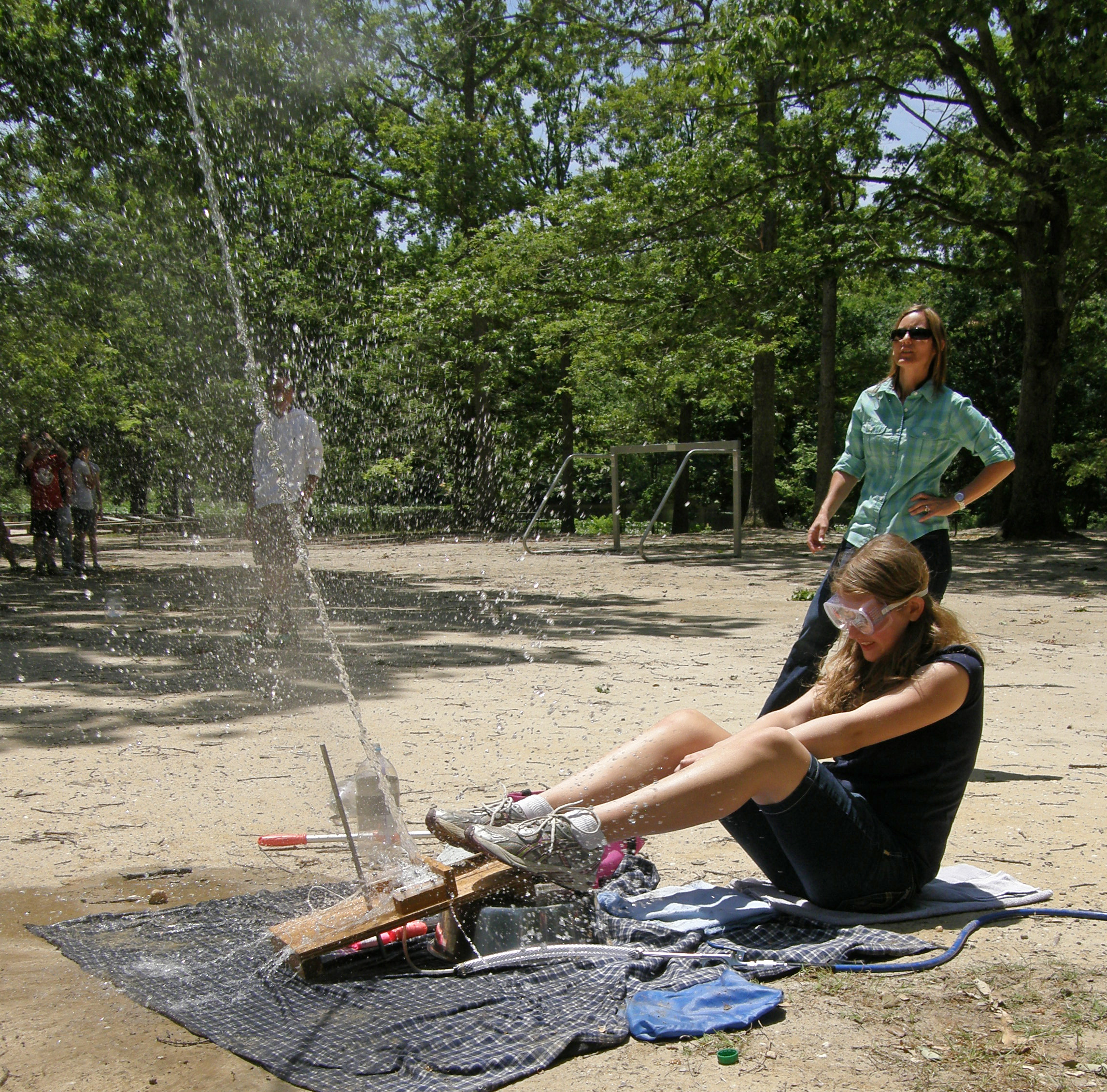
Brandi Simpson (standing) watches as a Chesapeake Public Charter School eighth grader launches her recycled bottle rocket at Mattapany Day Camp. (Courtesy photo)
Students tour base and use bottle rockets to explore physics
NAVAL AIR SYSTEMS COMMAND, PATUXENT RIVER, Md. — Twenty-one eighth graders recently explored how their science, technology, engineering and mathematics (STEM) education translates into the work carried out here at Naval Air Station Patuxent River.
In partnership with the Naval Air Warfare Center Aircraft Division (NAWCAD) Education Outreach Program, Atlantic Test Ranges environmental scientist Brandi Simpson guided Chesapeake Public Charter School students on a tour of both the U.S. Naval Test Pilot School (USNTPS) and the Aircraft Survival Systems Development and Prototype Lab, as well as a hands-on bottle rocket experiment.
At the Test Pilot School, USNTPS Security Manager Rich Harris explained to students what it takes to become a test pilot as they toured the aircraft hangar. At the Aircrew Survival Systems Development and Prototype Lab, aerospace experimental psychologists Lt. Cmdr. Hank Phillips and Joe Geeseman showed students more than five generations of protective flight and military apparel and the horizontal accelerator used for dynamic testing, and discussed the importance of flight safety.
“I’m a big advocate for learning,” said NAWCAD Education Outreach Coordinator Terri Chase. “I love working with the kids and giving them the opportunity to see what the NAWCAD community has to offer locally.”
After the two tours, students created and launched recycled bottle rockets at the Mattapany Day Camp by predicting possible flight patterns at different units of pressure measurement.
Pairs of students worked together: The co-pilot called out a countdown, the pilot released a rocket from the launch pad, the two-liter bottle shot up into the sky and landed in the campsite, and the co-pilot then measured how far the rocket traveled and recorded that data in a class chart. Every student got a chance to perform both the role of pilot and co-pilot.
“I love seeing students’ eyes light up the moment they understand a difficult concept,” Simpson said. “When I see their eyes light up or a big smile on their face, I know I'm contributing to their education and making a difference in their lives.”
The NAWCAD Education Outreach Program is geared toward energizing and exploring local students’ STEM education. The program partners scientists and engineers with schools to strengthen young scientific minds and support NAWCAD initiatives.