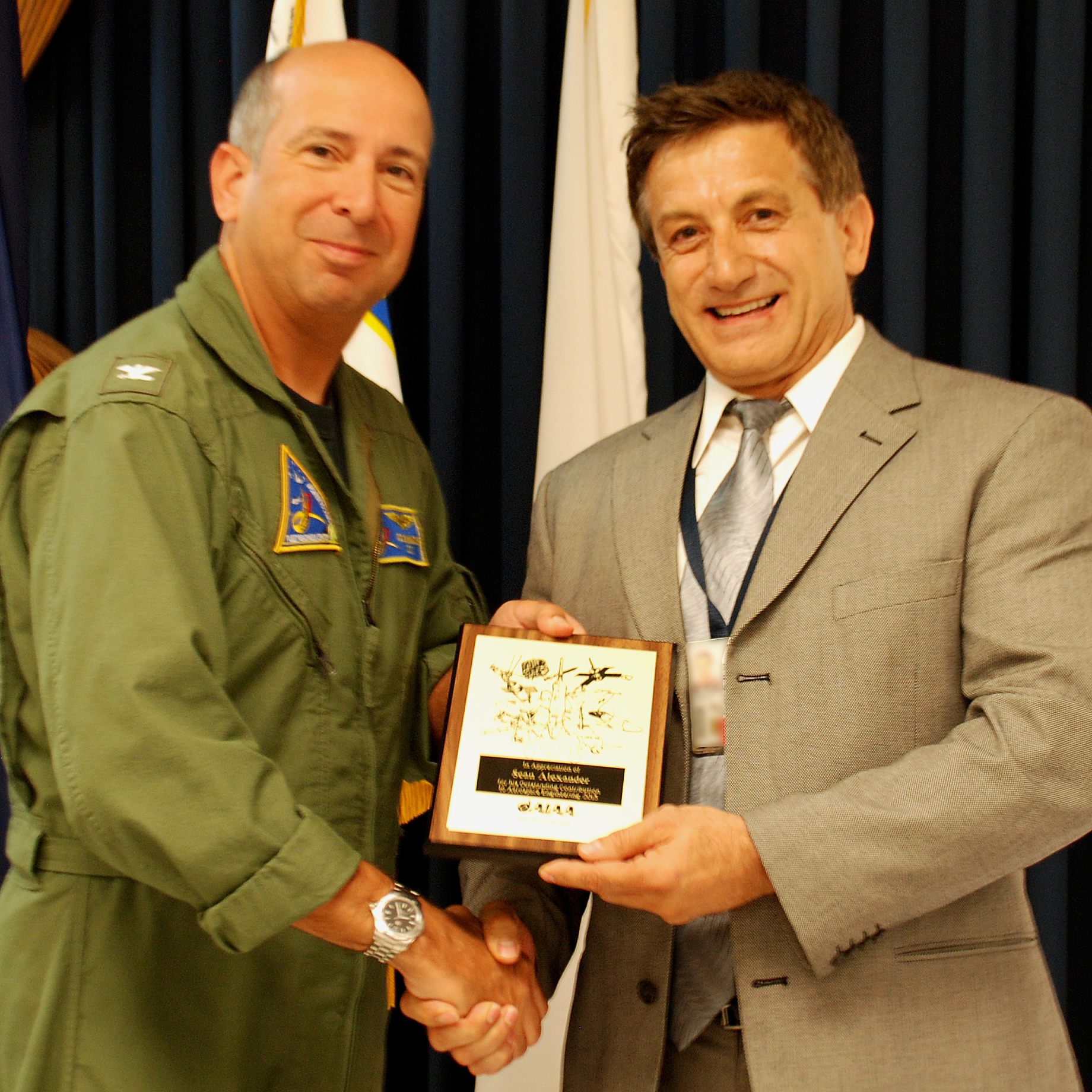
Fleet Readiness Center Southwest Commanding Officer, CAPT Don Simmons presents engineer Sean Alexander with an appreciation award for his outstanding contribution to Avionics Engineering.
FRCSW Engineer wins AIAA Engineer of the Year Award
Fleet Readiness Center Southwest (FRCSW) Engineer Chosen AIAA Engineer of the Year
By FRCSW Public Affairs
NAVAL AIR STATION NORTH ISLAND, CA – Fleet Readiness Center Southwest (FRCSW) Engineer Mr. Sean Alexander has been selected as the most outstanding contributor to aerospace engineering by the American Institute of Aeronautics and Astronautics (AIAA) during the annual dinner held May 23, 2013, in San Diego, CA.
AIAA has more than 35,000 members nationwide.
Mr. Alexander is one of the top engineers within NAVAIR (FRCSW parent command) and has been responsible for solving a critical safety issue for the EA-18G Growler fleet.
In late 2010 the first EA-18G squadron deployed ashore in Iraq began to experience cabin pressurization issues. After providing extensive remote troubleshooting assistance to the squadron, it became apparent that on-site support was required. Mr. Alexander flew to Iraq to provide such troubleshooting. Arriving two days before Christmas he worked an average of sixteen hours a day for the complete two and half weeks he was in country, including working on Christmas and New Years Day.
Mr. Alexander was able to narrow down the list of potential causes, clarify some of the system operations questions that the squadron had, and shore up the required maintenance procedures, all of which allowed the squadron to keep the aircraft flying and performing their mission.
Upon returning from Iraq, Mr. Alexander and his team began working with their acquisition and certification counterparts at Boeing and Northrop Grumman to try and resolve the issue and develop a solution for the fleet. From the onset, the general consensus was that flight testing should be used to determine the root cause. Mr. Alexander did not believe that flight testing was the best nor most efficient option. Instead he believed that a laboratory test stand could be developed to find the root cause and test possible solutions.
Mr. Alexander knew that the time, complexity, and cost associated with instrumenting a test aircraft and developing a test plan would push out the delivery of a solution to the fleet beyond acceptable limits.
Mr. Alexander’s solution was to construct a lab test stand at a fraction of the cost which would also allow for far more “flights” since the number of simulations would not be limited. Mr. Alexander also believed that a test stand would afford accurate control of the environmental variables (temperature, humidity, pressure). Control of such variables would not be possible in flight testing, which could ultimately render the flight testing unable to yield results.
Mr. Alexander was able to duplicate the failure being experienced on the aircraft and ultimately was able to derive a solution that not only addressed the original issues that had been experienced on the aircraft in Iraq, but also provided assurance that the cabin pressurization issues would not occur beyond the outer limits of the aircraft’s flight envelope.