
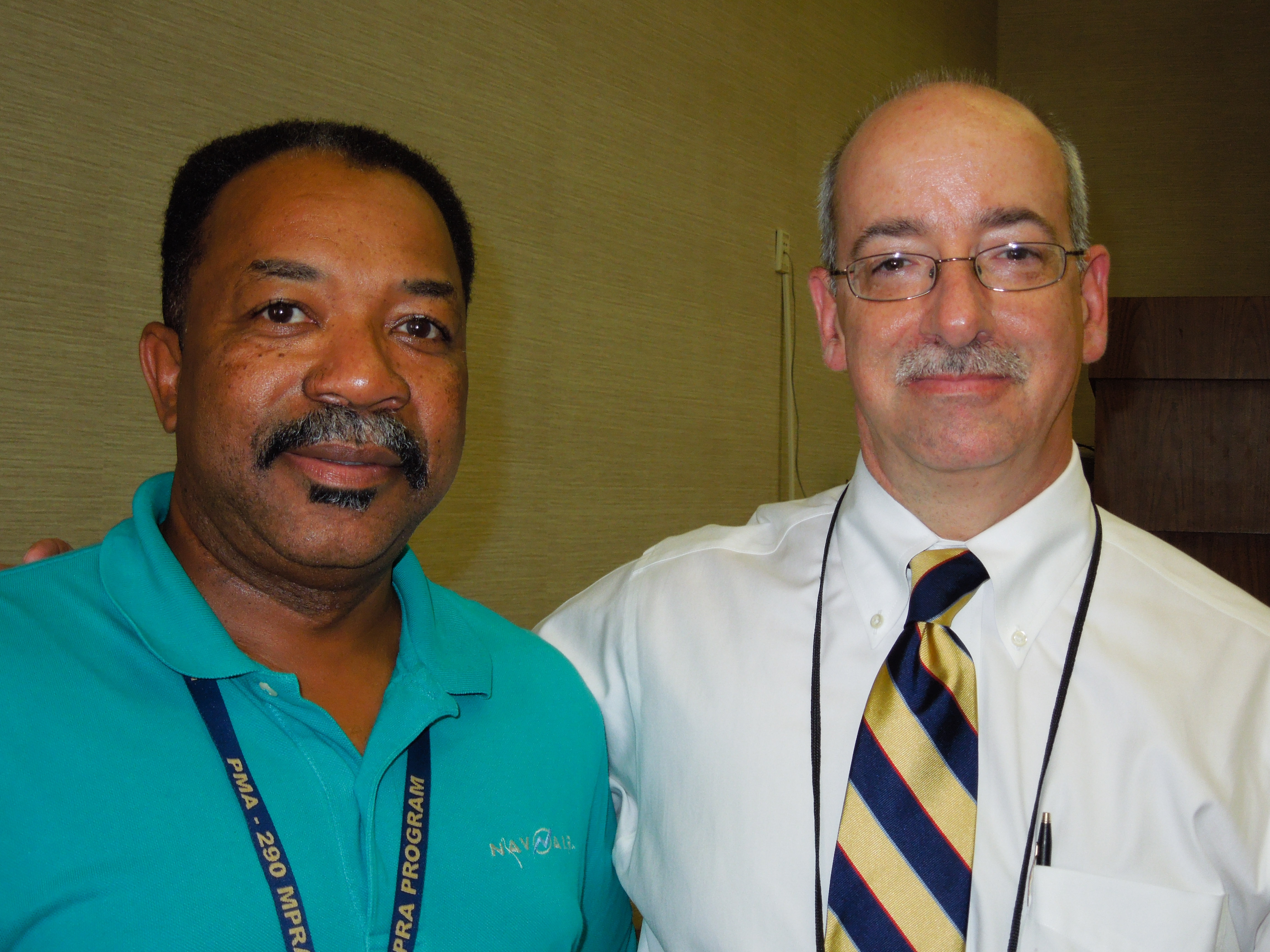
Mentee Bruce Jackson, left, with mentor Todd Balazs at a NAVAIR speed mentoring event held May 22 in Building 1489. Balazs is the deputy assistant commander for Logistics and Industrial Operations (AIR 6.0A); Jackson is the P-3 principal deputy aircraft program manager for Logistics and is assigned to the Maritime Patrol and Reconnaissance Aircraft Program Office (PMA-290). (U.S. Navy photo)
Speed mentoring opens door for relationship, but this mentee wants to take it slow
NAVAL AIR SYSTEMS COMMAND, PATUXENT RIVER, Md. — Naval Air Systems Command's speed mentoring events aren't so much about finding your vocational soul mate; they're more about finding your professional soul.
Launched nearly a year ago by the command’s National Mentoring Team, the activity was inspired by “speed dating,” the popular matchmaking rage where singles are introduced in a series of short meetings. The "date" ends when the organizer rings a bell after a set amount of time and the participants move to the next person.
The latest speed mentoring activity was hosted by the Principal Deputy and Program Manager Forum May 22 in Building 1489 at Naval Air Station Patuxent River. The experience offered more than 20 attendees nine-minute sessions with 12 mentors who focused on helping them solve a pressing problem.
Organizers said the intent of speed mentoring isn’t to “click” in nine minutes, but to whet the workforce’s appetite for what a good mentor-mentee relationship can do for one’s career.
We met mentor Todd Balazs, deputy assistant commander for Logistics and Industrial Operations (AIR 6.0A), and mentee Bruce Jackson, from the Maritime Patrol and Reconnaissance Aircraft Program Office (PMA-290). Jackson is the P-3 principal deputy aircraft program manager for Logistics. The two agreed to share their experience.
Why did you sign up for this speed mentoring event?
BALAZS: I look forward to these events. They provide me with an opportunity to meet many of the talented members of the workforce and offer advice to support their career path and goals. These events also give me strong insight into what's on the mind of our workforce and how I can do a better job as a leader in NAVAIR to eliminate barriers to speed to the fleet and improve affordability and quality of life.
JACKSON: I signed up to gain more knowledge and discover career growth, promotion and personal development opportunities, as well as to share the value of speed mentoring with my fellow employees and subordinates.
Did you come to this event with preconceived notions about speed mentoring?
BALAZS: Since I have done several speed mentoring events, I knew what to expect, but each time, I learn something new from the workforce.
JACKSON: I had some preconceived notions, but I wanted to experience the process for myself.
What was your initial reaction upon meeting your mentor?
JACKSON: Although they were senior-level managers, they were extremely pleasant, easily approachable and willing to provide assistance and obtainable goals.
Each employee was asked to come prepared with at least three mentoring topics to discuss with the mentors. What were your topics?
JACKSON: My topics were: What leadership development training/programs would you recommend for career development? What impact would staying in a program office for more than seven years have on one's career development? If you are certified in a particular discipline, should you look to pursue another discipline to increase your promotion opportunities?
Were you able to address the mentee’s major concerns/topics?
BALAZS: Each mentee has something different on his or her mind. I encouraged them to use this forum as a means to gain different perspectives on the same topic.
Was this a valuable experience for you professionally? Do you think nine minutes was sufficient time to receive professional feedback? Would you try it again?
JACKSON: It was most beneficial! Nine minutes was not ample time. Perhaps if the number of mentor stations was reduced to eight to 10, from 12, it would have allowed more time to be spent with each mentor.
Did the mentee seem open to your advice?
BALAZS: Yes. Each mentee was really open to listening to my advice — on training programs, different positions and selecting a mentor.
How would you rate this speed mentoring session on a scale of 1 to 5, with 5 being very informative and successful?
BALAZS: I would clearly rate it a 5. This was an outstanding event.
JACKSON: I would rate it a 4.
Do you think you made a professional connection that could extend beyond this “speed” event?
JACKSON: Definitely!
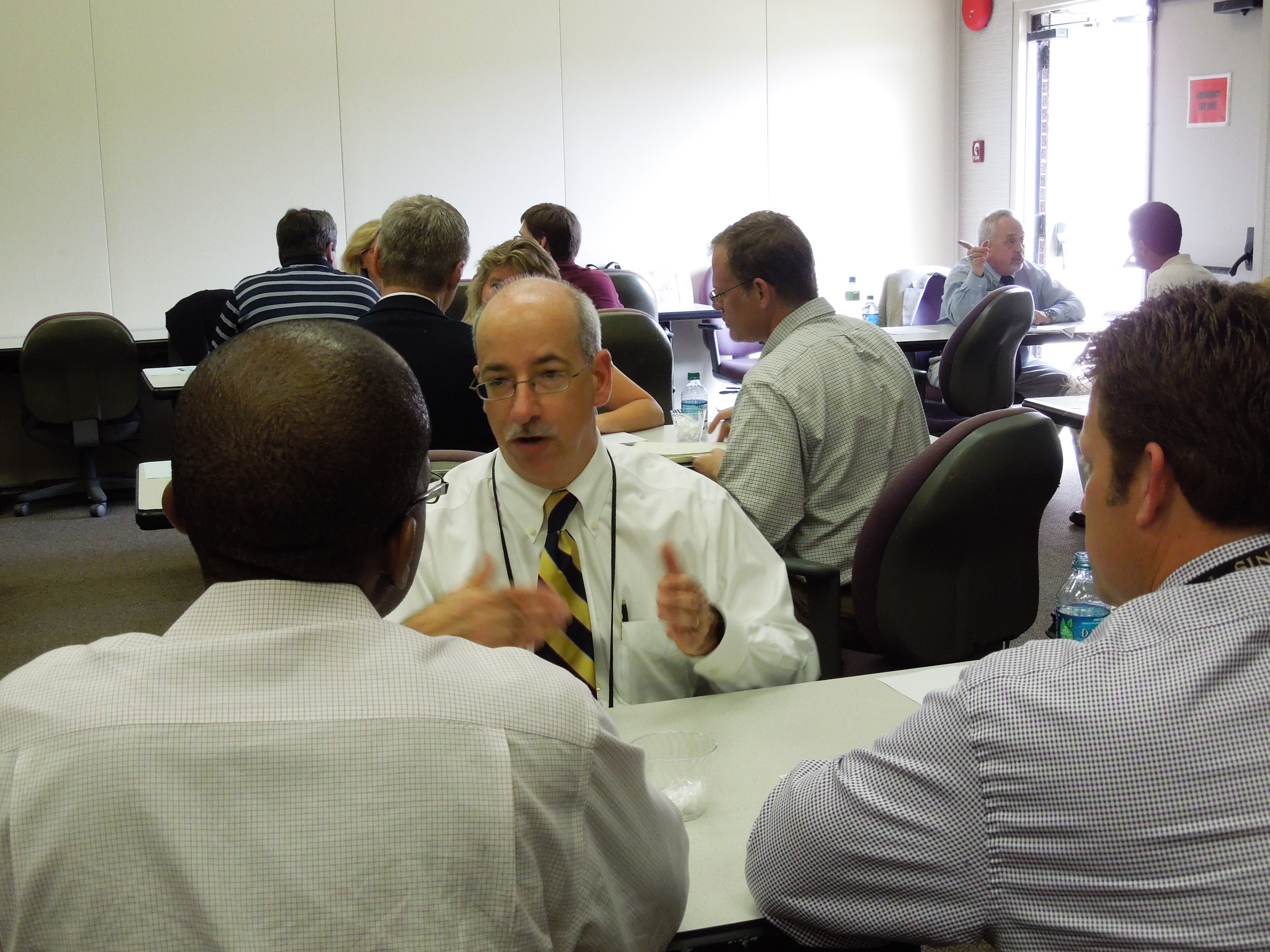
Todd Balazs, deputy assistant commander for Logistics and Industrial Operations (AIR 6.0A), offers advice to two Naval Air Systems Command employees during a speed mentoring event held May 22 in Building 1489. Launched nearly a year ago by the command‘s National Mentoring Team, speed mentoring was inspired by “speed dating,” where singles are introduced in a series of short meetings. The activity offered more than 20 attendees nine-minute sessions with 12 mentors who focused on helping them solve a pressing problem. (U.S. Navy photo)