
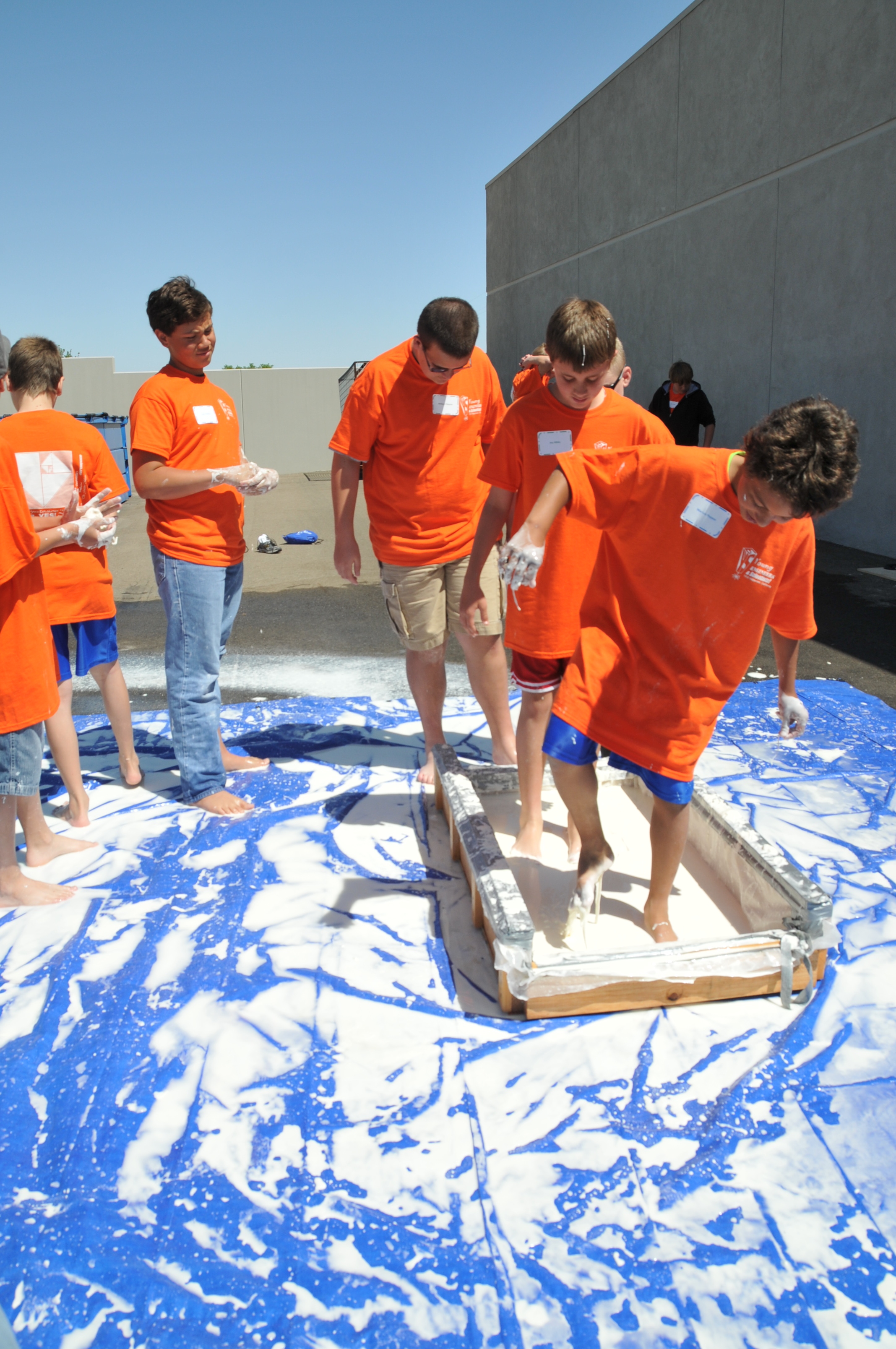
Middle school students walk over a quicksand compound during the 2013 Young Engineers and Scientists! conference at Naval Air Warfare Center Weapons Division China Lake on April 20. The compound was created using corn starch and water, which created a Non-Newtonian fluid. Students learned that they would not sink if they walked across at a high speed, but as soon as they slowed down and applied more pressure, they sank instantly. (U.S. Navy photo)
156 students attend YES!
NAVAL AIR WARFARE CENTER WEAPONS DIVISION, CHINA LAKE, Calif. - Fifty one volunteers welcomed 156 middle school boys and girls to Mclean Lab, during the 2013 Young Engineers and Scientists! (YES!) conference April 20.
Rear Adm. Paul Sohl, Naval Air Warfare Center Weapons Division commander, kicked off the event explaining the role of Weapons Division to the students. Sohl also shared the importance of safety, following the rules, challenging volunteers and asking the hard questions.
NAWCWD Executive Director Scott O’Neil explained the importance of using the tools available today to gain a solid education.
“When I was your age, we did not have advanced science programs available for young students,” said O’Neil. “The first time I [encountered engineering], I was 12 years old and I was thinking as I was mowing the lawn, how did this work? How did the motor transmit power to the wheels and the reel that cut the lawn? When I got done mowing the lawn, I decided I needed to take the thing apart. So I took the motor apart, I took the lawn mower apart. I thought I understood how it worked and started putting it back together. I got it back together and had a few parts lefts over and it didn’t work and finally I built the courage to go tell my dad. He saw what I had done and first thing he got mad at me, the second thing he did is he walked back in the house, he changed his clothes and came out and took the mower apart again. We then put it all back together. As we put it back together he told me how the motor worked and how the power was transferred from the motor, to a pulley system, to a chain, to a set of gears that ran the wheels. That was the first encounter of engineering.”
O’Neil then showed a couple of videos and described the steps he took that got him to where he is today. He showed the kids that he had to create his own tools to learn engineering as a kid and how lucky the students are to have a program such as YES! in their reach. After showing pictures of the first missiles he worked on at NAWCWD, he answered questions.
Students were then deployed to one of 15 workshops throughout Mclean Lab. The workshops were designed to excite students about science, math and engineering. The students attended three workshops throughout the day.
“It is important that we at NAWCWD and NAVAIR interact with these kids, because they are people that will work here and bring fresh and new ideas in the future,” said Steven Garcia, a NAWCWD employee and YES! volunteer. “These young students are so intelligent and intuitive and if we spark the interest at a young age, they will do nothing but grow over the years.”
An all-volunteer staff conducted the workshops. Volunteers gave time and energy to create an exciting as well as a learning experience for the kids. Each workshop consisted of 10-15 students and was designed to be hands-on.
“The guys and girls are learning what it means to create a projectile, see how far it goes and what happens if they change one small measurement,” said Mark Everitt, YES! conference master of ceremonies. It is designed to get them out of the classroom into a hands-on environment, learning about math, science and engineering. Our goal is to transition students from a ‘wannabe to a gonnabe,’ and bring them up in a way that allows them to make good choices when selecting schools and fields of study.”
Zach Burns, a Monroe Middle School student, had a birthday on Saturday and instead of having a party, he chose to attend YES! for the third year in a row. Burns said his favorite workshop was ice cream from thin air. Not only did he learn the properties of liquid nitrogen but he got a unique birthday treat.
“It was pretty cool and very cold,” Burns said.
This is the fourth year of the YES! conference and it won’t be the last, said volunteer coordinator, Erica Beeler, NAWCWD employee.
It was sixth-grader Jay Hibbs’ first time attending the conference.
“I learned that if you apply less pressure to quicksand, you will float, but the more you apply the faster you sink,” Hibbs said after running across a corn starch and water solution designed to mimic quicksand. “This is a good program because some kids don’t get the hands on learning experience at the classroom.”
YES! is one of many programs offered at NAWCWD to expand the knowledge of young students in the Indian Wells Valley area.
“We want them to come back, we want them to work here one day,” said Everitt. “We want to create more scientists and engineers. The nation needs them, NAWCWD needs them and NAVAIR needs them. The more engineers the better.”