
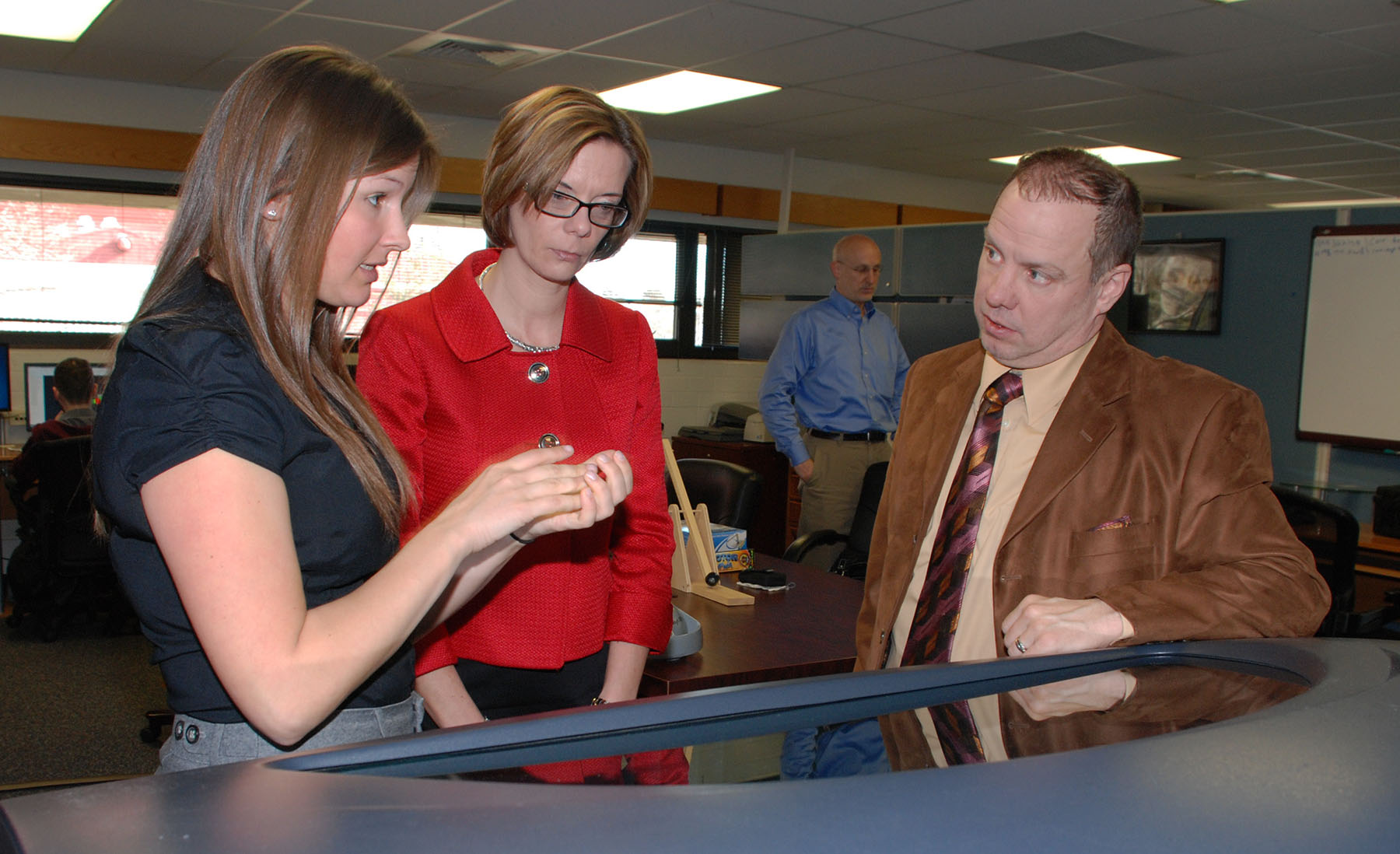
Christine Farrell (L), NAVAIR Lakehurst mechanical engineer, describes to Jill Dobrowansky, School Superintendent for the Lakehurst Board of Education and John Schmelzle, NCMA Lakehurst Chapter President the concept of 3D printing and how it is used to support the Navy mission of aircraft launch and recovery and support equipment at JB MDL. (U.S. Navy photo)
Naval Civilian Managers Association interfaces with local N.J. school district
Joint Base McGuire-Dix-Lakehurst, N.J. – Superintendent of Schools for the Lakehurst Board of Education Jill Dobrowansky recently visited the Naval Air Systems Command, Naval Civilian Manager’s Association at Joint Base McGuire-Dix-Lakehurst to discuss the development of a Science, Technology, Engineering and Mathematics Laboratory at the Lakehurst Elementary School.
Dobrowansky met with NCMA officers at the Joint Base to further champion STEM initiatives and to learn more about the capabilities of 3D printers. NAVAIR currently utilizes 3D printers in support of its rapid prototyping capabilities. Christine Farrell, a mechanical engineer for NAVAIR, discussed this technology with Dobrowansky and described how it could be used in a STEM laboratory at the elementary school.
3D printing, or additive manufacturing, is a process of making a three-dimensional solid object of virtually any shape from a digital model. 3D printing is achieved using an additive process, where successive layers of material are laid down in different shapes. 3D printing is considered distinct from traditional machining techniques, which mostly rely on the removal of material by methods such as cutting or drilling (subrarctive processes).
A materials printer performs 3D printing processes using digital technology. The technology is currently being used in many fields to include: jewelry, footwear, industrial design, architecture, engineering, construction, automotive, aerospace, dental and medical industries and education.
According to a 2011 article in The Economist, “three-dimensional printing makes it as cheap to create single items as it is to produce thousands and thus undermines economies of scale. It may have as profound an impact on the world as the coming of the factory did....Just as nobody could have predicted the impact of the steam engine in 1750, or the printing press in 1450, or the transistor in 1950, it is impossible to foresee the long-term impact of 3D printing. But the technology is coming, and it is likely to disrupt every field it touches.”
As a forerunner in this cutting edge technology, NAVAIR engineers at Lakehurst are utilizing 3D printing to economically and efficiently design and construct products that support the Fleet and the critical mission of Aircraft Platform Interface – allowing the successful and safe operation of Navy aircraft from carriers, ships and expeditionary airfields worldwide.
Also during Dobrowansky’s March 5visit to the Joint Base, NCMA Executive Board member Farhad Choudhury, presented a $500 check to the Lakehurst Elementary School to be used toward STEM initiatives. This is the third consecutive year that the grant has been given to the school by the NCMA as a way of encouraging teachers to develop and design new ideas in STEM education.
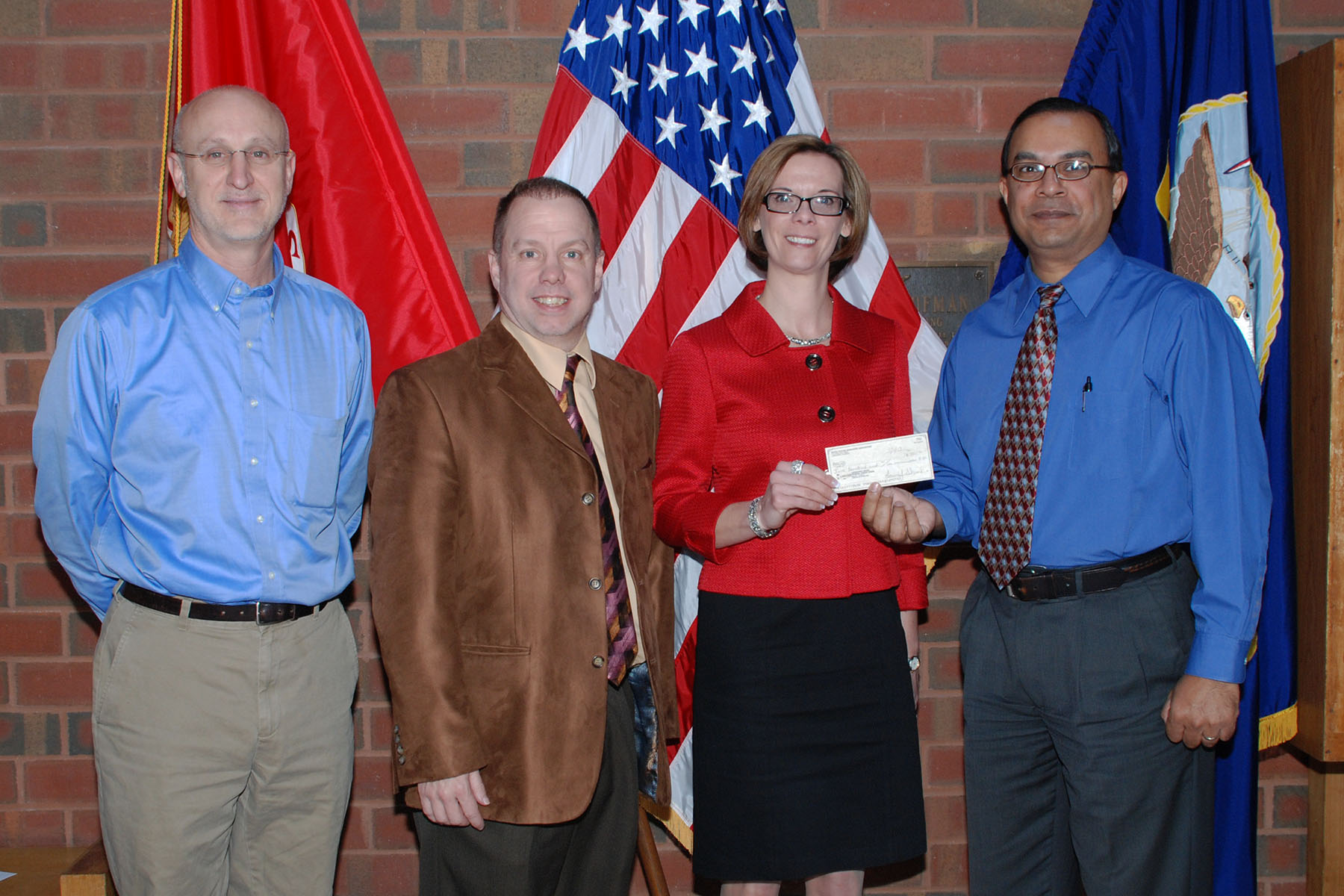
(L-R) William Borkowski, NAVAIR Lakehurst Educational Outreach Coordinator; John Schmelzle, NCMA Lakehurst Chapter President; and Farhad Choudhury, NCMA Executive Board member, present a check to Jill Dobrowansky, Superintendent of the Lakehurst Board of Education, to facilitate STEM initiatives at the Lakehurst, N.J., elementary school during a visit March 5 to JB MDL. (U.S. Navy photo)