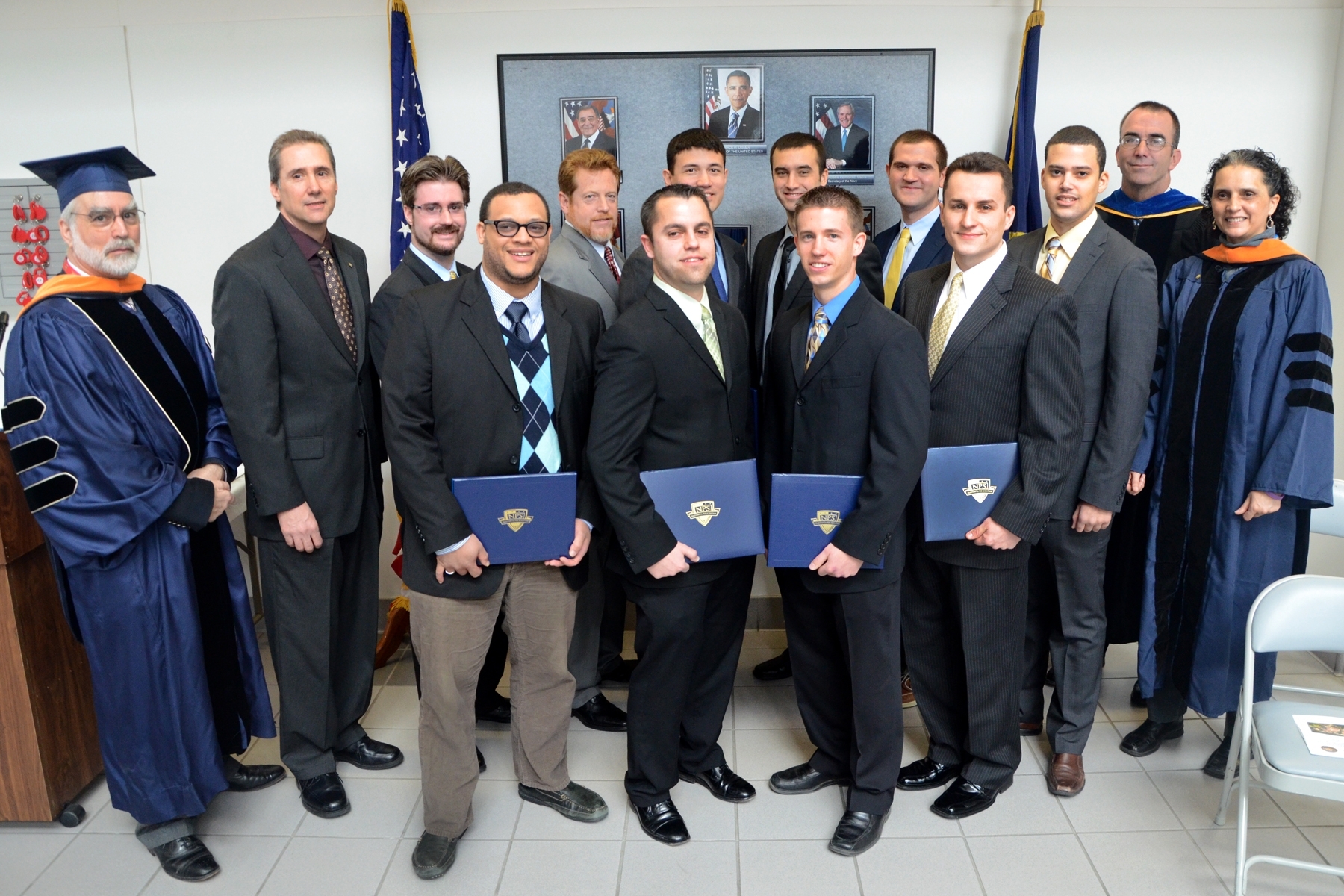
Naval Air Systems Command civilians assemble with their professors after receiving their master’s degrees in systems engineering during a graduation ceremony at Naval Air Station Patuxent River, Md. on March 28. Standing from left in the back row are Professors Dick Millar and Ron Carlson, Quinn Daniels, Don Bridges, Gabe Affandy, Todd Janer, Jordan Schmalz, Juan Rodriguez and Professors Gene Paulo and Rama Gehris. In the front row are Kevin Broadnax, Jeffrey Johnson, Drew Janicek and Jonathan McGovern. (US Navy Photo)
NAVAIR professionals earn master’s degrees in systems engineering
NAVAL AIR SYSTEMS COMMAND, PATUXENT RIVER, Md. — Twelve NAVAIR civilians received their master’s degrees in systems engineering during a graduation ceremony here March 28.
The employees were part of the seventh group to earn systems engineering degrees through a rigorous Naval Postgraduate School two-year program, all while working full time.
“This is a very important program within Naval Air Systems Command, especially within the engineering community,” said Jesse McCurdy, retired deputy assistant commander for research and engineering, during his keynote speech. “It is elemental and of significant value to the professional development of our future NAVAIR program chief engineers.”
In addition to diplomas, three graduates received special recognition for their outstanding academic achievements. One was Kevin Broadnax, an operations and support cost team lead for the Naval Air Warfare Center Aircraft Division.
“What drove me to pursue this degree was to gain a new skill set, to be a sponge and soak up everything one would need in this profession to excel,” Broadnax said. “The program management experience, the system manager experience, are things we do and things that I apply every day.”
Quinn Daniels, a reliability and maintainability engineer for the P-8A Poseidon Program, also received an outstanding academic achievement award.
“I’ve been applying a lot of the mathematic and integration lessons we learned to a lot of different projects,” he said. “Some of them have been cross-competency. It’s been phenomenal for my job, and a lot of that was very applicable to what I do.”
The 29 graduates completed a feasibility and affordability study on Hawaii algal biofuel for their required capstone project.
“The capstone project was the most challenging aspect, but also the most rewarding,” Broadnax said. “The lesson I learned wasn’t technical feasibility; it was communication. It’s how do you lead a group, how do you bring that group to achieve one common goal?”
In addition to the capstone project, the degree program requires students to complete 16 classes and maintain a minimum 3.0 grade point average. NAVAIR and the Naval Postgraduate School created the program in 2008.
“You have to go in knowing that you’re going to have to put forth a lot of effort on all of your group projects and really take the effort to motivate your group to get started,” Daniels said. “This team did that. We got a good start, and we had good people who brought us through to the end.”