
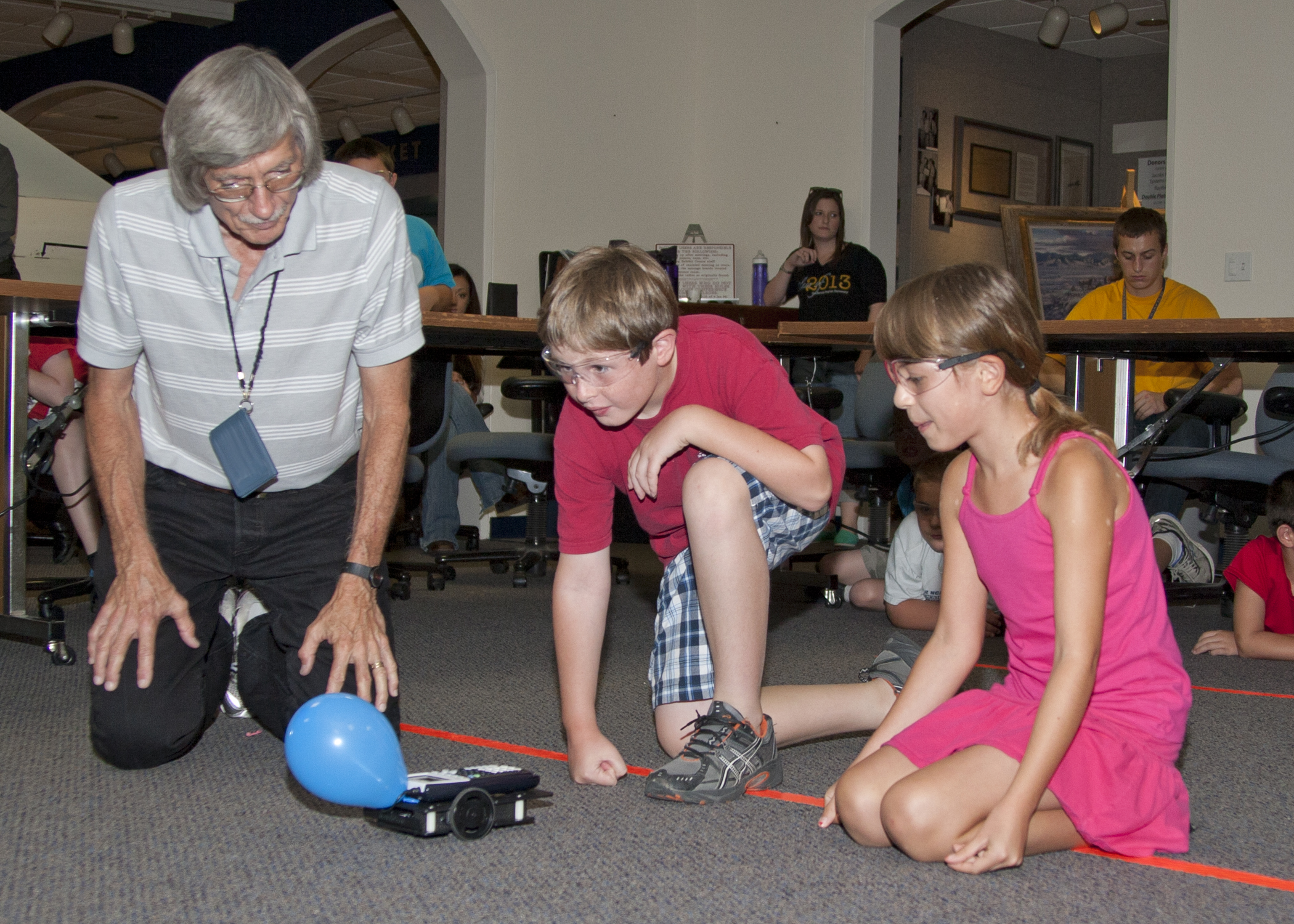
Dr. Bob Smith, a senior systems engineer at Naval Air Warfare Center Weapons Division China Lake, assists fifth-grade students in sending a calculator robot “downrange” to deliver a sample weapon, the balloon, to its target at the 2013 Summer Science Camp at China Lake on July 25. (U.S. Navy photo)
China Lake holds Summer Science Camp
Fifty local students attended the 2013 Summer Science Camp at Naval Air Warfare Center Weapons Division China Lake on July 9-11 and 22-25.
The camp was held at the U.S. Naval Museum of Armament and Technology. The first session was tailored to students going into sixth grade; the second session for students going into fifth grade.
“The goal is to teach them the basic principles of science, technology, engineering and math and expose them to what it takes to follow that career path,” said Tanner Hannon, a Pathways intern at NAWCWD.
Marine Maj. Jason Duke kicked off the week teaching students what the science, technology, engineering and math (STEM) career fields are and encouraged further interest in those fields. Duke is a project officer at Air Test and Evaluation Squadron 31.
“Kids at this young age are really impressionable and it’s important to reach them early to establish a solid foundation with an emphasis on education and career oriented goals,” Duke said.
Students had the opportunity to experiment with calculator robots, the science of flight and flight simulators, water- and air-propelled rockets and rocket payload recovery systems. Students also visited the airfield, saw Marines and Sailors in action and visited the NAWCWD Range Control Center to see real-life operations.
“I exposed them to the idea that they can start looking into career options and choose the school path that will help them reach that goal,” said Duke. “A lot of kids today think that scientists and engineers are nerds but that’s not the case. It is okay to like science, it’s cool to learn math and those so called nerds make pretty good money.”
There were multiple presenters from NAWCWD that demonstrated possible career fields within STEM in both the civilian and military sectors, and what education paths to take to reach that goal.
For 10-year-old Christian Witwer, this was his first time attending science camp.
“I signed up to learn cool stuff about science and wanted to build my own experiments,” he said. “Science is important to me because without it people wouldn’t learn about the universe and how things work.”
More than 25 volunteers contributed their time and effort to make this event happen. Volunteers assisted in the building and operating of projects, transporting the students from place-to-place, supporting the presentations and encouraging students to have fun with STEM.
“I made a rocket payload recovery system or a parachute,” Witwer said. “We used a cut-up trash bag, a tennis ball, string and some tape. I am definitely going to try this at home.”
After successfully building the recovery systems, volunteers assisted with launching them into the air using water- and air-propelled 2-liter bottles.
“When I was younger I was able to participate in programs like this and it put me on the path I am on now toward becoming an engineer,” Hannon said. “It’s critical to peak interests now, that way in high school they have a better idea of what courses to take to reach their goals.”
While at the airfield, students put on flight equipment, climbed inside an H-1 Cobra helicopter, learned how emergency responders respond via helicopter, and walked around an active-duty military squadron’s hangar.
The camps gave students an opportunity to see working applications of STEM and how those are important in daily operations for the military and civilian workforce at NAWCWD.
“I hope these kids stay in school and come to work with us one day,” said Hannon.
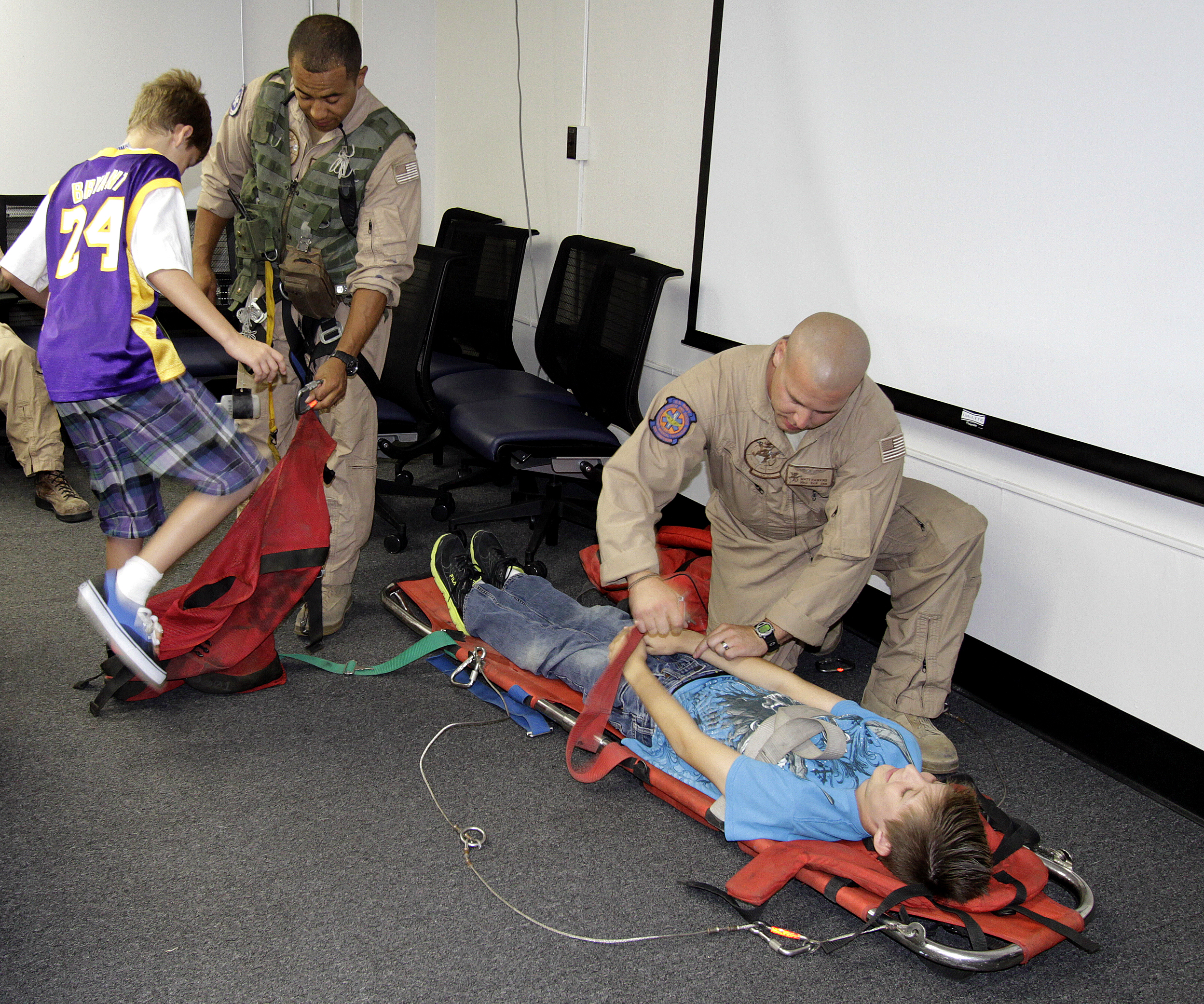
Naval Aircrewman 1st Class Eric Jenkins, left, and Hospital Corpsman 2nd Class Matthew Hawkins demonstrate two extrication/rescue devices used by the Air Test and Evaluation Squadron 31 Search and Rescue team during the 2013 Summer Science Camp at Naval Air Warfare Center Weapons Division China Lake on July 11. (U.S. Navy photo)
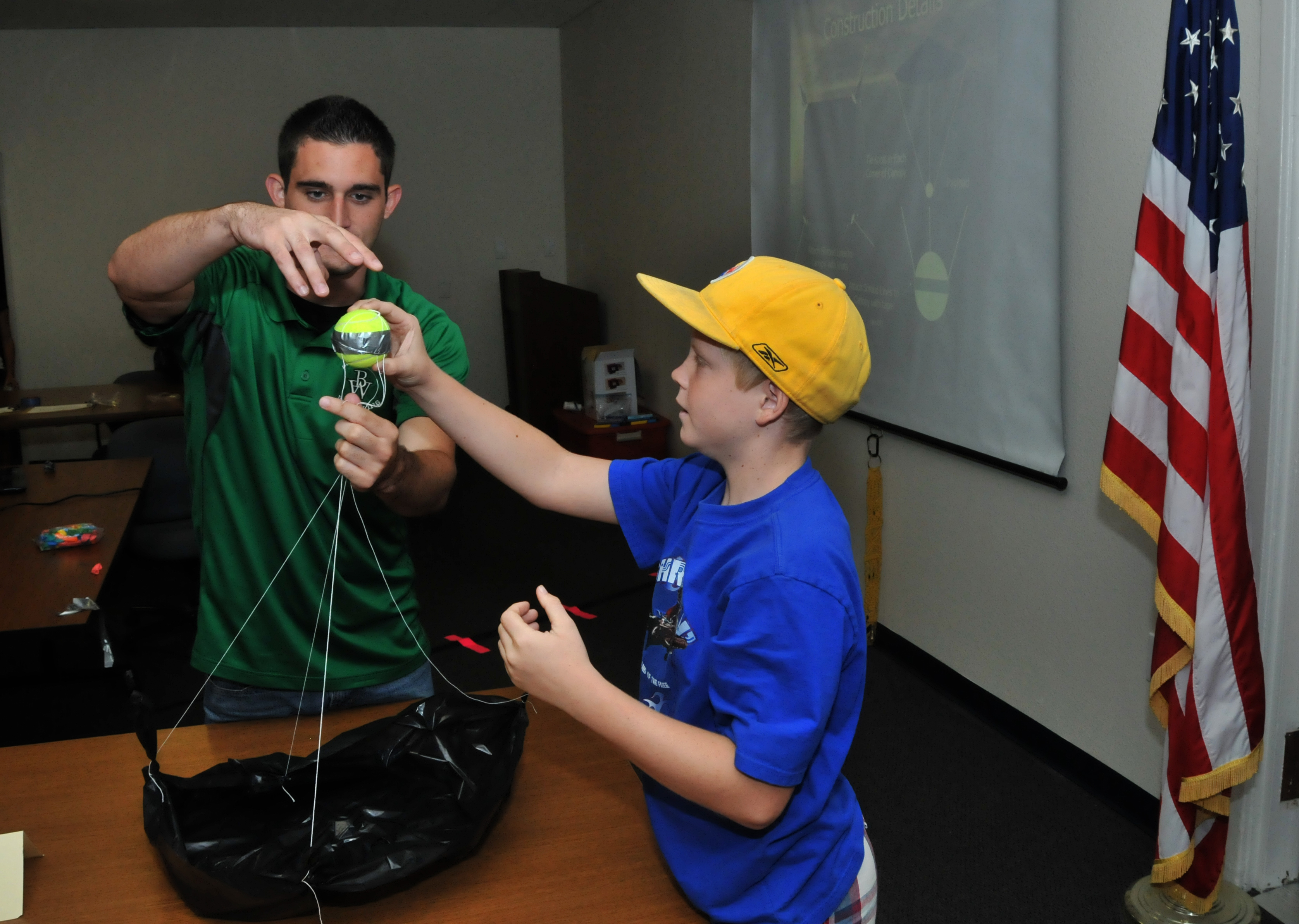
Tanner Hannon, left, a Pathways intern at Naval Air Warfare Center Weapons Division, and 10-year-old Christian Witwer build a model of a rocket payload recovery system during the 2013 Summer Science Camp at China Lake on July 10. (U.S. Navy photo)