Archived Body
NAVAL AIR SYSTEMS COMMAND, PATUXENT RIVER, Md. – The deafening sound of aircraft on the flight deck presents challenges to ground crews trying to communicate with air traffic control. But thanks to two small businesses the problem is well on its way to being rectified.
Through the Naval Air Systems Command Small Business Innovation Research, or SBIR, program, small businesses partnered with the Navy to develop technology that will potentially allow ground crew and air traffic control personnel to communicate more clearly.
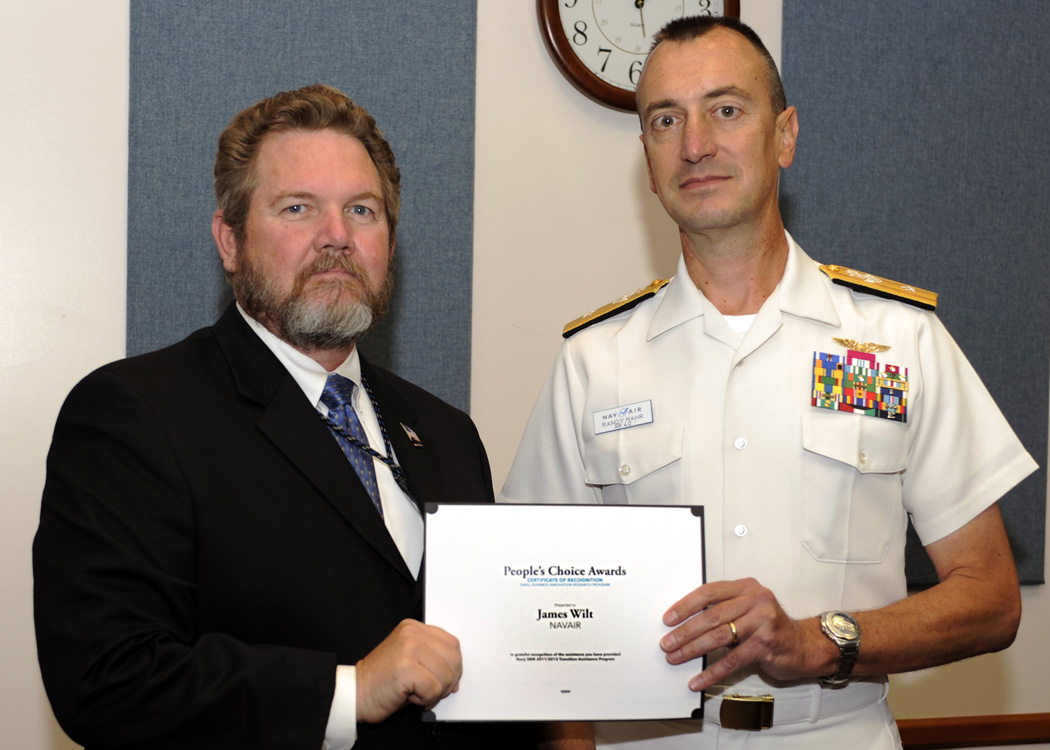
James Wilt, a senior scientist from NAVAIR’s Warfighter Survivability division, initiated the SBIR topics resulting in projects with two small businesses specializing in hearing technology.
“In my experience, small businesses have the know-how and can do things quickly,” Wilt said. “Sometimes they just need some help working through our TAP and SBIR processes. I’m happy to help them with that because it becomes a win-win.”
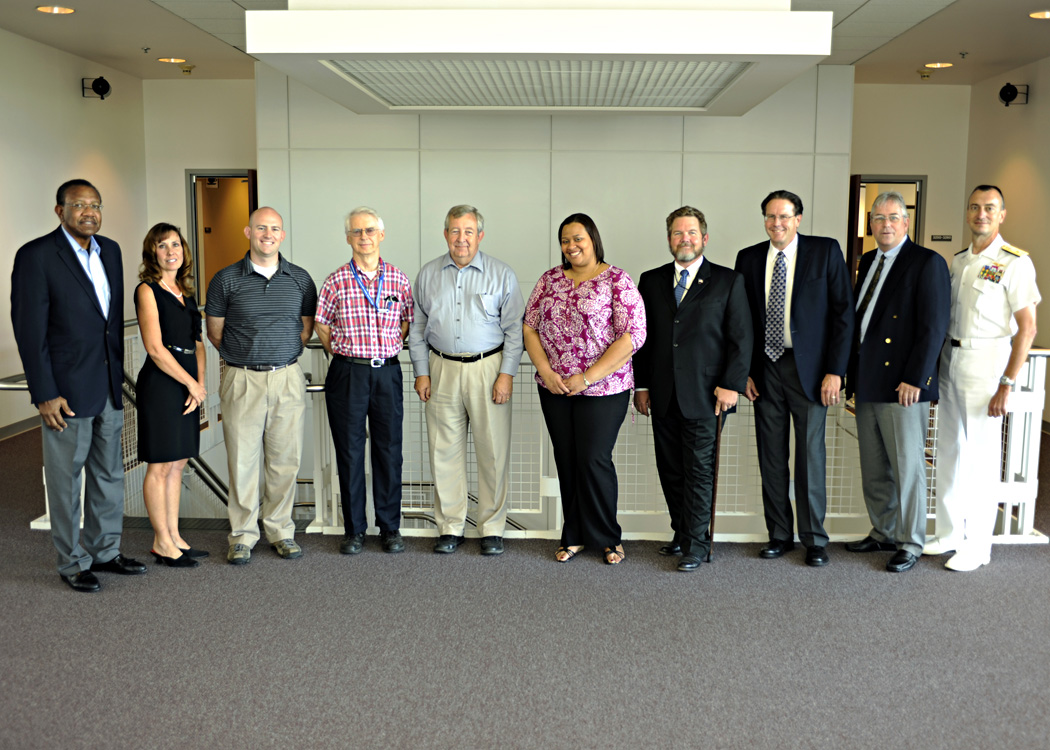
Wilt was one of 15 NAVAIR employees recognized by Naval Air Warfare Center Aircraft Division commander Rear Adm. Randy Mahr at the organization’s headquarters Aug. 16 with a People’s Choice Award for training and supporting small businesses working with the Navy and DOD. Selected by participating small businesses, the People’s Choice award underscored the importance of active Navy engagement in the process and recognized those who went above and beyond to help the small-business community.
“With the People's Choice Awards, you can't ask to be nominated,” Mahr told the attendees. “You can't put your own name forward for recognition. … I can't do anything to help you get this award. You earn it through your own efforts…you earn it through your own actions."
The awardees were also earlier honored June 5 in front of nearly 1,400 people at the 2012 Navy Opportunity Forum in Crystal City, Va., where the Navy, large prime contractors and small businesses gathered to form connections possibly leading to future technology transition.
“SBIR technologies help fill the capability gaps and meet the acquisition needs of the Navy,” said Donna Moore, the program manager for NAVAIR’s SBIR efforts. “It is a very robust process that harnesses talent and power throughout NAVAIR.”
MAKING AIRCRAFT TESTING MORE EFFICIENT
The awardees from NAVAIR filled many roles, from submitting original research ideas to being the liaison between the Navy and small business.
Award winner Dean Carico said he has often reached out to the small business sector to fill various fleet needs. An aerospace engineer for manned and unmanned air vehicle evaluation group, Carico worked with two small businesses on a project to help support test efficiency. He said the workload in a test program can vary greatly, so it is hard to find and optimize a balance between testing and analyzing results.
“Over the course of several years, the small business program has had a big positive effect on how we support testing,” he said. “We have a better realization of how the results relate to each other and the environment that we are testing within.”
Carico recognized the impact small business innovation can have on technology development in the Navy and proposed his first topic several years ago.
“Small companies are working on everything imaginable,” he said. “We should always look for new technology to tie together [what we have].”
Dr. John Asvestas, an electronics engineer with the Radar and Antenna Systems division, supported Carico’s point with a history lesson. He described how the Navy often expended funds on a trial-and-error testing method before using computers.
“Computer modeling and simulation has significantly reduced the number of design cycles, thus reducing prototyping costs and loss of design momentum,” he said. “In my own area of electromagnetics, SBIR funding has been instrumental to bringing a good number of simulation tools on line. Small business won’t burn through one million dollars in one day. A million goes a long way in a smaller company … you don’t have to go through hundreds of people [to get the job done.] It’s much more efficient.”
HOW SBIR WORKS
Each year, the SBIR office reaches out to NAVAIR for research topic ideas. NAVAIR employees submit ideas and a review board selects the most applicable and needed innovative topics for solicitation to research-oriented small businesses with fewer than 500 employees. Each small business competitor then submits a proposal.
SBIR has three phases, with Phase I and II being funded with SBIR dollars. Phase I provides an opportunity for the business to prove their feasibility, while Phase II demonstrates the feasibility through a prototype/process. Small businesses awarded a Phase II receive the option to participate in the Transition Assistance Program known as TAP.
The TAP is an intensive 11-month program that starts with a kick-off meeting and ends with the Navy Opportunity Forum. If the company participates, the TAP provides a business consultant and market research to help develop a strategy to transition technology into products ready for delivery to the fleet.
Phase II demonstrates the feasibility effort through a prototype/process and has a duration of 18-24 months.
The Phase III is non-SBIR dollars. The objective is to transition a company’s SBIR effort into products, tools or services that benefit the Navy acquisition program.
HOW TO MAKE SBIR WORK FOR YOU
By its nature, SBIR is a cost-efficient manner of conducting research and development.
“The goal and expectation of the program is to stimulate a technological innovation, included in that is the use of innovative technology to reduce lifecycle acquisition costs,” SBIR Program Manager Moore said.
Some of the efficiency, however, can be attributed to the role of the NAVAIR employee.
Another award winner, Mark Beranek, section head of the Information Processing Systems and Networking Technologies Branch, Core Avionics Division, identified four main objectives as he facilitates a connection between the Navy and the small business.
The first is to make the requirements clear at the start of the Phase II project, he said. The clearer the project and purpose, the more efficient the company will perform, he said.
Next, Beranek emphasizes the importance of introductions to the community, whether military or contractor.
“I work very hard to get [the business] linked in with the fleet or prime contractors,” he said. Without those key introductions, some of the businesses do not perform as well as they could, Beranek said.
The third objective ties closely to the second, but on a more personal level. It is important for the program office sponsors to maintain communication with the small business, continuously acting as a guide and mentor.
The most enjoyable part of his role is the fourth, Beranek said. “I don’t have to work at this,” he said. “It just happens. You’ve got to have passion for what you are doing and what the small business researchers are doing.”