
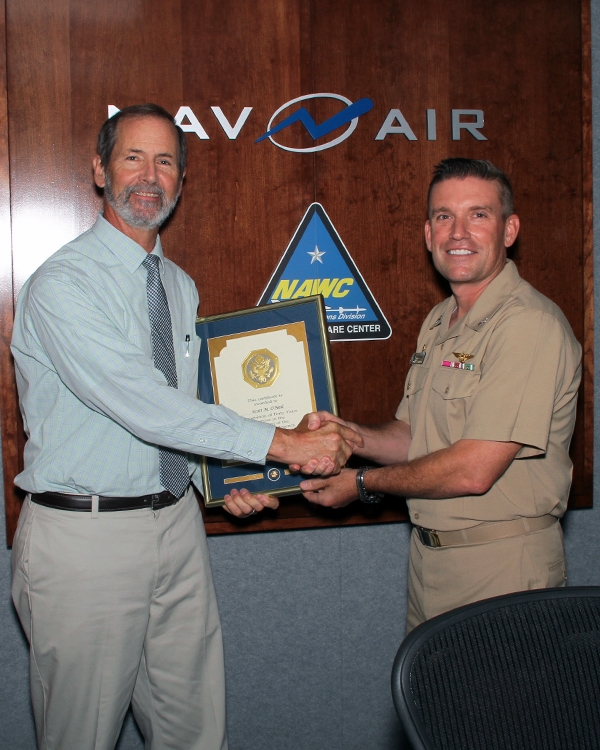
Capt. Harry Dunbrack, NAWCWD commander, presents Scott O’Neil, NAWCWD executive director, with a 40-year length of service award during a ceremony on July 12 at China Lake. (U.S. Navy photo by Dan O’Connor, NAWCWD VCO)
NAWCWD’s senior civilian logs 40 years at China Lake
July 3 marked 40 years of federal service for Scott O’Neil, Naval Air Warfare Center Weapons Division’s executive director and senior civilian.
When O’Neil arrived at China Lake in 1972 as a junior professional, his goal was to become a branch head. Although he never actually worked as a branch head, most would say he more than surpassed his goal.
Originally from Bremerton, Wash., O’Neil had two job offers when he graduated from Seattle University with a bachelor’s in mechanical engineering. He had to decide between a company in Colorado and the Navy in China Lake.
“I could have gone to that company and packaged electronics in a plastic box, or come here to build rockets,” O’Neil said. “It was an easy choice.
“When I got here, the reputation of this organization was phenomenal,” he said. “I really liked being part of a well-recognized and respected organization. Today, we’re still one of the Navy’s premiere labs.”
Like most people, his arrival in the high desert was unforgettable. O’Neil remembers leaving Seattle at 6 a.m. – 68 degrees and raining – and arriving in Inyokern at noon - 114 degrees. Until then, he never thought he’d live anywhere that didn’t have trees but he was immediately hooked on the work at China Lake, and Ridgecrest quickly became his home.
Looking back, O’Neil said one of the keys to his success in the challenging world of government defense work has been patience. He recalled the early seventies as a young engineer when he was doing hands-on work with thrust vector control systems, movable nozzles and looking at other ways to steer a weapon.
“It was all new and different technology, and we had a hard time trying to get it accepted,” he remembered. “Today, you look at the weapons and mostly all of them have thrust vectoring. We developed and enabled a lot of that and it’s had a huge impact on how our weapons are configured today.”
O’Neil also contributed firsthand to building new fuzes and titanium warheads for the Tomahawk cruise missile.
“Every time I see a Tomahawk strike, I realize that’s a direct contribution to our warfighting capability that came right out of NAWCWD,” he said. “Being part of that was fun, exciting work.”
O’Neil said he is still having fun now but in a different way. He continues to engineer but it’s more social and organizational engineering these days.
“It’s exciting to me to help create a common vision for the future,” he said. “It’s all about relationships, relationships, relationships – building them and sustaining them so we can all work together to produce capabilities, not just things.”
O’Neil recognized that there is not one prescribed career path for everyone; there is a need at NAWCWD for technical experts in particular disciplines, and there’s a need for managers and leaders.
“You have to spend time to think about and understand what really motivates you and what you like doing, and then go do it,” he said.
After about 10 years of technical work, O’Neil got his first taste of management. In 1982, he was selected as the technical manager for the Navy’s development of a propulsion and control system for the vertically launched antisubmarine missile. Under his guidance, the system design was successful and transitioned to industrial production.
From there, he progressed to other management positions including deputy program manager for Cruise Missiles Propulsion, and the Naval Weapons Center technical manager for Standoff Weapons and Cruise Missiles.
“We all come to a fork in the road and have to decide either to stay purely technical or get into management,” he said. “I came to the realization that I’m an achiever, not a power guy. Power does not motivate me.”
O’Neil said he gets satisfaction out of building, whether it’s a widget, a program plan, or a team. Never a branch or division head, he worked his way up the ranks through the project side before transitioning over to a small department. He held a variety of positions including head of the Weapons Systems Cost Analysis Division, head of NAWCWD's Information Management (IM) Department, and accepted a one-year assignment as NAVAIR’s IM competency leader. O'Neil was appointed to the Senior Executive Service in 1998 and served as head of NAVAIR's Weapons/Targets Department.
In 2002, NAVAIR chose O'Neil to lead its Atlantic Ranges and Facilities Department at Patuxent River, Md. About two years later, he assumed the position as director of the Integrated Battlespace Simulation and Test Department at Patuxent River.
“When I got to be the NAWCWD executive director, I felt like I was ready to take the reins of the organization and provide leadership,” O’Neil said. “I had a lot of different technical and management experiences, and had prepared myself pretty well.”
O'Neil’s list of academic and professional achievements is not a short one. He furthered his education and earned a master’s in mechanical engineering from the University of Southern California in 1977. The Massachusetts Institute of Technology (MIT) selected him as an Alfred P. Sloan Fellow, and he received his master’s in management from MIT in 1992. O'Neil also studied at the Federal Executive Institute in Charlottesville, Va. He is a member of Tau Beta Pi engineering honors society and is a registered Professional Mechanical Engineer in California. He has been honored for engineering and management excellence with a Naval Meritorious Civilian Service Award, a Senior Executive Service Presidential Rank Award (Meritorious), and most recently a Navy Superior Civilian Service Award.
Rear Adm. Mat Winter, former NAWCWD commander, presented O’Neil with the last award on June 14. “Scott’s been my right-hand man, a peer, an incredible advisor and counselor, and has given me great guidance,” Winter said. “I could not have asked for a better executive director. What he has done is in the hands of our warfighters today and they are using it. He continues to mentor, to lead, and provide the technical guidance for the systems that will be in our warfighters hands tomorrow.”
O’Neil acknowledged that it’s always nice to be recognized but it’s not what motivates him. “Awards like this are a sign of adding value but I get more satisfaction out of seeing us build capabilities for the Navy,” he said. “It takes us all to do that.”
Teamwork and personal interaction are sources of energy and motivation for O’Neil.
A self-described morning person, O’Neil is usually at work by 5 a.m. His routine 12-plus-hour days have him running from one meeting to another. O’Neil is no stranger to running; you can just about set your clock by his five-mile lunchtime run. For the last 30 years he has relied on that group run to boost his energy for the afternoon. He’s found that it’s also a good way to connect with different parts of the workforce.
“I run into people at the gym that I wouldn’t otherwise get to see,” he said. “You’d be surprised how much work can get done there.”
Running has been one of O’Neil’s passions since he arrived here. When asked what he is most passionate about, without hesitation, O’Neil answered, “Innovation. It’s about being willing to try something different. Being open and bold enough to think about the problems we are facing today in a way that’s different.”
Innovation is one of the characteristics that has defined the China Lake reputation since its beginning.
“Our culture, values and attitudes have remained constant,” O’Neil said. “What’s changing the most is the breadth of our work. We’ll always do weapons work, but what will be different is how we use those weapons and how we can make them more effective.”
So when he’s not in a VTC, giving command overviews to visitors, or planning for the future, how does a busy NAWCWD executive director spend his free time? Like most people, he said, he spends time with family and works around the house. He especially enjoys his backyard metal and woodworking shop. Whether he’s making wooden bowls or jewelry boxes for his daughters, or welding, O’Neil uses that time to tap into his creative side and find that needed balance.
To the workforce, O’Neil says maintaining a healthy balance is essential.
“You can have your cake and eat it too,” he said. “You can balance your work and your home life but you have to be in touch with what’s important to you and have good feedback systems in place. It’s good to have goals and targets but you can’t be in a hurry. Stay the course, be patient and be ready when opportunity arises. Stay in a job long enough to see the fruits of your labor but not too long that you become stagnant.”
O’Neil said he doesn’t have immediate plans for retirement but doesn’t expect to get a 50-year pin either.
“As long as I can still contribute and add value to the organization, I will be here,” he said.
One thing is for sure - O’Neil will remain in the area after retirement and said he will look for ways to give back to the community where he and his wife, Ruth, have raised their five children.
“This is home,” said O’Neil, who may be interested in teaching in the local school system when he decides to close his federal career.
But for now, O’Neil sees his job as forging new ground and setting the course for the future of the Weapons Division. That future as O’Neil sees it, involves more work with biofuels and unmanned systems, getting value out of the command’s intellectual property, and operating with more of a business perspective.
“Our future is innovating and creating the effects that the warfighters need when they need it,” he said. “That means we have to redefine what a weapon is and we are in the process of doing that. It’s not just the weapon it’s the whole kill chain.
“Focusing on capabilities and helping the Navy establish awareness around the entire kill chain is critical and I think NAWCWD is leading in that. We found out a long time ago that the weapon is a major part but it’s not the complete system. If there are weaknesses in the system, then the weapon can’t effectively do its job. We have to focus on the entire kill-chain not just the weapon or delivering the weapon to the target.”