
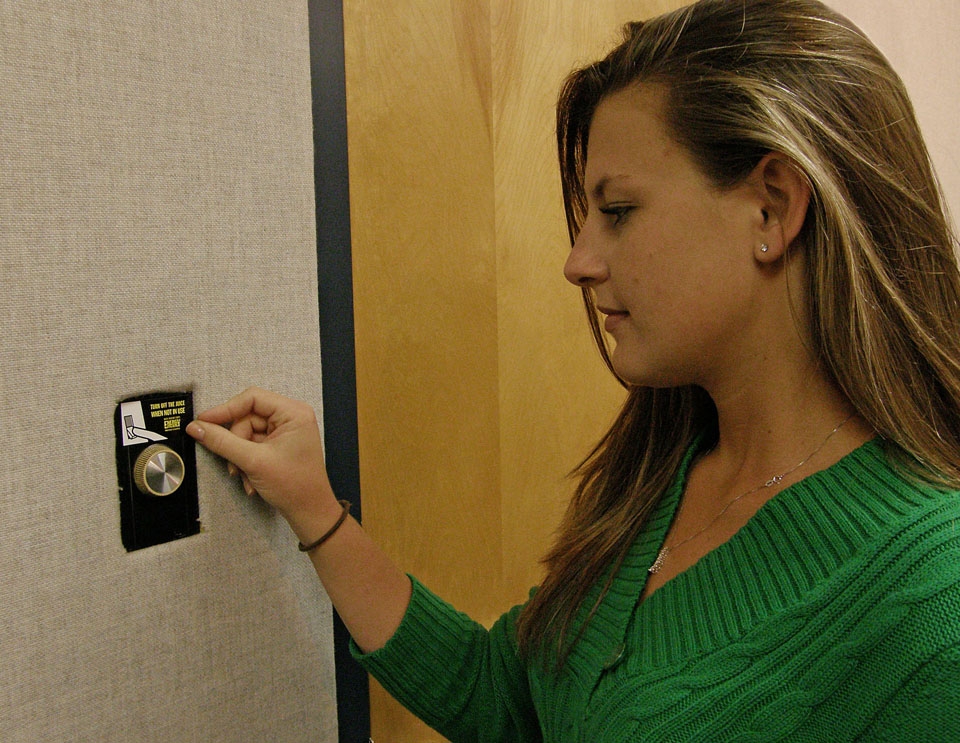
Atlantic Test Ranges, or ATR, Green Team member Kelsy Johnson applies a “Turn Off the Juice When Not In Use” sticker to a light switch in ATR’s main building. ATR is promoting environmental stewardship by implementing energy-conservation initiatives under the direction of its new Green Team. (U.S. Navy photo)
The lights fantastic: Atlantic Test Ranges launches energy-saving projects
Archived Body
NAVAL AIR SYSTEMS COMMAND, PATUXENT RIVER, Md. – Doing its part to promote environmental stewardship, the Atlantic Test Ranges (ATR) is implementing energy-conservation initiatives under the direction of its new Green Team.
The Department of Defense, which is responsible for almost 80 percent of the government’s energy consumption, launched several efforts in 2009 to combat its high-energy usage, and to ensure that 40 percent of the Navy’s total energy consumption comes from alternative sources by 2020.
Part of the NAVAIR Ranges Department, the Atlantic Test Ranges are fully-instrumented and integrated test ranges that provide full-service support for testing and training. This support includes Research, Development, Test and Evaluation of aircraft and training for aircrew and integrated avionics and mission systems.
ATR’s Green Team promotes sustainable use of resources and a culture of environmental consciousness at ATR. The goal is to develop green initiatives that can be implemented in all areas of the ATR organization to improve energy efficiency. Through these initiatives, Green Team lead Melanie Anderson believes the team is creating positive change in the culture and community of ATR.
“Our mission was always to generate ideas and get some of those short-, mid- and long-term ideas out on the table,” Anderson said. “We needed to do some research to understand the costs and benefits to help ATR management make the most informed decisions.”
The first ATR Green Team project, lighting optimization, was approved in October. To save energy through lighting upgrades, timers were installed in the hallways of ATR’s main building to automatically turn off 21 fixtures after work hours. The energy and cost savings is expected to be 10,098 kilowatt hours, totaling more than $1,300 per year, officials said.
Since then, other lighting projects have been approved, including replacement of ATR exterior lighting using LED technology. As an added benefit, all of these projects are being submitted for rebates from the utility provider, which will enable ATR to receive a credit on its monthly utility bill.
To capture energy savings, the Green Team needed to understand ATR’s energy consumption, including an assessment of all meters associated with the complex. The team and completed an extensive mapping effort of ATR’s 14 utility meters and collected utility data of the complex’s monthly energy consumption. Based on this analysis, the team said it now knows, with a level of confidence, which parts of the building are serviced by specific meters.
“It can be very challenging to understand what we are actually consuming as an organization,” Anderson said. “To understand the data, we’ve spent a lot of time working with the utility provider and the NAWCAD Energy and Environmental Efficiencies Efforts coordinator to get an accurate depiction of what we consume every month.”
Knowing how much power each building uses will allow the team to track changes in power use when they implement future energy-savings programs.
The Green Team said getting the message out is an important part of its service, and since its establishment in August 2011, the members have hosted two community outreach events. The team held a “Turn Off the Juice” campaign during Navy Energy Awareness Week in October, which included a fun “Juice Social,” and distribution of stickers to offices and common areas reminding users to turn off unused lights
In April, the Green Team participated in the ATR Annual Spring Cleanup, which included giveaways, trivia and information for Earth Day.
Although the ATR Green Team originated in the NAVAIR Ranges and Sustainability Office, it now includes members from all areas of the ATR organization, including Facilities, Information Technology and a management representative.
“We wanted representation and participation across the ATR complex, so that it was not solely an environmental thing,” Green Team member Jennifer Paulk said. “We need the knowledge and expertise of the people who know the facilities and the operations of ATR to reach our energy-saving goals.”
ATR Green Team officials said they are soliciting comments and suggestions from the ATR community via [email protected], and in person.
MAKING THE ENERGY CUT
The Atlantic Test Range Green Team used the Southern Maryland Electric Cooperative, or SMECO, utility rebate program to cut its outdoor electricity bill in half.
WHAT HAPPENED: With the help of a representative, ATR’s Green Team looked at every outdoor light and identified 12 400-watt halogen lamplights to replace with 17-watt LED lights. The electric utility credited ATR $450 toward its June 2012 bill of $750.
TOTAL IMPROVEMENT IN POWER EFFICIENCY: 95 percent
COST FOR EACH REPLACEMENT LIGHT: $214.38
REBATE FOR EACH REPLACEMENT: $150
SAVINGS EXPECTED: Approximately $400 per year
Source: ATR Green Team Member Kelsy Johnson