
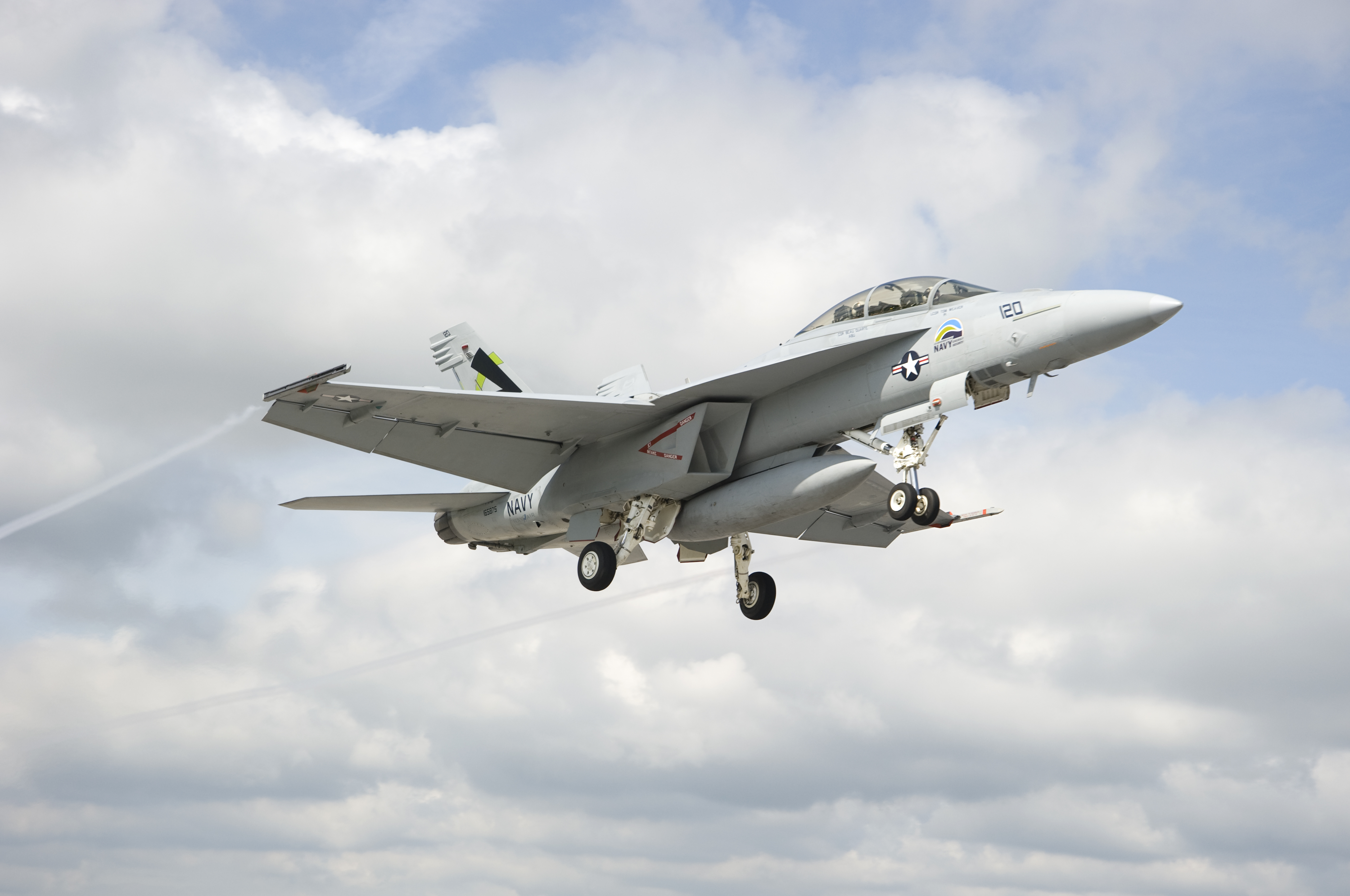
For the sixth consecutive year, the F/A-18 and EA-18G Program Office’s (PMA-265) Green Hornet team has snagged a CNO Environmental Excellence Award for its focus on energy efficiency, pollution reduction and safety. PMA-265 manages the variants and subsystems of the F/A-18A-D Hornet, F/A-18E/F Super Hornet, pictured, and EA-18G Growler aircraft for the Navy’s Tactical Aircraft Programs PEO(T). (U.S. Navy photo)
Take a number: Six reasons why Green Hornet team has earned 6 CNO environmental awards
NAVAL AIR SYSTEMS COMMAND, PATUXENT RIVER, Md. – No wonder they’re dubbed the “Green Hornets.”
For the sixth consecutive year, the F/A-18 and EA-18G Program Office (PMA-265) has earned a Chief of Naval Operations (CNO) Environmental Award for its commitment and leadership support of pollution reduction and safety readiness.
Navy officials announced PMA 265’s win in the Environmental Excellence in Weapon System Acquisition, Large Program, Individual or Team category Feb 22. In addition to achieving six CNO Environmental Awards, the organization won Secretary of the Navy Environmental Award level honors in 2003 and 2009.
PMA-265, which manages the variants and subsystems of the F/A-18A-D Hornet, F/A-18E/F Super Hornet and EA-18G Growler aircraft for the Navy’s Tactical Aircraft Programs PEO (T), balances environmental, safety and occupational health concerns with operational needs. The program’s Green Hornet team manages all environmental, safety, and occupational health (ESOH) aspects for the F/A and EA-18G with its systems engineering and decision-making processes.
As the primary tactical aircraft of the Navy, the F/A-18E/F Super Hornet is the focal point of various energy and environmental initiatives. Michael Rudy, the organization’s ESOH program manager, shared six examples of how PMA-265 has cut its carbon footprint and improved safety while earning salutes from naval leaders:
PROACTIVE: PMA-265 has been successful in its environmental programs by proactively seeking to mitigate any potential environmental problem in the initial design stage, Rudy said. For example, the final configuration of the Super Hornet contains 40 percent fewer parts and 50 percent fewer cadmium-plated fasteners, Rudy said. (Cadmium is toxic and can have a negative impact on the environment). PMA-265 also designed halon, an ozone-depleting substance, out of the engine fire-suppression system in compliance with international standards.
LEADERSHIP SUPPORT: “The F/A-18 and EA-18G’s leadership has consistently supported ESOH programs and led the Navy in finding ways to make our aircraft safer for its personnel,” Rudy said. "This included Retired Vice Adm. Joe Dyer, PMA-265’s program manager from 1994-1997, who invested in initiatives to remove chromium, a potentially harmful element from the primer on our aircraft; and Captains Mark Darrah and Frank Morley, who led jet-noise reduction initiatives.”
ENERGY SECURITY: The Super Hornet is the first Navy aircraft to demonstrate alternative fuel capability using a 50/50 blend of camelina biofuel and the Navy's primary jet fuel, jet propellant (JP)-5. The Green Hornet, an F/A-18F Super Hornet, successfully flight-tested a 50/50 blend of camelina-based fuel and conventional petroleum-based JP-5 jet fuel on Earth Day April 2010. The Green Hornet was also used as a backdrop for President Obama’s major policy announcement on energy security that year. The Green Hornet team also leads biofuel testing with other Navy aircraft. The Blue Angels flight-demonstration squadron successfully demonstrated the camelina-JP-5 biofuel blend at the August 2011 NAS Patuxent River Air Expo. The Green Hornet testing continues, with a carrier trial slated for summer 2012.
NOISE CONTROL: PEO (T) and PMA-265 have partnered with several organizations on noise-reduction technologies. PMA-265’s F414 engine-noise reduction program continues to support research and development of mechanical chevrons, which mix the jet plume faster to reduce noise. A seven-decibel reduction was demonstrated in the range identified as the most hazardous for personnel noise exposure. This will be the first installation of jet noise reduction technology on any DoD high-performance tactical aircraft, Rudy said.
RECYCLING: PMA-265 promotes increased recycling and reuse of Hornet parts when the aircraft enters demilitarization and disposal, often going beyond recycling and reuse of parts identified by the Naval Supply Systems Command “save” list.
PROMISE: PMA-265 sponsors promising technology initiatives for reducing emission levels associated with high-power engines used in the Hornet aircraft, Rudy said. Air emission and fuel consumption reductions are the goal of the Trapped Vortex Combustor project, where partially combusted air from the cavities mixes with the main airflow, reducing the carbon footprint without compromising the engine’s performance.