
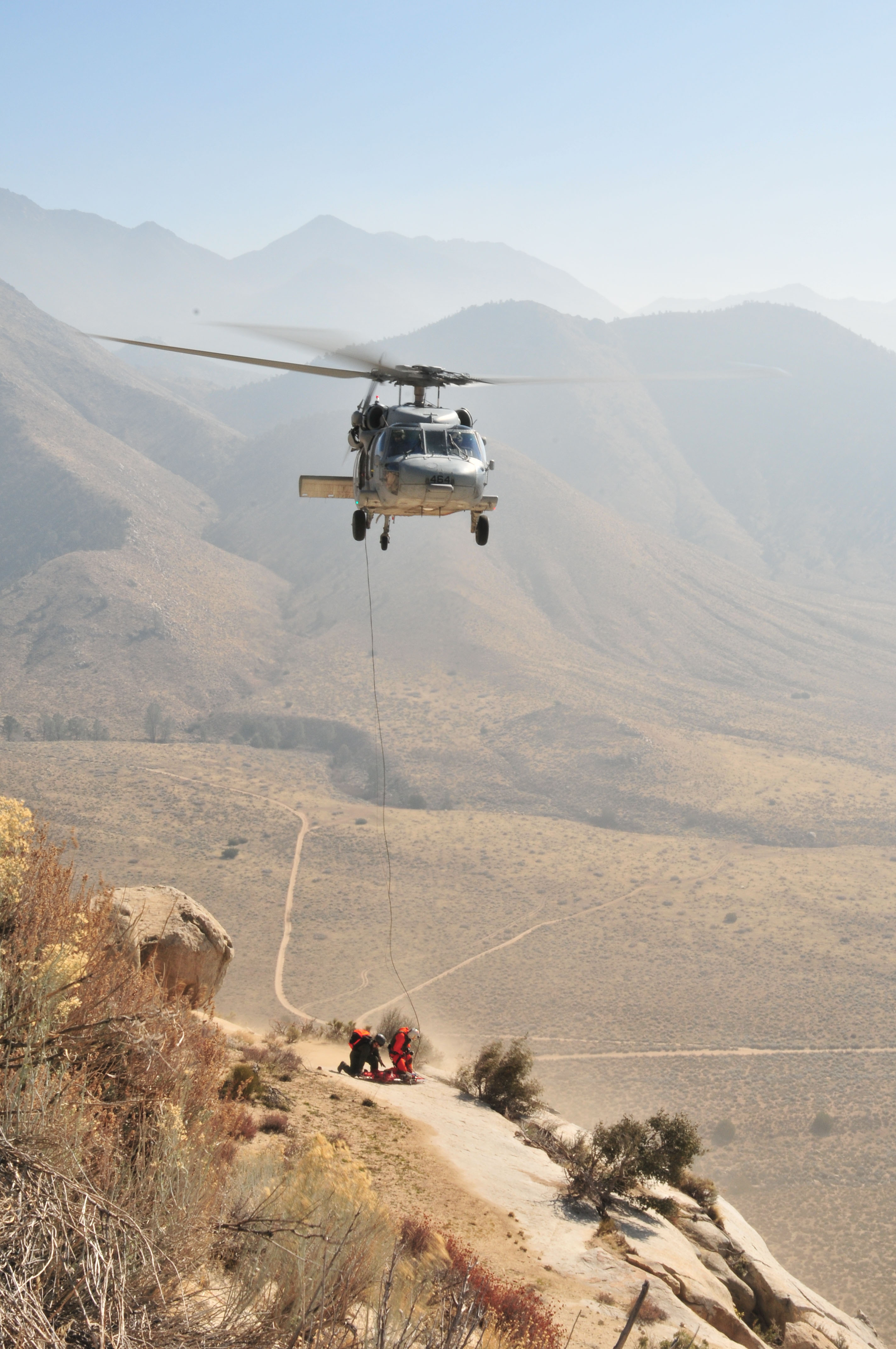
Rescue 464, an MH-60S helicopter from VX-31's Search and Rescue (SAR) unit, hoists a survivor from a hillside during a recent training mission near China Lake, Calif. (U.S. Navy photo)
VX-31 rescues injured motorcyclist in Death Valley National Park
CHINA LAKE, Calif., –NAWCWD VX-31 Search and Rescue (SAR) received notification of an off-road motorcycle accident in Death Valley National Park (DVNP), shortly after 1:00 p.m. on Thursday, Feb. 2. The victim suffered a severe neck injury. SAR mission commander Lt. Brian “Lumbergh” Culver, co-pilot Lt. Dan “The Dirt” Cabrales, SAR medical technician HMC Curtis Trull, SAR crew chief AWS1 Mark Podzon, and helicopter inland rescue aircrewman (HIRA) AWS2 Eddie Alford gathered information and briefed for the mission. Within several minutes the crew launched their MH-60S helicopter, Rescue 464, and headed to the scene.
Cabrales explained, “The initial location we received was right on; we found the survivor less than 20 minutes after takeoff. That was a huge help. Normally, we get to a location and search for at least 20-30 minutes before we find who we are looking for.”
After evaluating the landing zone, Culver landed the aircraft next to a dirt road near the top of a canyon. Trull, Podzon and Alford made their way to the survivor where they assessed his condition. Fortunately, one of the survivor’s riding companions was a trained Emergency Medical Tecnhincian (EMT) and had provided him with basic treatment and stabilization.
“When we arrived on scene the patient was lying on a backboard, strapped down in full spinal precautions. A 4-6 inch laceration at the base of his skull had been treated and dressed with gauze. Even though he was being treated for shock and oxygen therapy was administered, the patient was able to communicate. We applied a splint to a painful right wrist. We also treated his right lower ribs with a large dressing and tape to provide stabilization and comfort,” said Trull.
While the patient was being treated, Culver and Cabrales collaborated on how to transport the survivor to the nearest trauma center in Las Vegas.
Winds were gusting between 20 and 30 knots creating turbulence. As soon as the helicopter lifted off, it was bouncing around quite a bit.
Culver recalled, “Trull and Alford asked us to try and smooth out the ride, but we could only do so much. I tried to find a null area next to the upwind canyon wall but it didn’t help much. I felt horrible because I knew the survivor’s injuries and every bump must have been causing him more pain.”
Trull had to wait to place an IV into his arm because he couldn’t safely put a needle in the patient with the jostling. The pilots gave Trull a heads up as they flew over a ridgeline, counted down the time until they reached clean air, and then cued Trull who placed the IV as soon as the ride smoothed out.
As they neared Las Vegas, Rescue 464 tried to contact Las Vegas Center, the agency that controls the busy airspace around Las Vegas, without success. Air Traffic Control Centers have to grant clearance to an aircraft to enter the airspace. Without it, both pilots risk a flight violation that could end their flying careers.
“We couldn’t get in touch with air traffic control because of the mountains between us. Finally, a Southwest Airlines flight coming out of Vegas heard us and relayed our information to Las Vegas Center,” said Cabrales.
After getting permission to enter, the pilots located the helipad at Las Vegas University Hospital, and landed Rescue 464. A waiting ambulance whisked the survivor to the hospital where surgeons waited.
After refueling in Las Vegas, Rescue 464 returned to China Lake. The operation took about nine hours from the initial call to their return to China Lake. This is the first SAR mission since January 2012 for VX-31.