
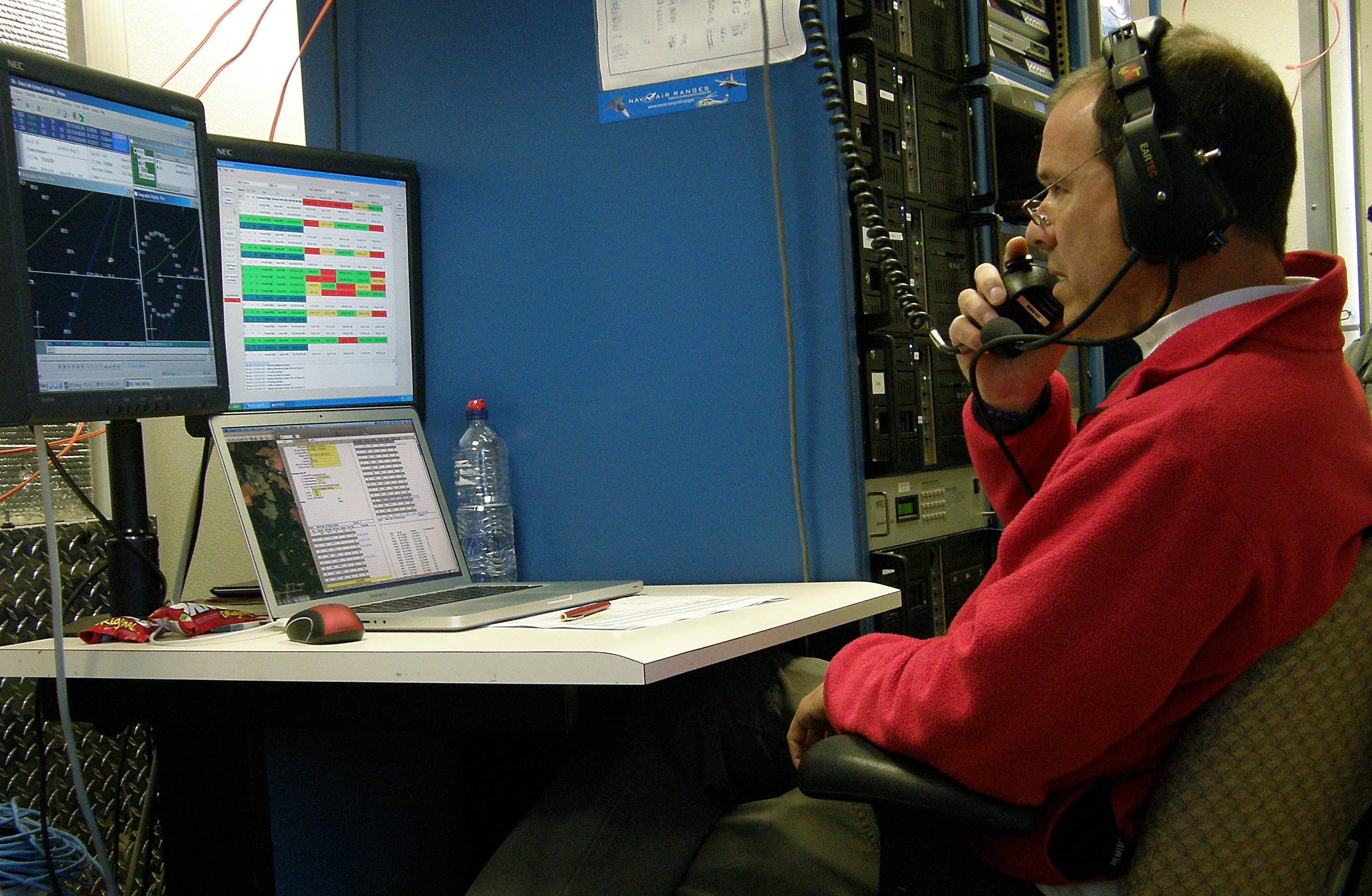
PRISM team lead Mike Falco communicates with the pilot of an approaching aircraft during acceptance testing of the new MRI imaging spectrometer.
 (U.S. Navy photo by Jennifer Amber)
New tool for aircraft survivability
NAVAL AIR SYSTEMS COMMAND PATUXENT RIVER, Md. -- A new capability now exists at the Naval Air Warfare Center Aircraft Division that is helping engineers save warfighter lives thanks to the hard work of a team from the Atlantic Test Ranges.
An imaging spectrometer, recently purchased by the Patuxent River Infrared Signature Measurements (PRISM) team, is now part of the engineering toolbox assisting design teams in making aircraft more survivable by providing high resolution, infrared spectral imagery data.
“Infrared cameras are banded instruments and provide spatial or two-dimensional images, but they don’t provide wavelength information. Spectrometers are not banded instruments and do provide data spectrally or per wavelength,” said test conductor, Mike Falco. “The new MRI imaging spectrometer will provide spectral data on every pixel of its cameras.”
Recently, the PRISM team deployed to the St. Mary’s County Regional Airport in California, Md., to perform acceptance testing of the new imaging spectrometer. Enhanced features included a high dynamic range and fast frame rates.
During the acceptance testing, a Baron twin-engine aircraft was outfitted with an Advanced Range Data System. ATR’s Global Positioning System team members Barbara Layman and Leilani Pearson staffed an Enhanced Data Link Subsystem workstation, which displayed the aircraft’s time, space and position information data in real-time overlaid on a map.
“As a cooperative target, the Baron’s pilot was in contact with the test team that used the display view to send instructions and flight pattern adjustments to the pilot for each run. GPS also provided post-processed data to the engineers after each test,” said Falco.
Maryland State Police helicopter, Trooper 7, stationed at the St. Mary’s Airport, became a target of opportunity for the PRISM team to collect data as it flew at the airport. The team also collected infrared signature measurement data on other aircraft as they flew in the airspace over PRISM instrumentation.
The result is that PRISM engineers are able to break apart the infrared measurement data into pieces, separating the IR signatures of the sky, airframe, reflections, hot parts and plumes for every frame of the acquired test run.