
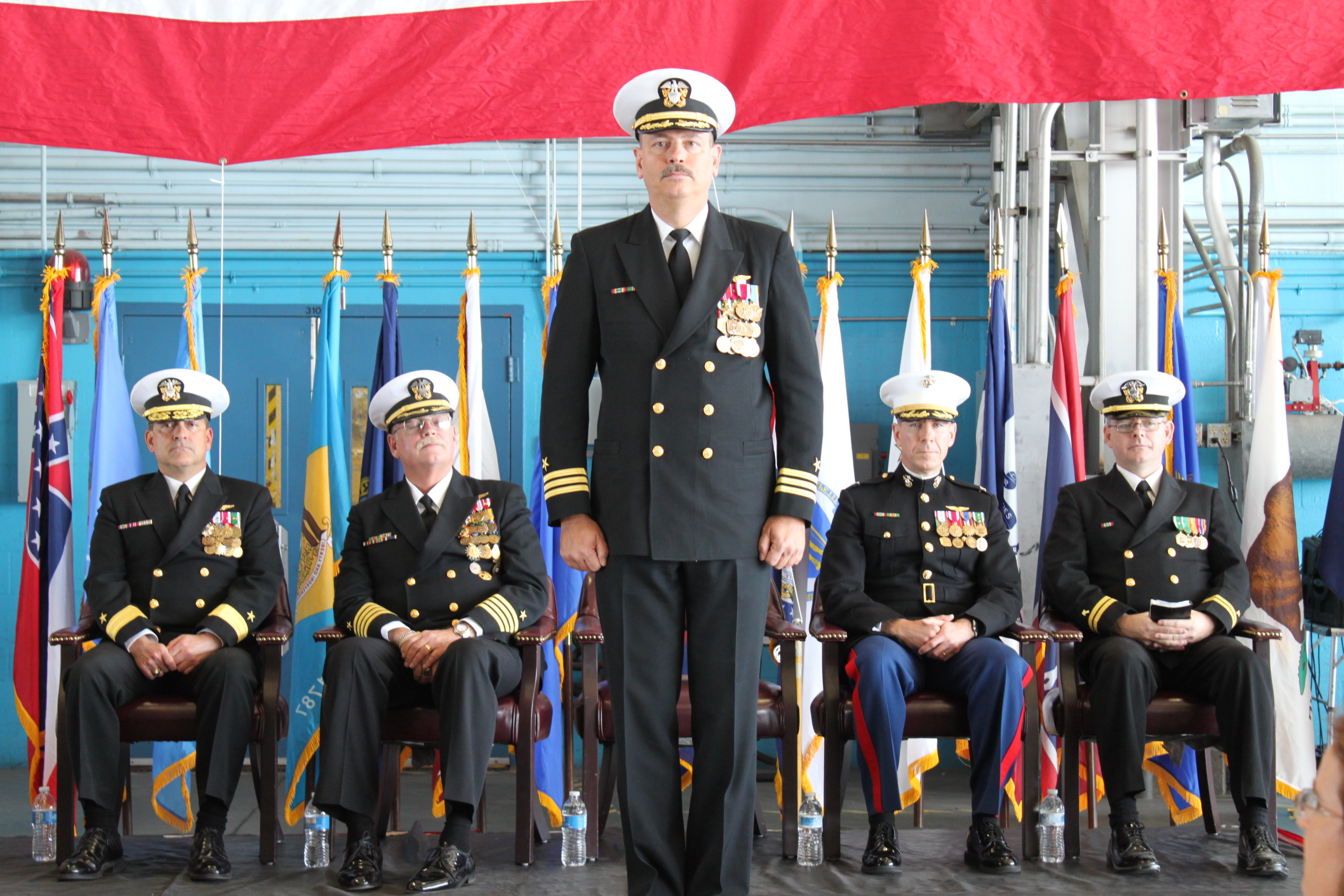
Cmdr. Ian Anderson (standing), VX-31's executive officer is flanked by Rear Adm. Mat Winter, NAWCWD commander, Capt. Tim Prendergast, Col. Andre Mercier, VX-31 commanding officer, and Lt. Derek Horne, NAWS chaplain, at Anderson's retirement ceremony held at VX-31’s Hangar 3, Feb 10. (U.S. Navy photo)
VX-31 executive officer retires after 26 years of service
CHINA LAKE, Calif. – Cmdr. Ian C. Anderson, executive officer of Naval Air Warfare Center Weapons Division (NAWCWD) Air Test and Evaluation Squadron (VX) 31, retired from active duty service Feb. 10, after more than a quarter of a century of service. Shipmates, friends and family gathered at VX-31’s Hangar 3 for an official retirement ceremony to bid “Fair winds and following seas” to Ridgecrest’s native son.
Keynote speaker Rear Adm. Mat Winter, NAWCWD commander said, "CDR Anderson is an outstanding naval flight officer, mentor, and leader. Throughout his 25-year career, he reinvented himself to meet the changing demands of naval aviation while modeling professionalism and inspiring both military and civilians by his personal commitment to country and his passion for service."
Guest speaker and retired Navy captain Tim “Spike” Prendergast regaled the audience with colorful vignettes from Anderson’s past.
Twenty-five years after Anderson reported aboard NAS Pensacola, Fla., for flight training in 1987, he has logged approximately 4,000 flight hours in several military aircraft, has been qualified to fly seven different types of Navy jets and has flown in nearly every type of mission discipline in naval aviation.
“My dream as a child was to fly fighter jets off an aircraft carrier,” Anderson said. “I had no idea that I would get to do all the things I’ve been able to do since I joined the Navy 25 years ago. I've logged flight time in 17 different types of aircraft and in just about everything the Navy has. My favorite, the F/A-18F Super Hornet Block II, is probably the most impressive all-around combat aircraft that I’ve ever flown in.”
Anderson’s experience includes more than 490 “traps” (carrier arrested landings) in the F-14A/B/D, EA-6B, FA-18D, FA-18F and EA-18G. Along the way, he’s also logged operational flight time in the A-6E, E-2C, S-3B, ES-3A, T-45A, SH-60B, AH-1W, F-5F, F-15D, B-52H and KC-135R.
Capt. Bill “Farkle” Freckleton, one of Anderson’s former instructors who shot down a MiG-17 during the Vietnam conflict in March 1972 while on his first carrier deployment as an F-4 Phantom RIO, was in attendance.
Farkle recalled, “I regarded you [Anderson] as a student who was literally at the top of the pack in operational knowledge of the AWG-9. You were one of the very few who fully understood the Nav Grid and employment of the WCS in outer air battle scenarios against jammers and multi-plane raids.”
Reflecting on his career, Anderson felt that his time as an F-14 Radar Intercept Officer (RIO) instructor at Marine Corps Air Station Miramar in San Diego, Calif., was one of the most gratifying in terms of making a difference.
“I understand how teachers feel after years pass and former students look them up and tell them how they made a difference in their lives and careers,” Anderson said. “Taking my students up in the airplane and watching them have that ‘ah-ha!’ moment when they first master a particular aviation principle or skill you’ve taught them was very rewarding to me. It gave me a great sense of accomplishment that I was helping perpetuate the proud legacy of naval aviation.”
After becoming executive officer of VX-31 in late 2008, Anderson has assisted with a myriad of developmental software and hardware projects for NAWCWD’s leading-edge programs. Flight test aviators at China Lake help acquire data for the engineers and, as a result, help shape systems functionality.
“We provide an aviator’s assessment as to how it functions, providing our perspective from the cockpit,” Anderson said. “Based on our individual experiences in operational conditions, we pass along information as to how it works, how it should work, or how it can work better.”
Anderson has spent nearly a third of his military career at China Lake, testing weapons and sensors in Navy jets at VX-9 and VX-31.
“The challenge and interest of both developmental and operational flight test — working with the flight test engineers at the Advanced Weapons Laboratory and helping to get the systems working and ‘up to spec’ before they are implemented in the fleet — has been really fascinating to me,” said Anderson. “VX-31 has been a highly rewarding tour of duty, due mostly to the truly outstanding people who work here.”
Anderson reflected “Despite all the changes we’ve seen and the time that has passed, the personalities, mindsets, attitudes, camaraderie and approaches to problem-solving – the ‘culture’ of naval aviation – are so similar in today’s aircrew compared to those in the past,” Anderson said. “You really gain a sense of being a small part of something much bigger, with an amazing history. You inherit that legacy, that tradition. It has been an honor to be a part of an organization as successful as naval aviation.”
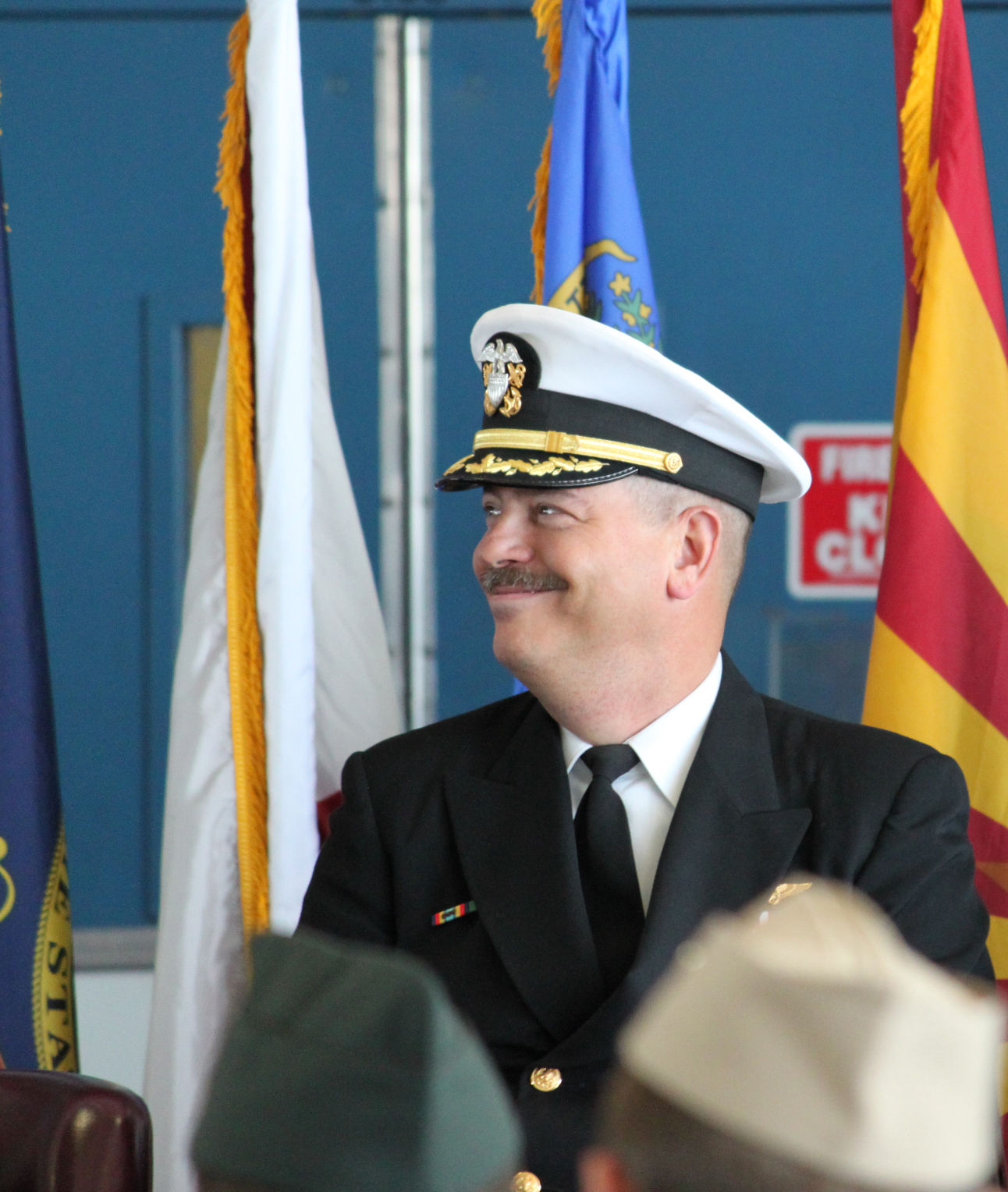
Cmdr. Ian C. Anderson, retired from active duty service Feb. 10, after more than a quarter of a century of service. Shipmates, friends and family gathered at VX-31’s Hangar 3 for an official retirement ceremony to bid “Fair winds and following seas” to Ridgecrest’s native son.(U.S. Navy photo)
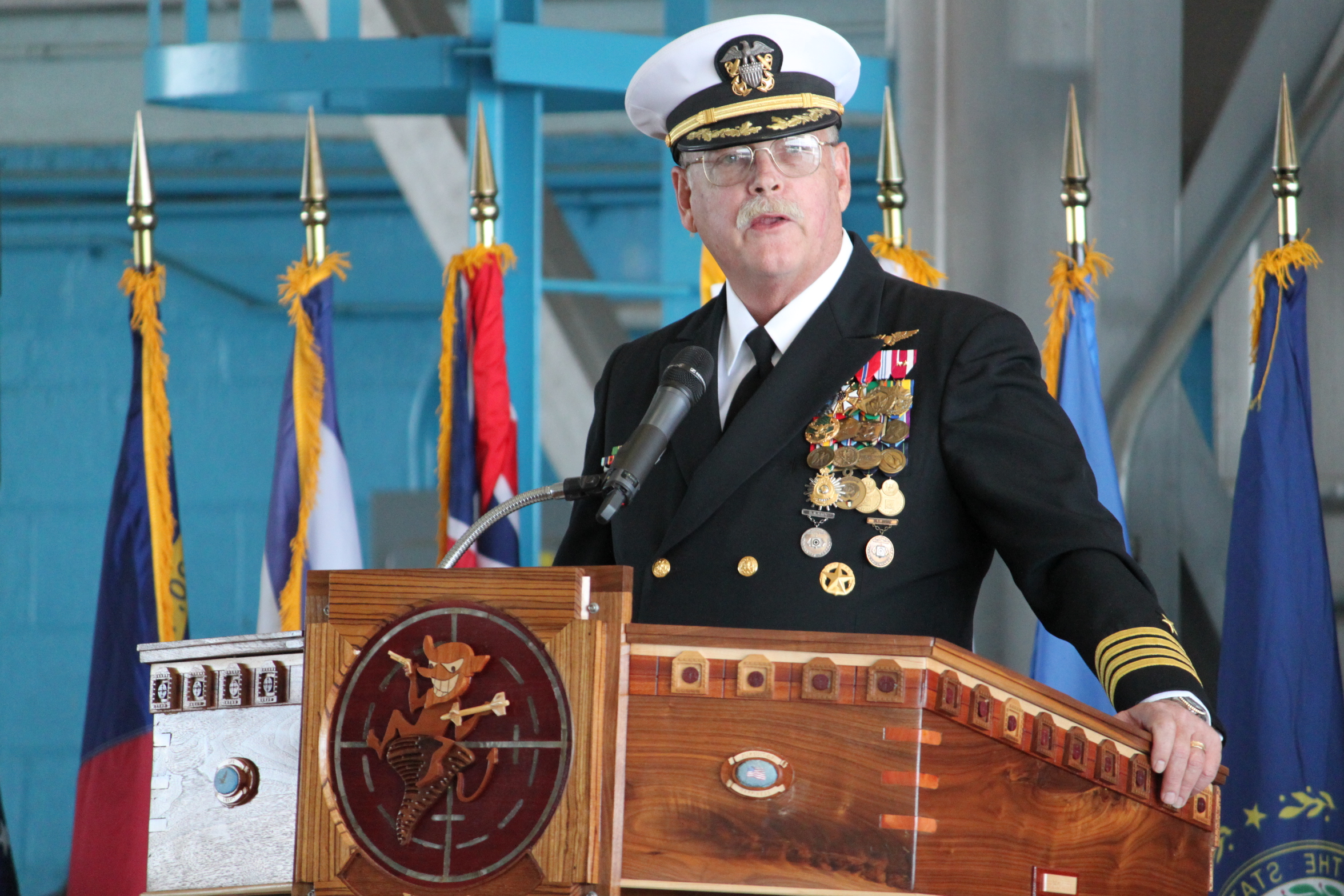
Capt. Tim “Spike” Prendergast, a former commanding officer of then Lt. Anderson entertained the audience with vignettes from Anderson’s past. (U.S. Navy photo)
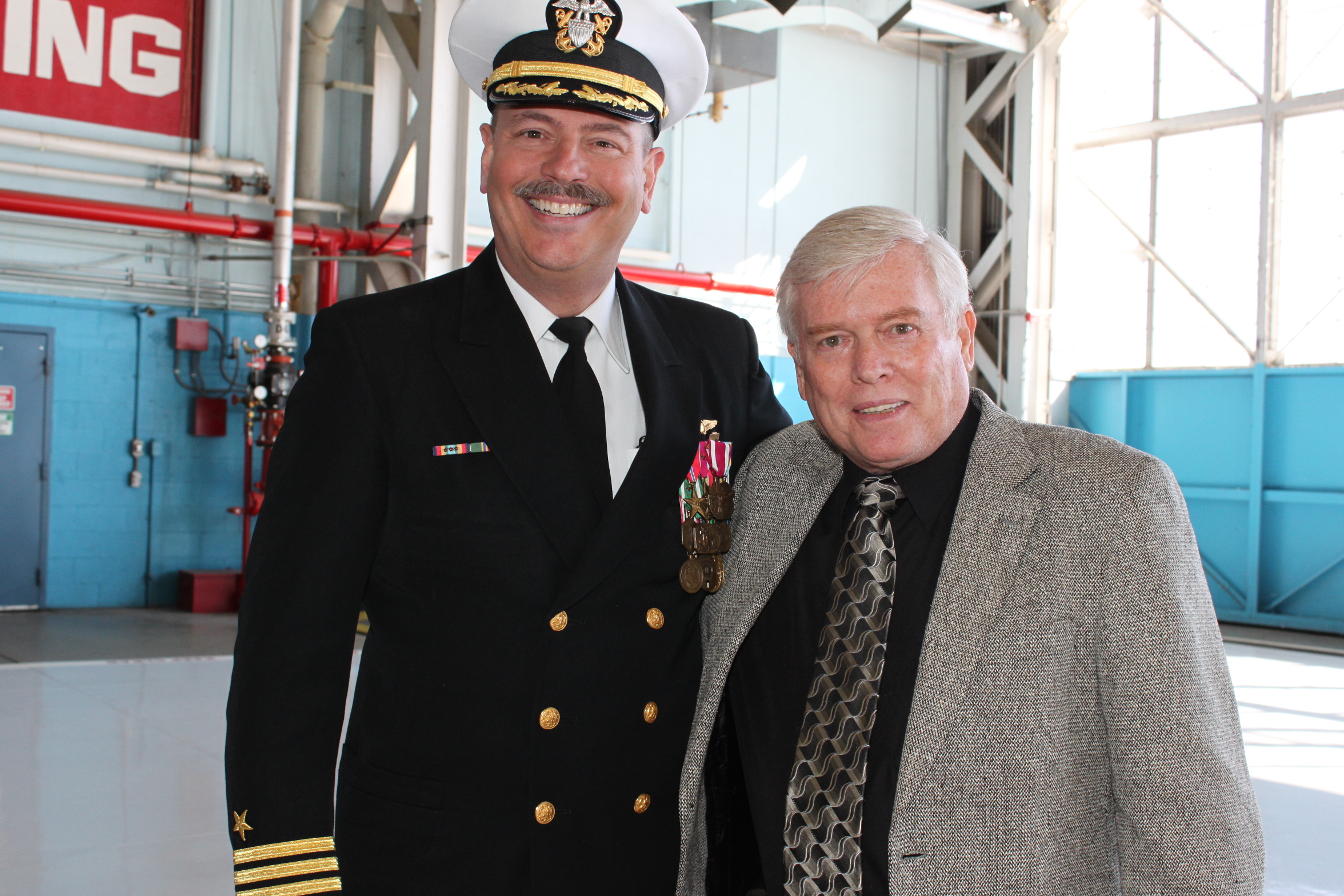
Cmdr. Ian Anderson stands with Capt. Bill “Farkle” Freckleton, one of Anderson’s former RIO instructors. Freckleton and his pilot shot down a MiG-17 during the Vietnam conflict, March 6, 1972, while on his first carrier deployment as an F-4 Phantom RIO. (U.S. Navy photo)