
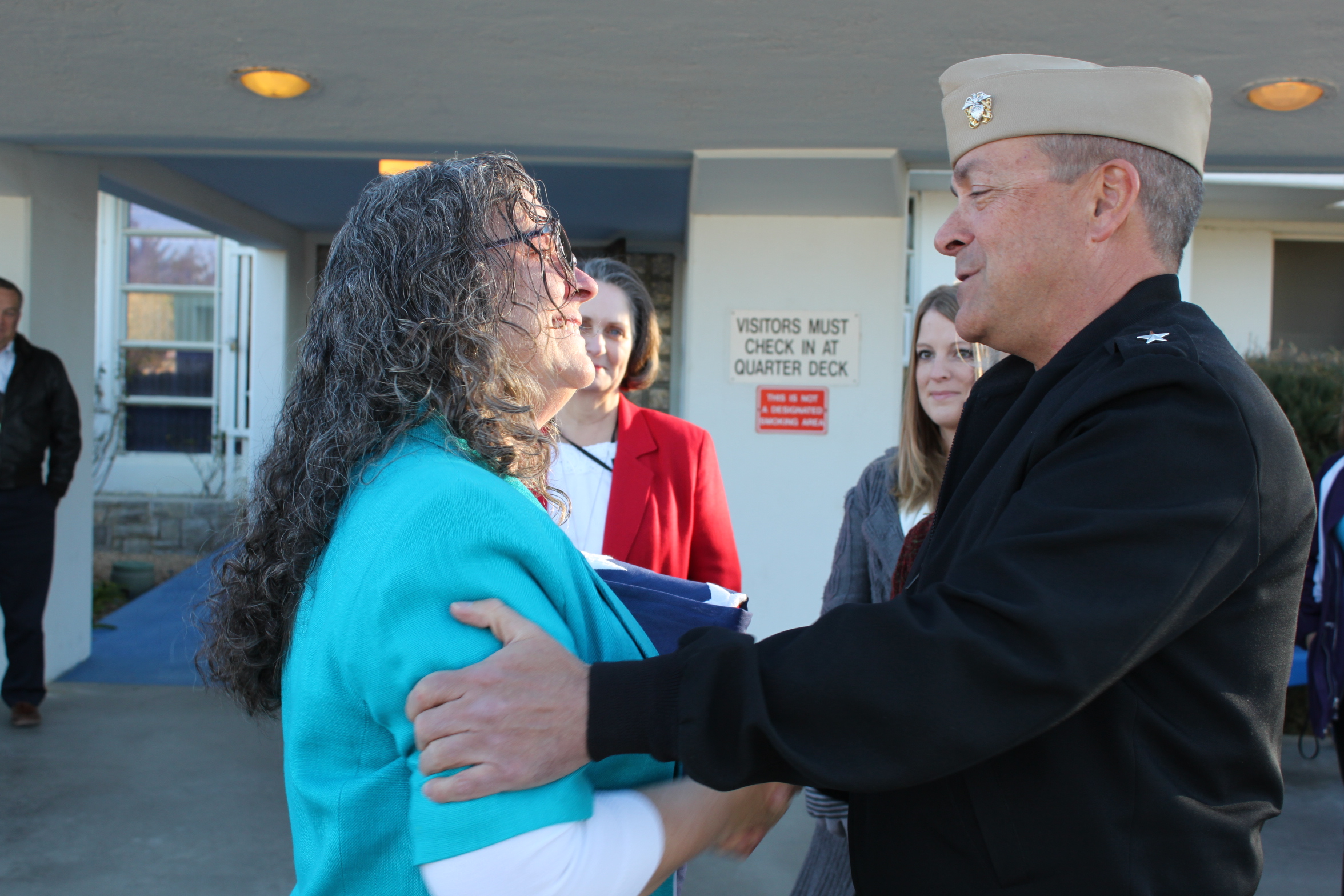
Rear Adm. Mat Winter, NAWCWD commander, congratulates LeeAnn Burfeindt on her 33 years of service at China Lake after her flag raising ceremony Feb. 2. (U.S. Navy photo)
WD employee retires after 33 years
NAWCWD CHINA LAKE, Calif., – After 33 years of working here, LeeAnn Burfeindt retired and passed the program torch to the upcoming team.
According to Greg Wheelock, Spike Missile project manager, ”Spike’s biggest promoter came in a little five-foot, four-inch package named LeeAnn Burfeindt.”
Burfeindt left the global positioning system – inertial navigation system (GPS-INS) group and transferred to the Spike project in 1999.
“Fortunately, I knew a lot of people,” Burfeindt said. “If something needed to get done, I did it or found someone who could get it done.”
During the first down-range missile launch, Burfeindt coordinated the test, ordered parts for the missiles, assembled the missiles together, attached the rocket motors, and loaded missiles on the launch rail.
“The only thing I didn't get to do was press the launch button,” she said.
Burfeindt’s career began at China Lake as a temporary clerk in 1979. She filled in as secretary for the sensors and platforms group, then with procurements as a clerk and, later, as the base telephone operator for a month.
Burfeindt explains, “This was back when you had to connect the autovon lines at the switchboard for incoming and outgoing calls. You could even listen in, if you had time. Of course I never did.”
In 1979, she became a permanent secretary for the gun systems branch. She later applied for a position as an air conditioning equipment mechanic helper in public works and landed the job that doubled her salary. She was selected from a pool of more than 50 applicants and got one of the two open positions that was open. Burfeindt finished the 'unofficial pre journeyman training program' ahead of schedule, and received her journeyman rating in less than three years.
While attending electronics classes at Cerro Coso Community College, she was rated as an electronics technician. After working at public works for five years, Burfeindt transferred to Echo Range and worked for section head Allan Lesniak. One of her responsibilities at Slate Range was to follow the pairs of copper phone lines down the side of the mountain, checking for damage by wild burros.
In her words, “One of my greatest accomplishments there was to get the radar sites to shine on Slate Range for calibration every morning. They were having a problem getting the radar crews to do this and I was tasked with the responsibility. After a couple of weeks visiting the various sites, we came to an agreement that all the radars would shine on Slate Range every morning for calibration. They did, and I worked at Echo Range for five years.”
Always looking for a challenge, Burfeindt seized an opportunity to operate a $1.3M certification van for the High Speed Anti-Radiation Missile team and learn more about radars, so she transferred to the North Ranges and conducted down-range testing that included Bull Pup, Wild Horse Mesa, and Coles Flat target areas. Ordinarily, the data that was collected by the certification van was supposed to be presented by the customers, not the person who collected the data. Burfeindt, however, was considered the expert and allowed to present the data at the pre-fire meetings. She worked at the North Ranges for five years.
In 1994, Dave Allen hired Burfeindt to work as a network services coordinator/IT specialist/computer specialist. She coordinated the effort to have 220-volt power installed in a building at Point Mugu and succeeded in getting the Microsoft Exchange servers on-line, on schedule.
About three years later, Burfeindt joined the GPS-INS group as their computer specialist/electronics technician. One of the most interesting aspects of this position for Burfeindt was keeping a server called Sirius updated.
Burfeindt’s career “spiked” when she began working with the miniature munitions team in 1999. For more than 12 years, Burfeindt had her creative hands in the Spike project. According to Burfeindt, “It’s the best project I have had the opportunity to work on and the greatest people I have had the pleasure to work with.”
LeeAnn and her husband, Butch, are moving to Idaho for their retirement.
“We’re going to finish raising our twins, and go on as many Maranatha Mission trips around the world that God will allow,” she said. “The busier we stay the better we like it.”
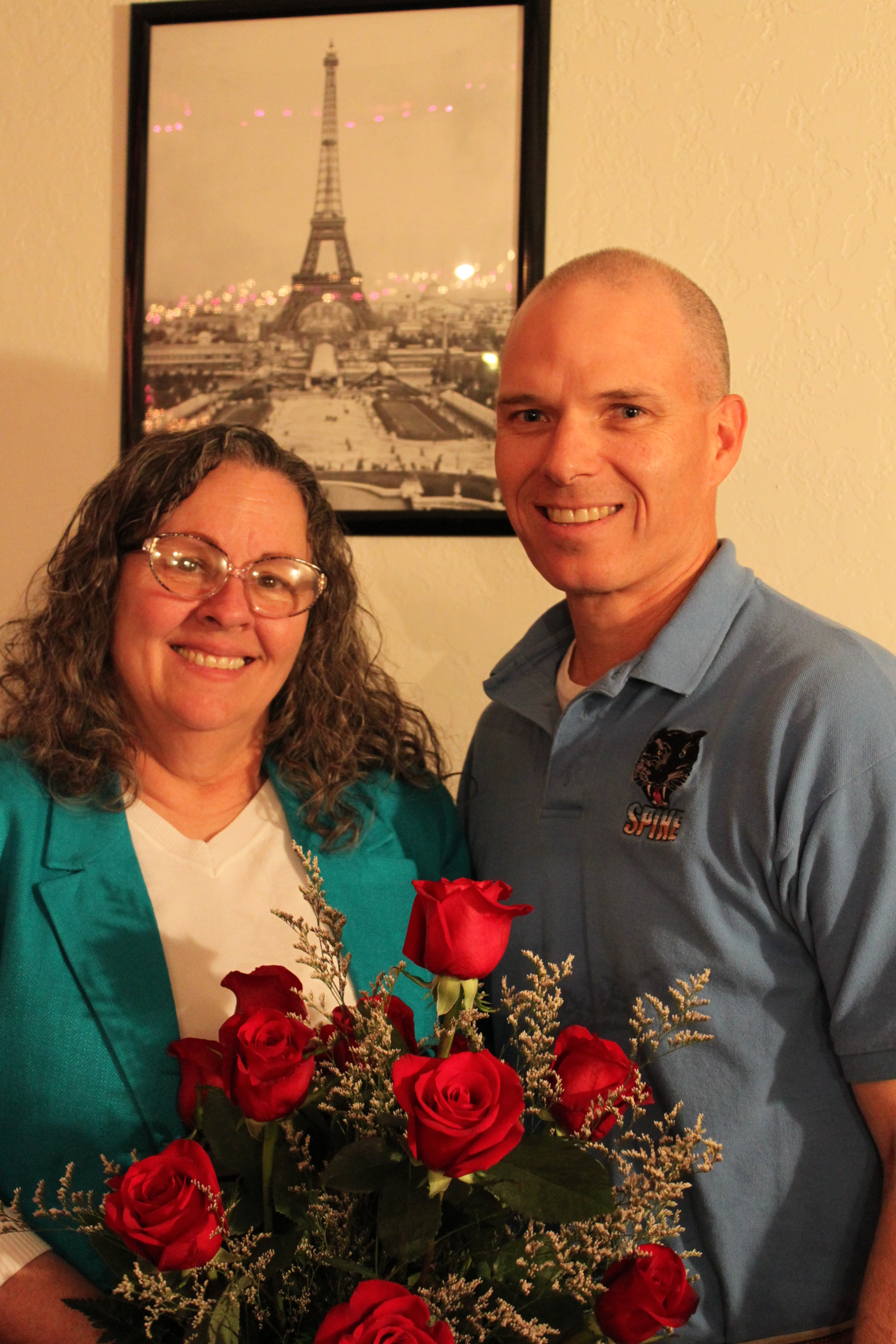
Don Christison, head of the guidance engineering branch, congratulates LeeAnn Burfeindt at her retirement luncheon held Feb. 2. (U.S. Navy photo)