
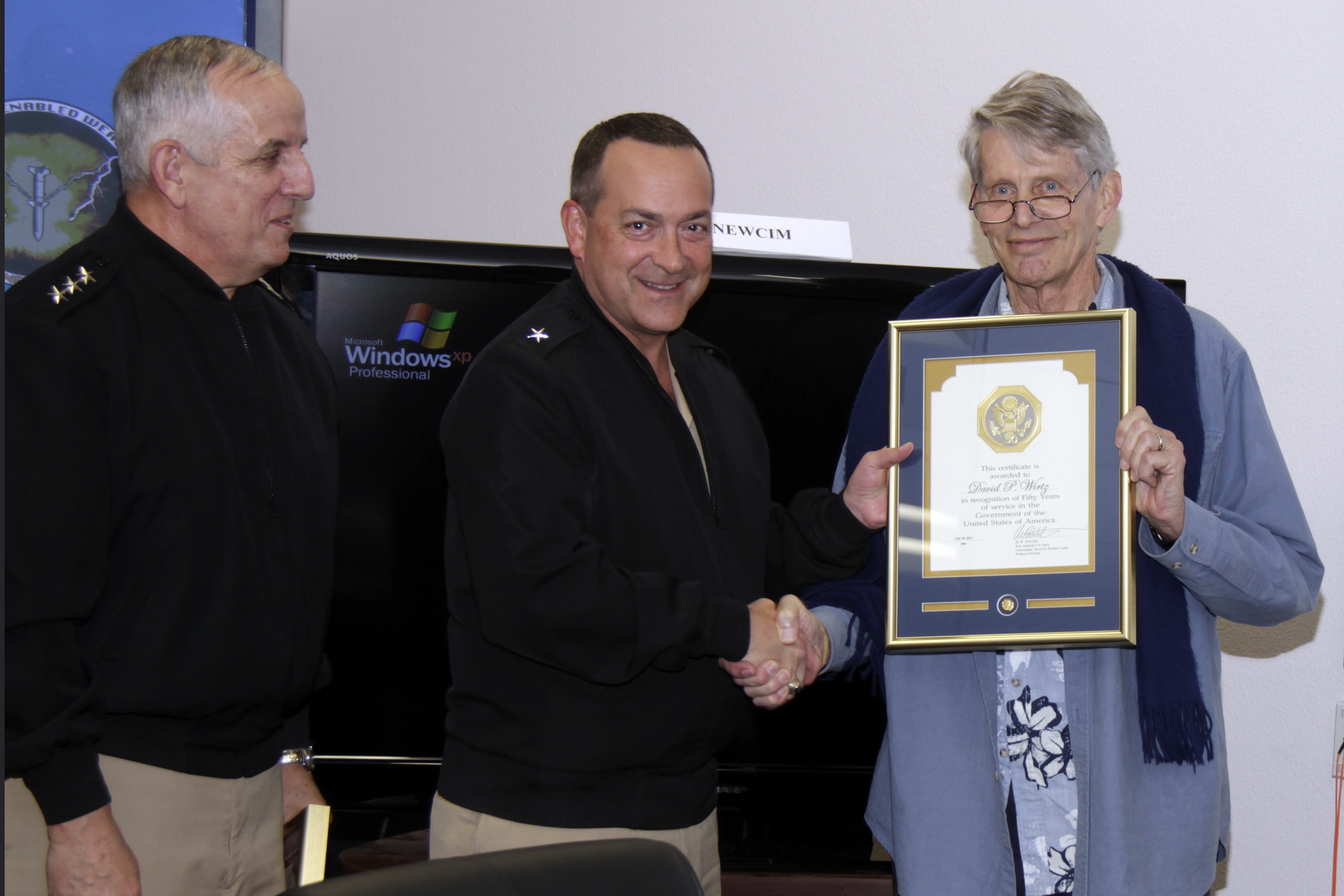
Rear Adm. Mat Winter, NAWCWD commander, recognizes David Wirtz with a 50-year Length of Service Award. Vice Adm. David Architzel, NAVAIR commander, joins the celebration during his recent visit to China Lake. (U.S. Navy photo)
WD senior scientist of 50 years receives prestigious awards
Vice Adm. David Architzel, NAVAIR commander, took time during his tour of the west-coast based facilities at Point Mugu, San Nicolas Island and China Lake to meet and congratulate several NAWCWD employees. Among those Architzel honored was 50-year NAWCWD employee, David Wirtz who received both the Navy Superior Civilian Service Award and a 50-year Length of Service Award.
Wirtz is a prolific author, credited with more than 100 technical papers and numerous patents during his stellar career at China Lake. He is distinguished as the only low observables expert in the United States and recognized as an authority in electromagnetics, aerodynamics, and propulsion.
Wirtz worked on 10 different weapon programs including Harpoon, Condor, Chaffroc, SLU FAE, Vertical Launch ASROC, AGILE, GORJE, Generic Low Observable Missile (GLOM), Walleye and Zuni.
Architzel said, “Dave, you've given so much to the country and to the Navy over your time that I'm just honored to be in the same room with you.” Architzel congratulated Wirtz on his accomplishments and presented him with the Navy Superior Civilian Service Award.
When he worked in the field of applied research, Wirtz designed aerodynamic tests which helped identify and solve problems for Harpoon and Condor. He later developed test techniques for measuring internal overpressures caused by hypervelocity particle impacts on an aluminum structure whose accuracy could not be confirmed until piezoelectric devices became available in the 1970s (at which point the earlier testing techniques were validated).
Wirtz designed and evaluated the Chaffroc designs relative to aerodynamics and stability. He also conducted an extensive evaluation of the rocket accuracy of the SLU FAE. He later developed a method to couple vane aerodynamic analysis with the conical flow of a rocket nozzle thus enabling the successful design of the Vertical Launch ASROC System. In addition, Wirtz worked on the gimbaled-nozzle design and aerodynamic performance for AGILE and GORJE.
In the 1970s, Wirtz participated in the design, analysis and fabrication of a Low Energy Structure (LES) using a louver/atrium concept. This resulted in a structure which maintained a temperature which never went below 65 degrees Fahrenheit in the winter with no heating besides solar and the thermal mass. He also developed a method to use the rock storage in summer as a pre-cooler for the evaporative cooler resulting in an additional 8 degrees Fahrenheit of cooling.
Since the 1980s, Wirtz established a small group of engineers at China Lake and Point Mugu and trained them on observables engineering. He designed and developed the GLOM which was the lowest signature air vehicle available for testing at that time. He developed many unique testing and data display techniques which revolutionized the RCS design and measurement community that have become the national standard.
Wirtz was selected as senior fellow by his peers in the NAWCWD Fellows Program. Other rewards he received during the years are NAVAIR Senior Engineer (2001), NAVAIR Fellow (2004), Michelson Award (2006), and DON Meritorious Civilian Service Award (2003). Wirtz obtained a bachelor’s degree in aerospace engineering at the University of Colorado, and a master’s degree in engineering at the Universtity of California Los Angeles.
Reflecting on his 50-year history at China Lake, Wirtz said, “I consider the fact that I have a son and two daughters, and a son-in-law, who work at the base part of my greatest accomplishments.”
Following the presentation of awards, Wirtz stated, “China Lake has been a place where you have the freedom to do what you need to do. It is a fantastic, absolutely fantastic place."