
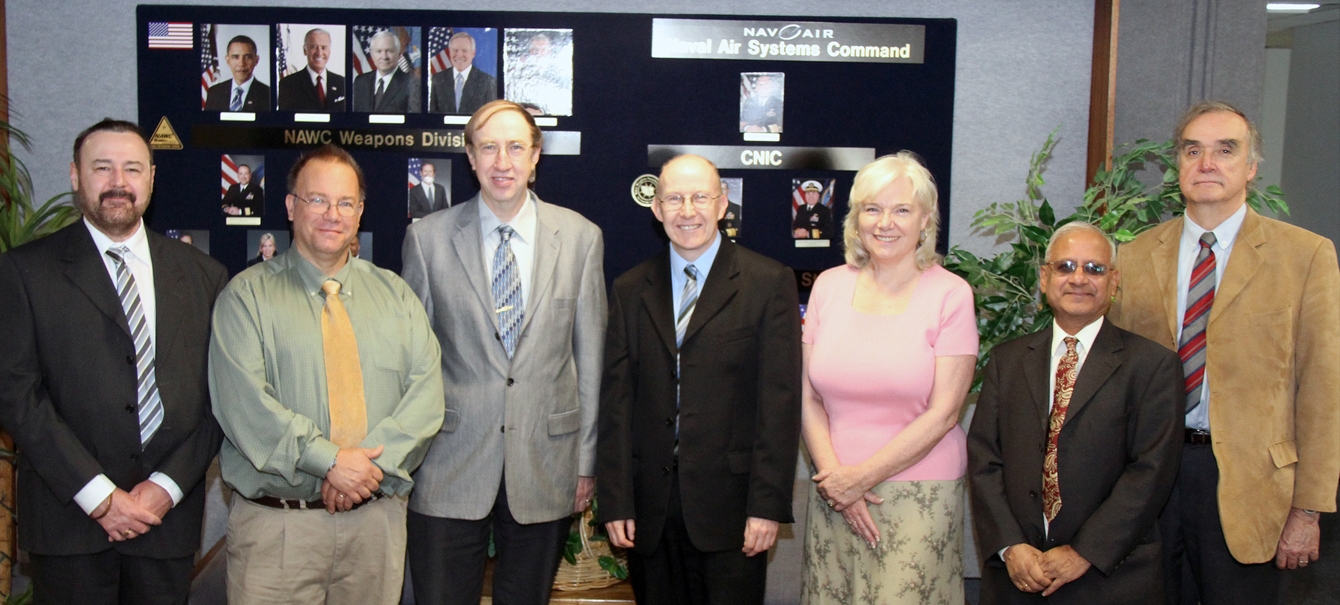
Arun Majumdar, senior scientist of the Physics Division and director of the Optical Beam Control & Atmospheric Propagation program (second from right) hosted the first annual Technical Cooperation Program (TTCP) held at China Lake. Participants are (L – R) Kenneth Grant, senior research scientist from the Defence, Science and Technology Organisation, Australia; Alan Hays, laser scientist, U.S. Army; Kenneth Schepler, principal scientist, U.S. Air Force Research Laboratory; Kenneth McEwan, Defence Science and Technology Laboratory, United Kingdom; G. Charmaine Gilbreath, head of Free Space Photonics Communications, Naval Research Laboratory; and Georges R. Fournier, research scientist, Defence Research and Development, Canada. (U.S. Navy Photo)
TTCP holds first annual conference at China Lake
Arun Majumdar, senior scientist of the Physics division and director of the Optical Beam Control & Atmospheric Propagation program at Naval Air Warfare Center Weapons Division (NAWCWD) recently hosted a conference at China Lake for the Technical Cooperation Program (TTCP).
TTCP is an international cooperation agreement between five principle countries, United States, United Kingdom, Canada, Australia, and New Zealand that encompasses basic research, exploratory development and demonstrations of advanced technology development.
This scope includes the exploration of alternatives and concepts prior to development of specific weapon systems; feasibility demonstrations of innovative new concepts, techniques or equipment and their test and evaluation; the pursuit of alternative solutions to potential military problems; and generic systems.
As a part of an on-going effort to support the TTCP Sensors sub-group (TTCP SEN-TP-5), Majumdar coordinated the China Lake conference and then the group continued discussions at the Space and Naval Warfare Systems Command, San Diego. Representatives from the other four countries along with the U.S. Navy and Air Force scientific community were in attendance.