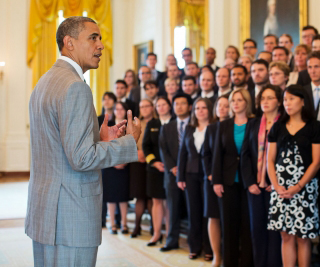
Naval Air Warfare Center Weapons Division research chemist Dr. Lee Cambrea, third from right in the front row, listens as President Barack Obama addresses 2011 Presidential Early Career Awards for Scientists and Engineers recipients in the East Room of the White House on July 31. (Official White House Photo by Pete Souza)
NAWCWD chemist earns presidential award
Dr. Lee R. Cambrea, a research chemist in the Naval Air Warfare Center Weapons Division Research and Intelligence Department, accepted a Presidential Early Career Award for Scientists and Engineers during a ceremony July 31 at the Smithsonian National Museum of Natural History in Washington, D.C.
“This is certainly pretty high on the list of career milestones; I’m not sure where I go from here,” said Cambrea, who dedicated the presidential award to her late mother. “She was always sure that I was going to be highly successful. This is for her.”
Cambrea was one of 96 researchers named by President Barack Obama as a presidential award winner. The Presidential Early Career Awards for Scientists and Engineers is the highest honor bestowed by the U.S. government on science and engineering professionals in the early stages of their independent research careers.
This award embodies the high priority the Obama Administration places on producing outstanding scientists and engineers to advance the nation’s goals, tackle grand challenges, and contribute to the American economy, according to a statement released from the White House.
“Discoveries in science and technology not only strengthen our economy, they inspire us as a people,” Obama said. “The impressive accomplishments of today’s awardees so early in their careers promise even greater advances in the years ahead.”
President Bill Clinton established the awards in 1996. Various departments and agencies annually nominate the most meritorious scientists and engineers whose early accomplishments show the greatest promise for assuring America’s preeminence in science and engineering and contributing to the awarding agencies' missions.
Cambrea is originally from northwestern Indiana; she graduated from Michigan City high school and earned a bachelor’s in biochemistry from Valparaiso University and a Ph.D. in analytical chemistry from Purdue University. She came to NAWCWD China Lake about five years ago. Working in a military environment had not been part of the plan for Cambrea, who always thought she would remain in Indiana close to family, work for a pharmaceutical company, and develop a drug that would cure cancer.
After graduation, she had her choice of job offers that would allow her to follow that plan. But the path took an unexpected turn when she happened upon a job announcement for NAWCWD that was just interesting enough to grab her attention. It wasn’t long before Cambrea was on her way to China Lake for an interview.
“I really liked the people and the work atmosphere here,” she said. “When I found out that as a brand new Ph.D., I could run my own program and start my own research, that sealed the deal.”
Cambrea works on several research projects of her own and also supports the research work of others. Currently, her two main projects deal with improving chemical sensors and developing a new type of latent fingerprint powder.
The sensor work is focused on making chemical sensors more sensitive and accurate. The military application of these enhanced chemical sensors could involve detecting atmospheric toxins or identifying IEDs (improvised explosive devices). Unmanned aviation vehicles could also be fitted with these sensors to determine, during a flyover, if exhaust from buildings contains any clues as to the work being done inside. This is a particularly challenging task as dilution of the exhaust gases into the atmosphere makes detection very difficult.
“In many situations, detecting parts per million is great,” Cambrea said. “However during a flyover, you might need to detect parts per trillion or better.”
One of the techniques associated with this research is surface enhanced Raman spectroscopy. It involves shooting a laser at a target molecule, and collecting the light as it is scattered back. The molecule of interest can then be identified in the resulting spectrum. Cambrea is working on developing new substrates, or platforms, for the sensors, adding nano-sized features, and changing the shapes of the features in an effort to enhance the scatter back to get a bigger, better signal.
The new fingerprint powder that Cambrea is developing will help to more quickly detect and identify criminals and terrorists. “If we find a terrorist location or an IED, we want to develop those latent fingerprints immediately to be able to find the person or persons responsible,” she said. “The faster we can get that information, the better.”
Normal latent fingerprint developing procedures, like dusting with powder, work well if the fingerprints are fresh. To get older prints from a small object, like a gun, it has to be taken to a lab and put in a special chamber where super glue is heated until it fumes and reveals a white fingerprint. Not only is this fuming technique complicated and time consuming, but another current challenge is trying to develop older fingerprints from an object that may be too big to be taken to a lab or one that needs to remain in place.
Cambrea came up with a way to produce the same chemical reaction of the fuming super glue and apply it to a powder, allowing a technician in the field to quickly dust an object, and snap a photograph of the fingerprint.
“Doing the kind of work that could save lives is really exciting,” she said. “The fact that I can tailor my programs to help the warfighter and protect people from IEDs makes my job rewarding and fun.”
Cambrea knew from a young age that science was her passion. She has participated in science fairs since she was in kindergarten. Beginning with her first project of producing pictures without a camera, to competing in state and international science fairs, Cambrea has enjoyed great success and experiences through her scientific endeavors.
Looking to the future, Cambrea said she enjoys the hands-on research but is also open to moving into a program management role when the time is right.
“I think I’m on a good path and I want to continue on it,” she said. “I just want to get the needed technology out to our military whether that’s by doing basic chemistry research or managing projects that are at a higher technology readiness level. I just want to move technology forward and transition it out into the field.”
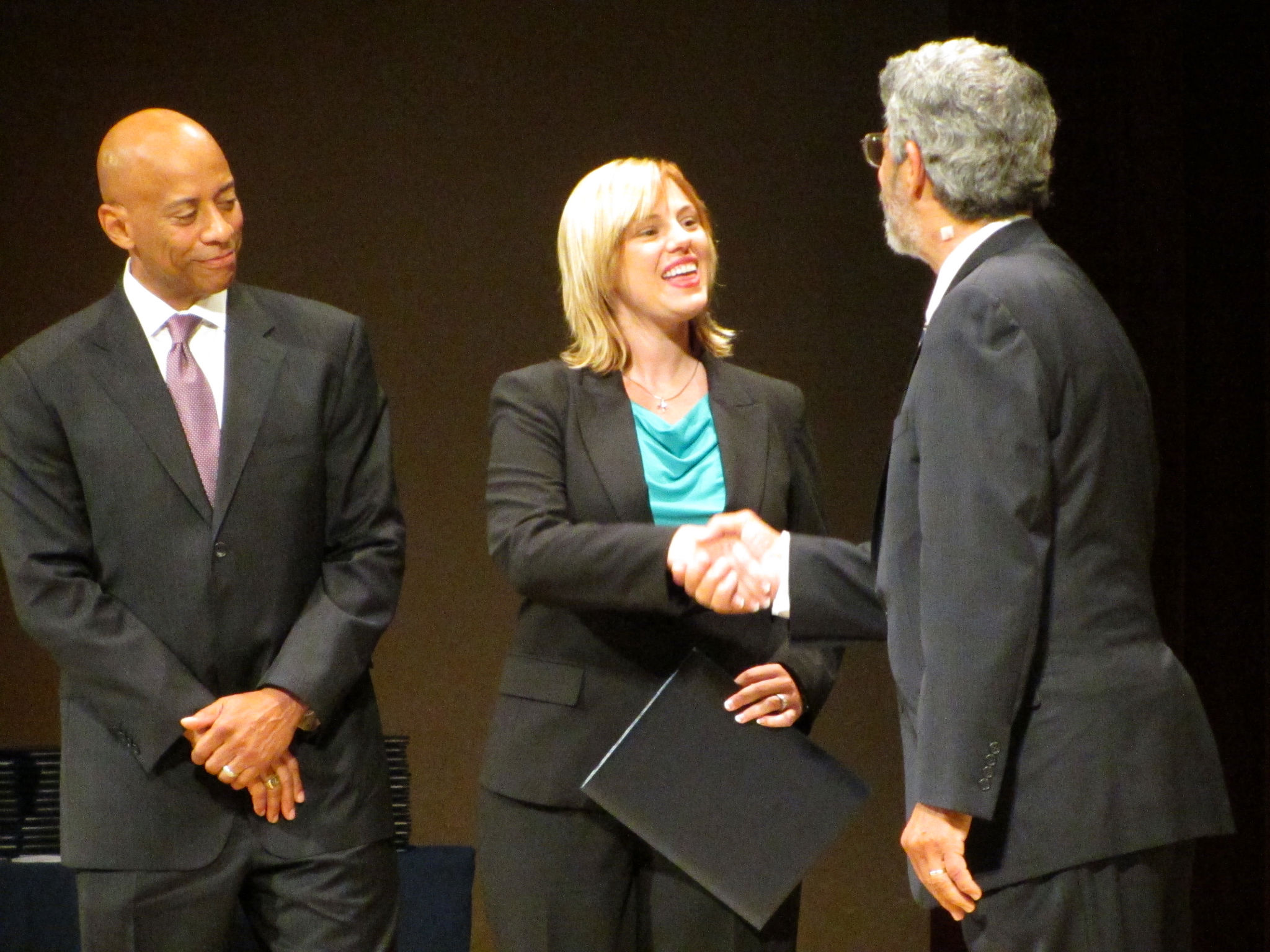
Dr. Lee Cambrea, a Naval Air Warfare Center Weapons Division research chemist, accepts a Presidential Early Career Award for Scientists and Engineers from presidential Science and Technology Advisor Dr. John Holdren during a ceremony July 31 at the Smithsonian National Museum of Natural History in Washington, D.C. Looking on is Deputy Assistant Secretary of Defense for Research Dr. Reginald Brothers. (Courtesy photo)
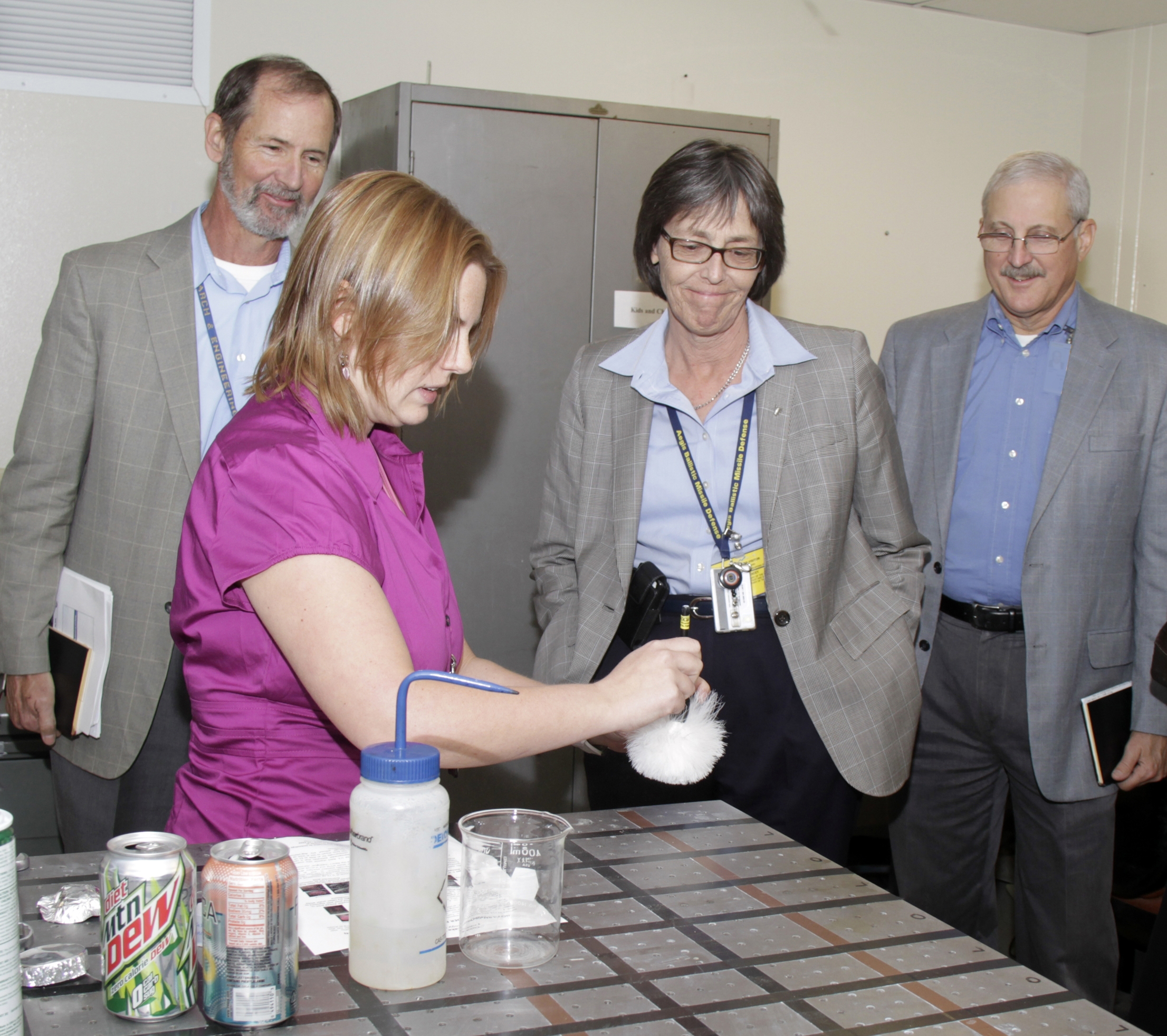
Dr. Lee Cambrea, a Naval Air Warfare Center Weapons Division research chemist, explains how a new fingerprint powder that she is developing will help to more quickly detect and identify criminals and terrorists to Deputy Assistant Secretary of the Navy for Research, Development, Test and Evaluation Mary Lacey, during a visit to NAWCWD earlier this year. Looking on are Scott O’Neil, left, NAWCWD executive director, and Dave Janiec, director of the Weapons and Energetics Department. (U.S. Navy photo)
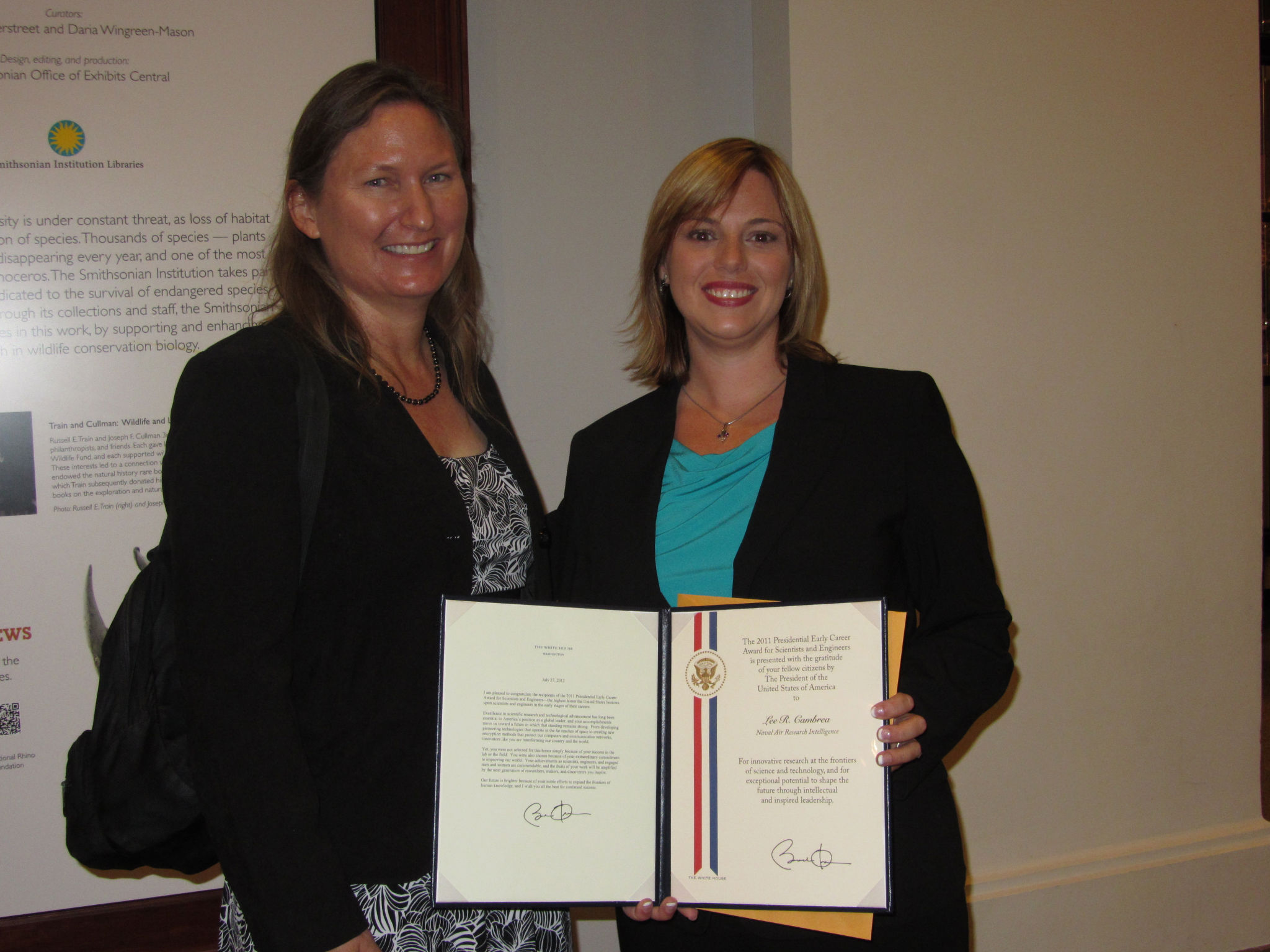
Dr. Lee Cambrea, right, a Naval Air Warfare Center Weapons Division research chemist, is joined by her supervisor Roxanne Quintana, head of the NAWCWD Analytical Chemistry Branch, at the Presidential Early Career Award for Scientists and Engineers presentation July 31 at the Smithsonian National Museum of Natural History in Washington, D.C. (Courtesy photo)