
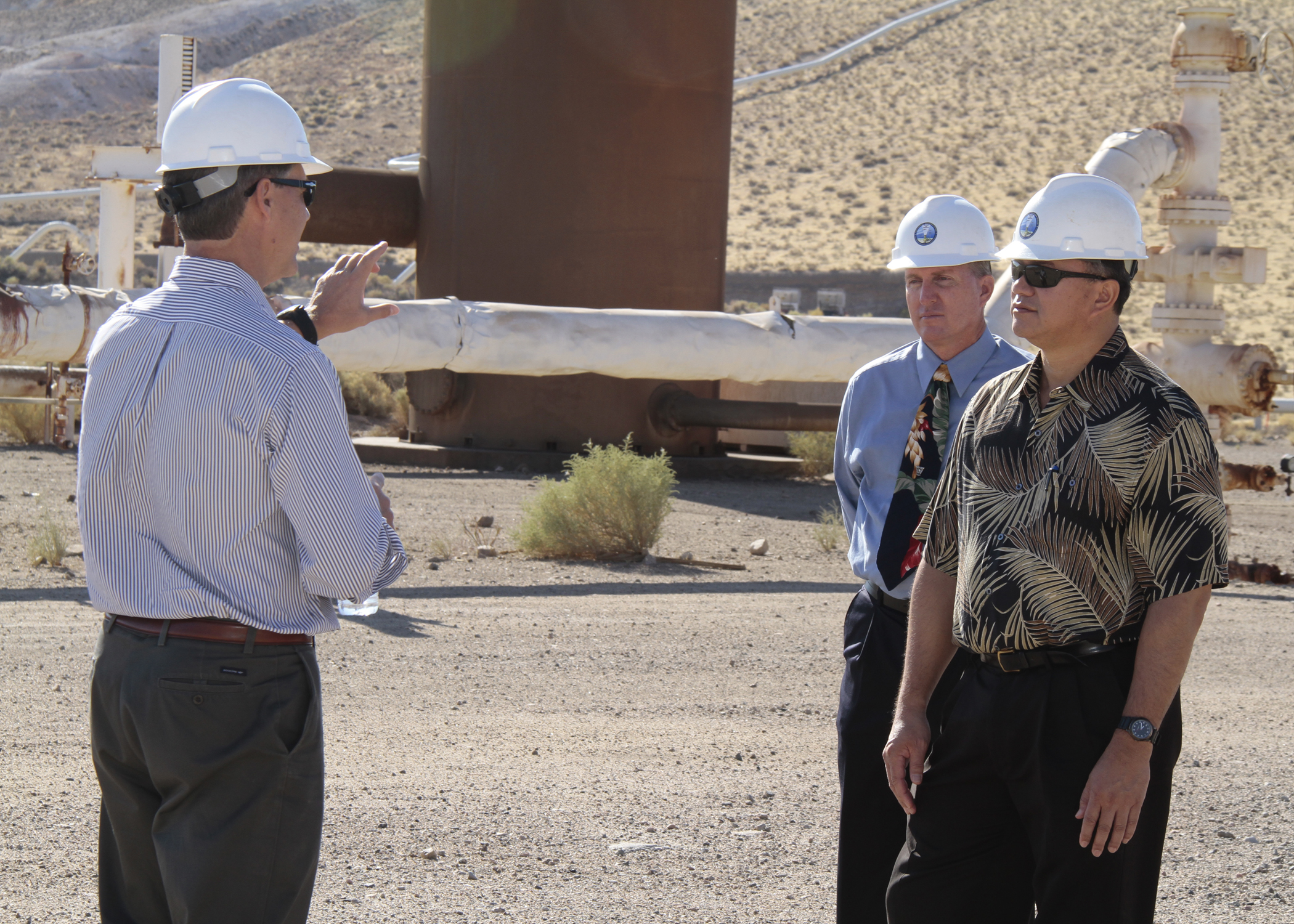
Left to right, George Ka’iliwai, Andrew Sabin and Ross Roley, senior military analyst with Cubic Applications, Inc., San Diego, toured the geothermal facility and visited with NAWCWD renewable energy leadership. (U.S. Navy photo)
Pacific Command director of Resources and Assessment visits China Lake
CHINA LAKE, Calif. – Dr. George Ka’iliwai III, the director of Resources and Assessment Directorate Headquarters, U.S. Pacific Command (HQ USPACOM) recently visited Naval Air Weapons Station. Ka’iliwai was interested in the geothermal activity at China Lake and Naval Air Warfare Center Weapons Division (NAWCWD) energy activities as it relates to potential synergies with PACOM.
NAWCWD executive director Scott O’Neil was the official host of the day-long tour conducted by Andy Sabin, head of the Geothermal Program office. Andy Corzine, NAWCWD deputy director of Technical Research and Engineering provided an overview of NAWCWD’s energy program to Ka’iliwai and Ross Roley, senior military analyst with Cubic Applications, Inc., San Diego.
Corzine stated, “Ka’iliwai’s primary reason to visit was to learn more about the geothermal activity here and then also to learn more broadly about NAWCWD energy activities and potential synergies with PACOM. My main message to him was an overview of NAWCWD, with particular emphasis on some of those things that are new since his last visit several years ago, including a number of examples of direct and rapid warfighter support.”
Corzine said, “I highlighted some elements of the current strategic plan so he learned not only about our full-spectrum weapons and warfare systems Research, Development, Acquisition, Test and Evaluation (RDAT&E) capabilities, but also specifically about our capabilities supporting Joint Strike Fighter (JSF), unmanned systems, next generation electronic warfare, integration & interoperability and, of course, energy.”
Through a series of overviews, technical briefs, and walking tours, Ka’iliwai obtained several ideas that may be useful to PACOM. Innovative technologies being developed at China Lake may ultimately help address identified priorities in PACOM's area of responsibility.
Michael Owens, Energy Coordinator for NAWCWD, said, “Ka’iliwai’s visit to NAWCWD is a demonstration of the commitment by Navy and DoD to support the renewable energy vision of the US military and the president of the United States. The NAWCWD Energy Strategy, in full support of the SECNAV energy goals, leverages the Weapons Center’s full spectrum Research, Development, Acquisition, Test and Evaluation expertise to deliver technological energy solutions to the warfighter across the DoD and its allies.”
According to Corzine, “Ka’iliwai was interested in learning from China Lake's collective experience with the geothermal plant, which was why he spent the first half of his day with the geothermal program office. I think he was considering how our experience in energy RDAT&E might possibly be leveraged to address PACOM's near-term energy requirements and goals.”
Ka’iliwai leads the command in resource planning, programming and budgeting for operational requirements; conducts strategic assessments; conducts war fighting analyses and technology assessments; and advocates for future capabilities and forces to accomplish USPACOM mission.
Ka’iliwai spent 25 years as an active duty Air Force officer and 7 years as a Federal senior executive. No stranger to the Mojave Desert, Ka’iliwai served as commandant of the U.S. Air Force Test Pilot School at Edwards Air Force Base, Calif. He served as the chief technology officer and technical advisor, Air Force Flight Test Center from July 2003 through July 2007.
John Stenger-Smith, Ph.D., Chemistry Division, Research and Intelligence department said, “Dr. Ka’iliwai was interested in our technology as it has the potential to extend the mission operation time of many platforms that require energy storage, as well as operation at night when no solar power is available. He was also very interested in our cooperative work with the Paper Battery Company as it related to our advanced electrolyte.”
Owens continued, “Energy security can be accomplished through energy technology innovation taking place within the labs and R&D centers at China Lake. Ka’iliwai’s visit will expand our renewable energy RDAT&E capabilities to our Joint service commands in the Asia-Pacific region, as well as support the global effort to reduce the US military’s dependence on foreign petroleum.”
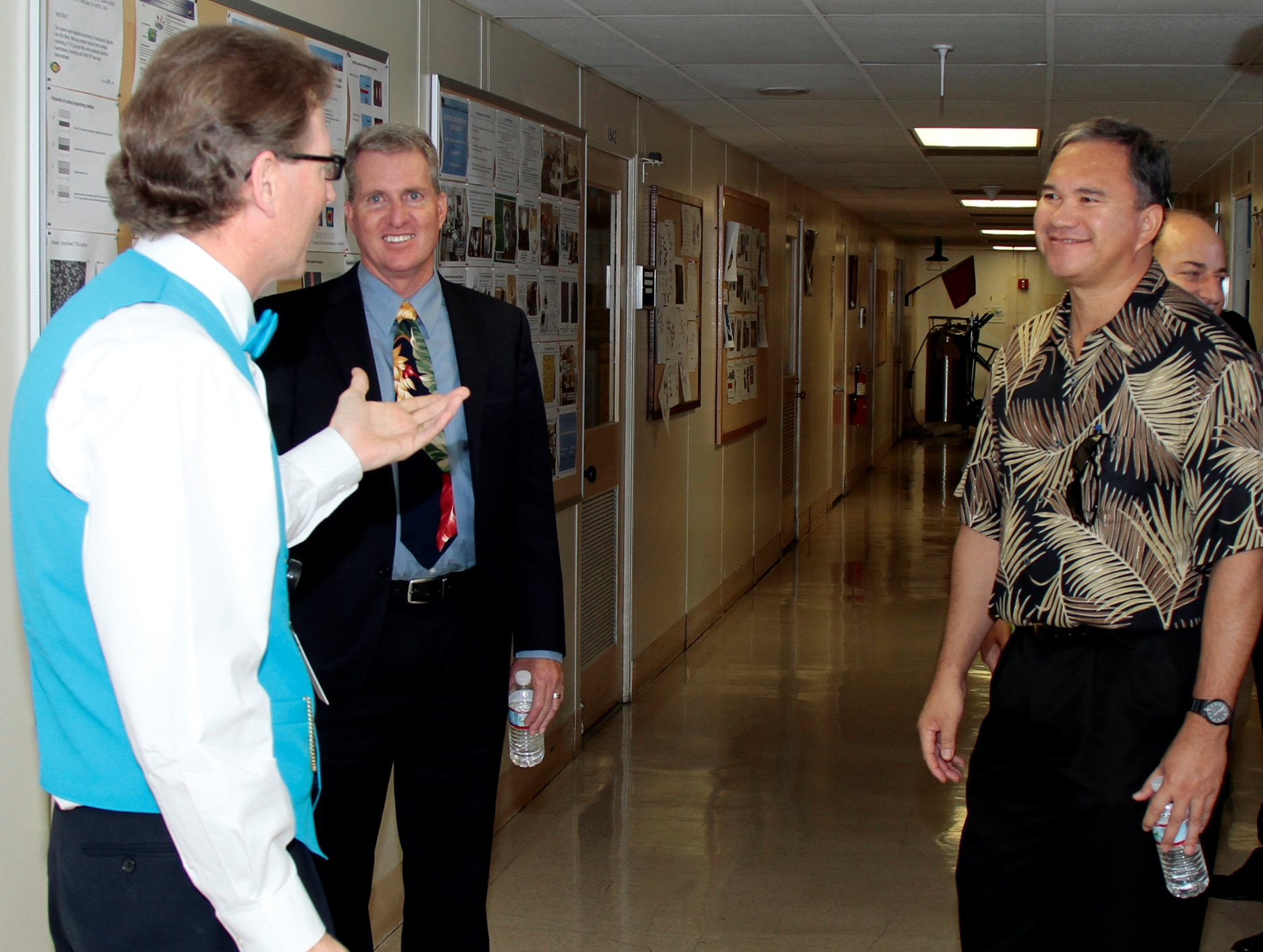
Left to right, NAWCWD scientist John Stenger-Smith from the Chemistry Division, Research and Intelligence department explains to guests Ross Roley and George Ka’iliwai the many platforms that require energy storage. (U.S. Navy photo)
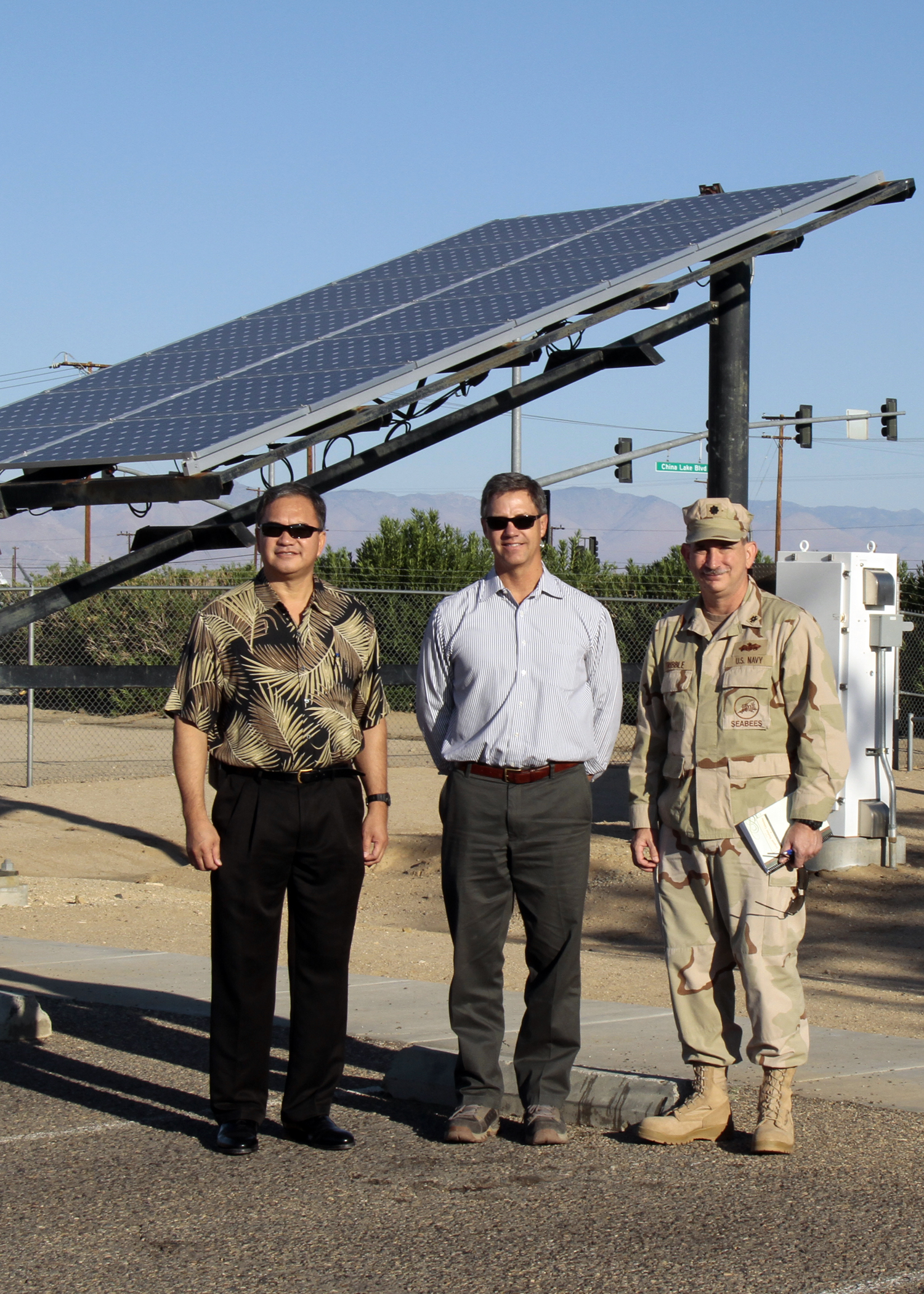
Left to right, Ka’iliwai stands with Andrew Sabin and Naval Facilities South West Public Works officer Cmdr. Rod Tribble in front of one of the many photovoltaic solar panels located aboard NAWS, China Lake. (U.S. Navy photo)