
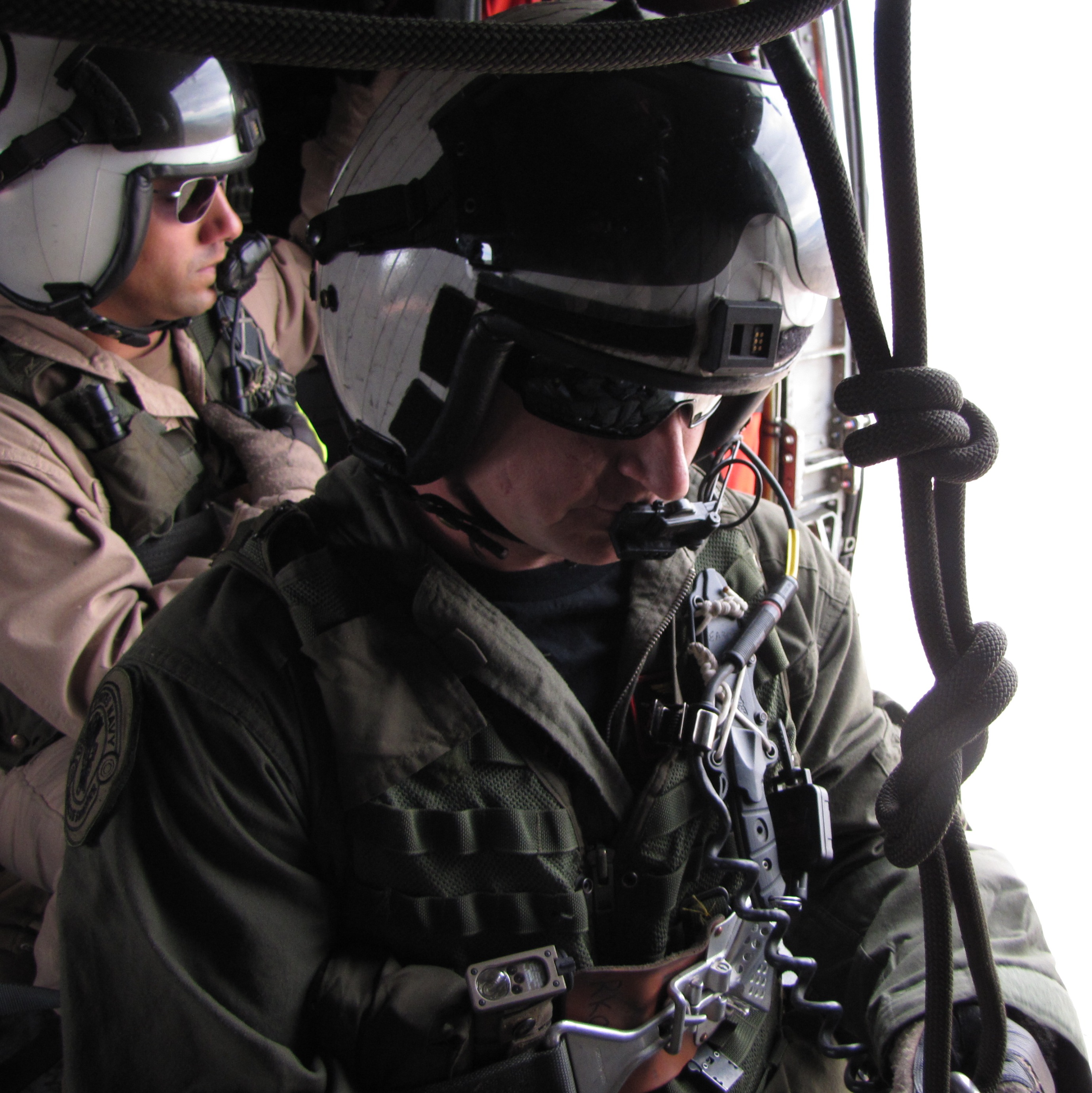
Search and Rescue (SAR) crewmen, AWS1 Anthony Michalski and AWS2 Erik Potter, from NAWCWD Air Test and Evaluation squadron (VX) 31, China Lake, Calif., responded to rescue mission at Cottonwood Pass in the eastern Sierra Nevada Mountains outside Olancha, Calif. (U.S. Navy photo)
VX-31 SAR rescues injured rider at Cottonwood Pass in the Sierra Nevada Mountains
CHINA LAKE, Calif. – Sept. 10, Veteran Search and Rescue (SAR) crewmen from NAWCWD Air Test and Evaluation Squadron (VX) 31 responded to rescue mission at Cottonwood Pass in the eastern Sierra Nevada Mountains outside Olancha, Calif.
On Friday, Sept. 9, Lt. Cmdr. Ken Gilbert, Lt. Neal Barham, AWS1 Anthony Michalski, AWS2 Erik Potter and HM2 Benjamin Hernandez, flew to Hume Lake, Calif., for an annual SAR conference that was hosted by the Fresno, Calif., Sheriff’s Office. On Saturday, more than 300 SAR professionals had arrived for the two-day conference to discuss training, capabilities, rescue techniques and coordination, as well as look over each others’ SAR equipment. At the end of the first day, about 6 p.m., they were surprised by an urgent request.
“We had just sat down to dinner, and somebody came in looking for the VX-31 SAR guys. We said ‘yep, we’re right here’ and he told us we had a SAR,” said Potter. A horseman had fallen in a remote location at Cottonwood Pass, near Horseshoe Meadow about 15 miles west of Olancha. He was severely injured and needed to get to a hospital.
Gilbert recalled, “Last year I hiked in the Golden Trout Wilderness to Cottonwood Pass with my family. I remember looking at the clearing and thinking it would be a great place to land if I ever had to come up here for a rescue. When they told me where the victim was, I knew exactly where they were talking about. I knew I could get in there.”
The rescue crew dashed to their MH-60S helicopter and within 20 minutes “Rescue 463” was in the air and climbing over the mountains toward the scene. As the altitude increased, the helicopter’s turbine engines produced less power and the rotor blades became less efficient. The pilots followed standard procedures for evaluating the landing zone, conducting a low pass and checking engine power. At over 11,000 feet and in thin mountain air, the landing zone was on the very edge of the MH-60’s maximum operating altitude.
“I used every ounce of power to get in there,” Gilbert recalled. “After a tense few moments, I finally established our helicopter in a five-foot hover. When the helo stabilized, I taxied closer to the survivor and landed.”
Hernandez reported, “After we landed, Potter and I grabbed our gear and ran toward the survivor. We quickly felt light-headed from the altitude and had to slow our pace.”
The rescue crewmen realized that human performance is also impacted by higher elevations. They discovered that traveling on foot was extremely taxing, especially when loaded down with emergency medical gear weighing upward of 60 pounds. After the rescue team reached the injured man, they assessed his injuries, placed a C-collar on him and lifted him onto a stretcher. Carrying the heavy stretcher to the aircraft was difficult, but the team worked together and got the job done.
Once the survivor was loaded, Rescue 463 lifted off. Due to radio problems enroute, the crew was unable to contact Ridgecrest Regional Hospital to request a landing at the helicopter pad. Instead, the SAR crew landed at China Lake, and the China Lake Fire Department arranged an ambulance for transport to the local hospital.
At 11,300 feet, this was the highest elevation rescue mission that VX-31’s Dust Devils had ever conducted. This was landmark for VX-31 because it was also the first mission in the newly acquired MH-60S helicopter.
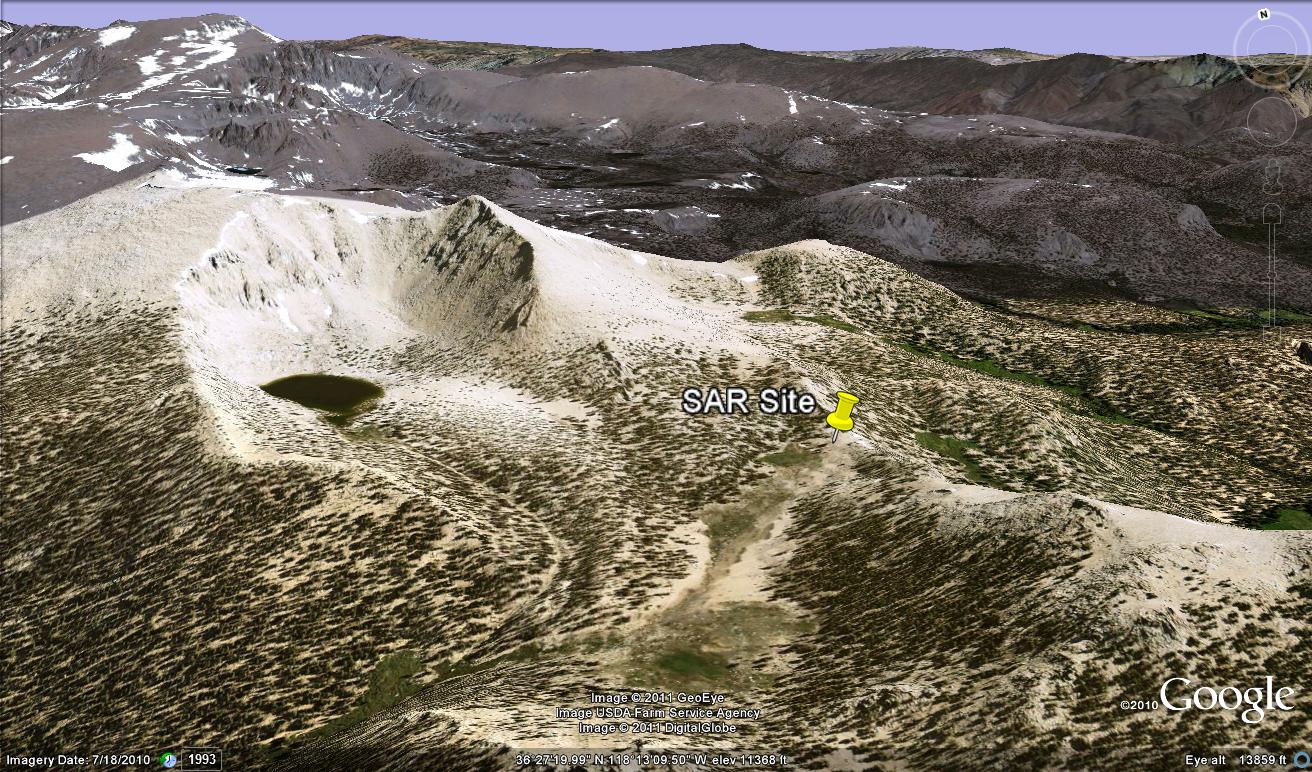
Site of the Sept. 10 rescue at Cottonwood Pass in the Golden Trout Wilderness of the Sierra Nevada Mountain range. Horseshoe Meadow lies approximately 1.5 miles east (right) of the pass, about 15 miles west of Olancha, Calif. (Image from Google Earth®)