
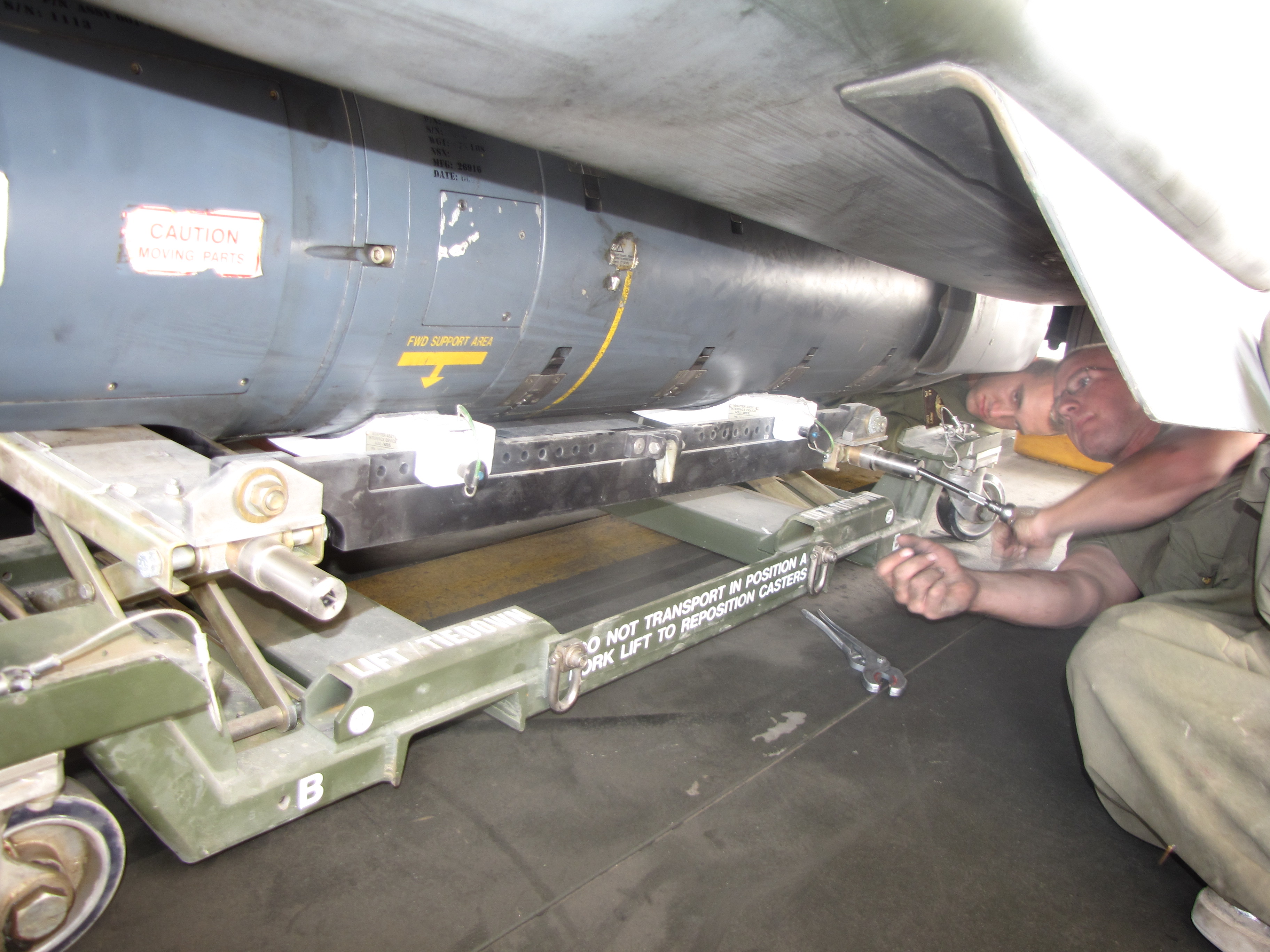
With the help of the loader, two Aircraft Maintenance Marines from VMA-513 load the Litening Pod on an AV-8B Harrier II. In a confined space, they have to achieve position, lift, adjust and attach the lugs on the BRU-36 rack as well as complete the electrical hook-up.
Lakehurst Engineers design Litening Pod Loader to support Marine Harriers
LAKEHURST, N.J. - For the past decade, the Marine Corps AV-8B Harrier II aircraft has been deployed in the Middle East in support of U.S. initiatives to combat global terrorism.
Many new operational capabilities have made this aging “work horse” a valuable asset to the coalition forces in the field. One major upgrade that has increased the capability of the AV-8B is the addition of the AN/AAQ-28(V) Litening Pod. This targeting pod, mounted in the center-line station of the aircraft fuselage, is a complex electronic precision targeting system that significantly increases the combat effectiveness of the aircraft during day, night and adverse weather conditions. It is used in the attack of ground and airborne targets with a variety of standoff weapons (i.e., laser guided bombs, conventional bombs and GPS-guided weapons).
To achieve sustained operational capability, all logistical and operational goals had to be met during the Initial Operating Capability (IOC) period of the pod. This was accomplished by “hanging” the Litening Pod on the wing pylons. In addition to achieving battlefield success, our USMC customers requested that this targeting system be moved to the aircraft centerline in an effort to enhance ground support operations.
The mounting system was easily modified to support this enhancement, however, loading the Litening Pod on the aircraft fuselage centerline between the 25MM Gun and Ammo pack, became a challenge. Due to the very low clearance on the bottom of the aircraft fuselage, this new mounting position prohibited use of the Common Support Equipment (CSE) Short Airfield for Tactical Support (SATS) Ordnance Loader, normally used for this task.
The NAVAIR Lakehurst (4.8.6 Division) Support Equipment Team tried to use other available equipment to accomplish this effort, but the CSE shipboard loader could not perform the task and the AV-8B Bomb Lift Trailer (BLT) could only load the Litening Pod onto the centerline store with the aircraft de-fueled and with the Nose Landing Gear (NLG) turned at 25 degrees to allow clearance of the BLT. Operational efficiency was greatly reduced and the solution was unacceptable.
The AV-8 Marine Corps community asked Jim Lowry, the Lead AV-8B PSE Engineer at NAVAIR Lakehurst, to solve the problem. After careful consideration, Jim devised a conceptual solution that was developed into a drawing package by Lakehurst design engineers, John Peterson and Steve Moss (Code 4.8.6.5).
“After taking into account all SE requirements for safe shore-based ordnance loading, we designed a new PSE Loader that can accommodate the large size of the Litening Pod and still be maneuverable within the confined space under the aircraft fuselage,” said Jim Lowry
The team used the Rapid Prototyping capabilities at NAVAIR Lakehurst to quickly produce and successfully test a shore-based prototype model. Critical testing and feedback was provided by Neil Davis, Test and Evaluation Engineer (Code 4.8.6.11) and the model was modified to production standards and approved for use in the theatre. Delivery is expected by December 2011.
After testing the prototype model, Marine Aircraft Maintenance Officer, Major Luke Jacobs commented about the timely efforts and exceptional teamwork of the Lakehurst engineers and artisans. “I just wanted to say thank you for getting this piece of gear out to us. It has had a direct impact on our ability to quickly reload aircraft post flight and conduct maintenance on our jets. Your efforts have made our jobs more efficient and VMA-513 a more effective combat squadron,” stated Jacobs.
With the success of the new design, a follow-on shipboard product is expected to be operational by 2013. Two prototypes are contracted for, and are being developed, to accelerate the required testing period needed for shipboard approval. This will definitely increase the capabilities and efficiency of all ship-board AV-8B Harriers.