
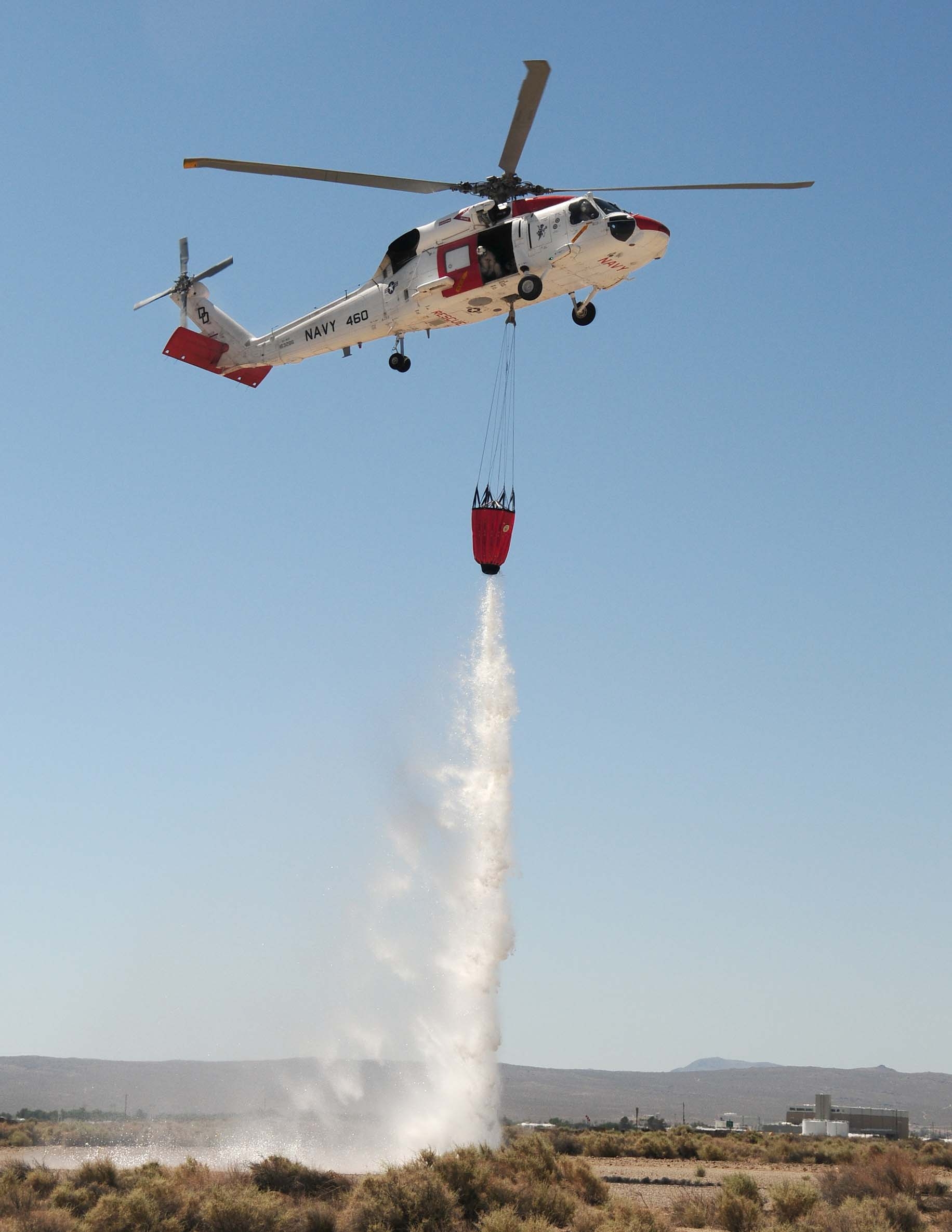
VX-31’s SAR team practices fire mitigation at China Lake with the SH-60F helicopter fire fighting bucket. (U.S. Navy photo)
VX-31 Dust Devils respond to firefighting call on China Lake’s north range
CHINA LAKE, Calif., –NAWCWD’s Air Test and Evaluation squadron (VX) 31 Dust Devils responded to a fire fighting support mission July 12 in the Superior Valley bombing range (part of China Lake's north ranges). This was the second fire that VX-31 helped suppress in the last 30 days. Lt. Cmdr. Ken Gilbert, Lt. Neal Barham, AWS1 Mark Podzon and AWR2 Hermilio Perez were the launch crew aboard COSO 460, a SH-60F helicopter.
A small four-acre fire was burning three miles north of the Superior Valley main complex. COSO 460 arrived and coordinated with the China Lake Fire Department to work the fire fighting bucket and get water to the remote site. In all, twelve buckets of water were dropped at the head of the fire. Because it was a very slow burning desert grass fire, the COSO 460 crew extinguished the fire after two hours of water bucket drops.
Gilbert stated, “We had great coordination between the on-scene China Lake fire team and our crew to get the buckets filled and on target. We expended a total of three flight hours supporting this fire.”
Cmdr. Ian Anderson, VX-31 executive officer said, “The water bucket our H-60 helicopters carry is relatively small, about 420 gallons; it's tailored for smaller fires and not designed for something like a large forest fire. Fortunately, we don’t have many forests in the impact areas at the China Lake ranges, and the bucket is well-suited to our needs. However, transit time to and from a water source, and the water lost in transit, must be considered because they can render the fire bucket useless. Since we must always maintain readiness to launch on a moment's notice for our primary mission of search and rescue, we choose our secondary missions carefully so we can immediately respond if a rescue call comes in."
According to Anderson, the fire-fighting bucket mission was taken on specifically for fires on the Navy ranges like this (in remote areas that trucks cannot reach), to help protect and preserve the local environment, historical artifacts, as well as limit damage to sensitive equipment on the ranges.
“I am very proud of the professionalism and skill demonstrated by our search and rescue team,” Anderson stated.
A similar fire occurred June 30, that was much larger in scope but was bounded by river beds and dirt range areas that limited its progression. VX-31 responded by dropping eighteen buckets of water that extinguished many of the hot spots and open fire areas before operations were suspended at sunset. That firefighting crew comprised Gilbert, Lt. Brian Culver, Podzon and HM2 Matthew Hawkins.
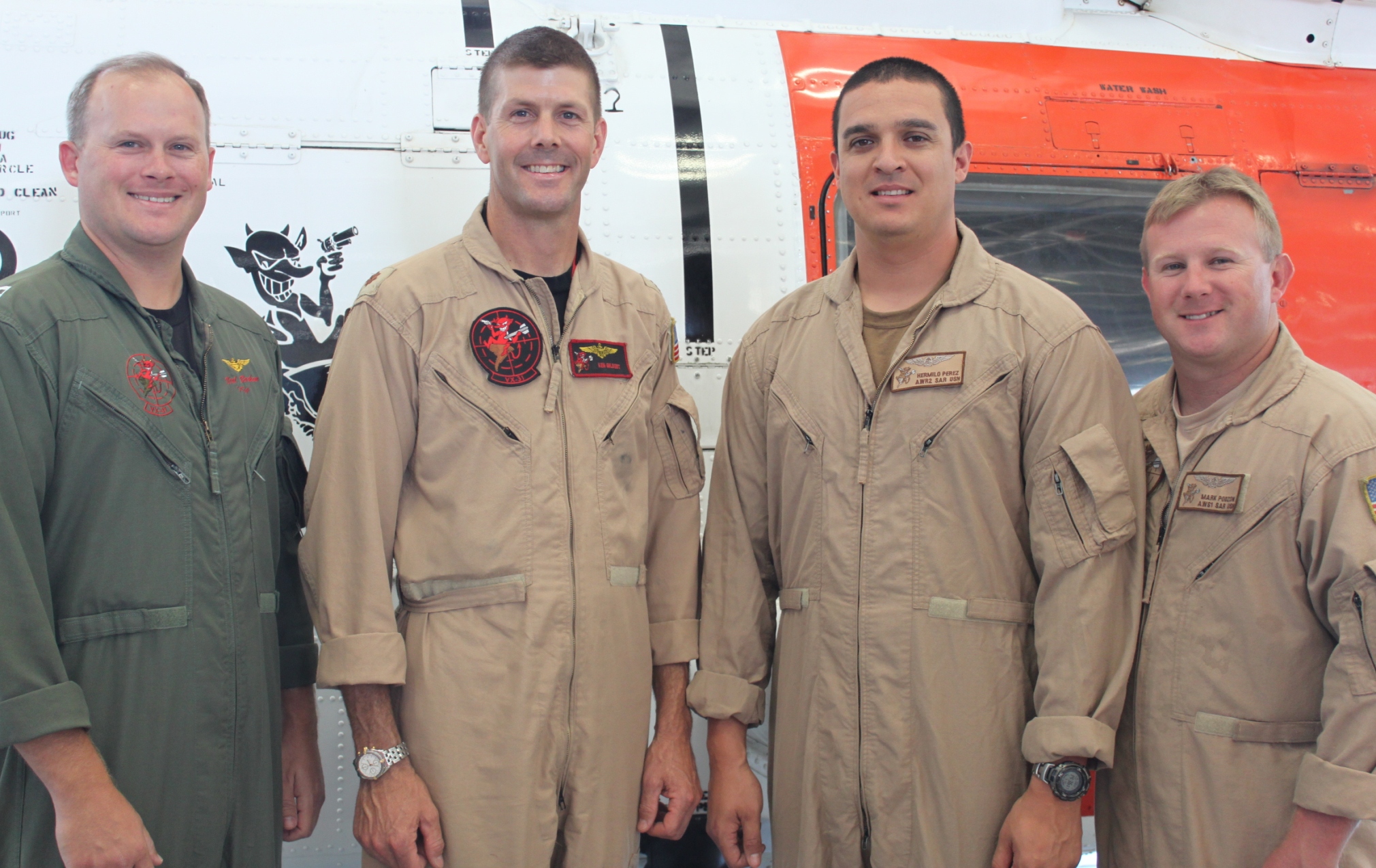
Left to right: Members of VX-31’s SAR team, Lt. Neal Barham, Lt. Cmdr. Ken Gilbert, AWR2 Hermilio Perez and AWS1 Mark Podzon, were the launch crew aboard COSO 460, an SH-60F helicopter, that responded to a fire fighting support mission July 12. This was the second recent firefighting mission that VX-31 responded to in the Superior Valley bombing range (part of China Lake's north ranges). (U.S. Navy photo)