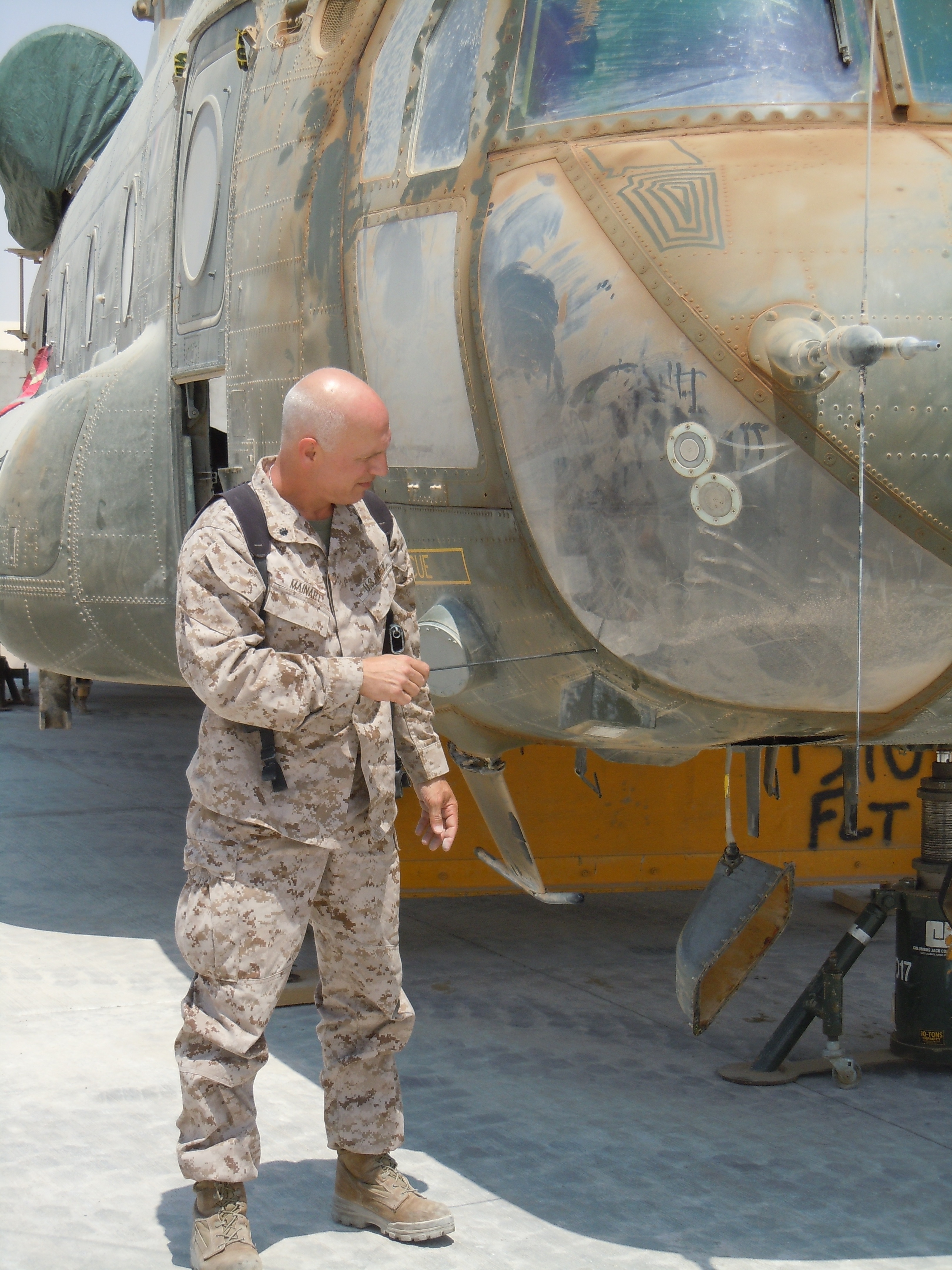
U.S. CENTRAL COMMAND -- Navy reserve Cmdr. Steve Mainart inspects damage on a CH-47 Chinook. Mainart is part of the Joint Combat Assessment Team which reviews and evaluates incidents to improve insight on enemy tactics and improve aircraft survivability. The team is comprised of active duty and reserve officers from all services and has performed more than 400 assessments in support of Operation Iraqi Freedom and Operation Enduring Freedom. (U.S. Navy photo)
Navy reservists in theater improve aircraft performance and survivability, and NAVAIR’s bottom line
NAVAL AIR SYSTEMS COMMAND, PATUXENT RIVER, Md. – The Joint Combat Assessment Team (JCAT), comprised of reserve and active duty officers from the Navy, Marines, Army and Air Force, has performed more than 400 critical aircraft assessments in support of Operation Iraqi Freedom and Operation Enduring Freedom.
Navy reserve officers working in support of JCAT’s mission - to examine aircraft battle damage incidents and determine the enemy’s weapon systems used in the attack and their tactics - have improved aviator performance and aircraft survivability while supplementing NAVAIR acquisition processes.
“The work of our reserve assessors in Iraq and Afghanistan has been critical to making our aviators more effective, our aircraft safer, and our processes better,” said Capt. John Slaughter, military director for systems engineering at NAVAIR. “Their work helps us complete more missions, achieve our objectives and bring more people home safely.”
NAVAIR is responsible for maintaining and improving aircraft survivability during the wars in Iraq and Afghanistan. However, at the start of these conflicts, NAVAIR did not have the capability to perform real-time battle damage assessments. Before JCAT was established, aircraft survivability analysis was based on Vietnam-era data developed by a team of dedicated assessors that was disbanded in the 1970s.
JCAT was created with assessors from the Navy and Marine Corps reserve and active duty Army and Air Force. NAVAIR’s Reserve Program provides more than 20 officers for JCAT from across the country.
“Having Navy reserve officers serving as assessors is a critical component to JCAT’s success,” said Slaughter. “These talented and dedicated officers bring a wealth of experience and perspective to their time in uniform that allows them to work better with air crews, functional commands and perform well over the wire.”
Using simple tools – such as a 4-inch, red laminated square card with black rectangular boxes on three edges and a rifle cleaning rod – JCAT assessors look for the facts about each incident. JCAT assessments have three typical components:
1) Assessors interview pilots and air crew to understand the engagement details of incidents.
2) Assessors perform a forensic study of the aircraft, its damage and any fragments.
3) Assessors identify the threat weapon(s) employed in the engagement.
JCAT assessors are trained on chemical residue collection as well as warhead fragmentation analysis and weapon part collection, and aircraft survivability equipment, and routinely work with intelligence officers and U.S.-based analysts to determine answers to new challenges or threats.
“JCAT’s assessors are like crime scene investigators popularized on television programs like CSI and NCIS,” said Navy Capt. William Little, JCAT’s in-theater officer-in-charge. “We focus on finding the facts, and through the laws of physics and the physical properties of materials, we reconstruct the processes which propagated the damage; compose a report documenting the damage; and based on available physical evidence positively identify the enemy weapon that caused it.”
JCAT’s work has enabled the aviation commander to determine the best counter-tactics and ensure the appropriate mitigation measures are employed to defeat the threat. Their findings are provided directly to the warfighters as well as the acquisition and test community, and the Joint Aircraft Survivability Program Office to share lessons learned, archive survivability data and reduce future aircraft vulnerabilities.
“The JCAT has provided a specific area of expertise for the G-2 that we otherwise would not be able to match,” said Lt. Col. George David, assistant chief of staff, 3d MAW (FWD) G-2. “JCAT determinations have led to discoveries such as the continued use of the .303 Lee Enfield rifle by insurgents for its range, and to developing pilot familiarization with threat weapons.”
“JCAT’s work saves lives, which is its most important function,” Slaughter said. “But by informing and improving our procurement processes today and in the future, it allows NAVAIR to make smart decisions that not only make the Navy a better fighting force, but saves taxpayers money at a time of economic crisis and fiscal deficits by ensuring lessons are learned in real-time and that changes are seen before they get too expensive.”