
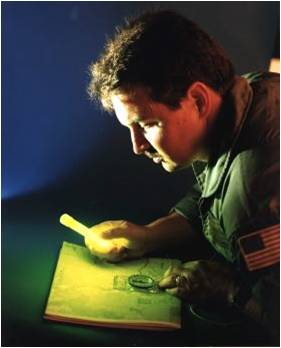
NAWCWD-Invented Chemiluminescent Lightstick. (U.S. Navy photo)
Invention Meets Innovation at NAWCWD
CHINA LAKE, Calif. –Innovation is not a new concept to the Naval Air Warfare Center Weapons Division (NAWCWD) at China Lake, Calif., but recent development of the NAWCWD strategic plan has reenergized the organization’s commitment to the subject. This renewed focus is surfacing in several components of NAWCWD business already. New procedures for patent protection and technology transfer activities are evidence of NAWCWD innovation in action.
NAWCWD has a rich history of invention and technology transfer to industry. One of the earliest examples occurred in the 1960s with the invention of a technique for explosive forming and welding of metals. The technology was later transferred out of DoD where it helped to revolutionize the metal-forming industry.
The most well-known technology to transfer from NAWCWD started with the invention of a device intended to provide emergency lighting for life rafts. The chemiluminescent light stick was patented in 1986 and now has far reaching commercial applications including safety illumination for children. Other NAWCWD technology spin-outs include stop-action video, logarithmic amplifiers, and weather modification.
Although major successes such as the light stick and stop-action video are now widely used in commercial markets, the financial return to NAWCWD and its inventors was limited. This situation had NAWCWD executive director, Scott O’Neil concerned. At a consortium meeting recently held at Massachusetts Institute of Technology, O’Neil asked, “Are we realizing the full benefit of WDs intellectual capital or, are we leaving something on the table?” O’Neil continued, “Our commercially viable patents represent real revenue that can be reinvested to further the core mission. By leaving money on the table we miss opportunities to deliver more capability to our warfighters.” O’Neil has since focused on developing innovative technology transfer practices.
Through a teaming effort between Research and Engineering, the Technology Transfer Office, the Office of the General Counsel, and the China Lake High Tech Consortium, several initiatives are moving forward. Promoting and incentivizing use of the center’s patenting process has become a high priority and cash awards have been added or increased at each stage of the process. Inventors can now receive $250 for disclosing an invention of merit. If the disclosure leads to the filing of a patent application the inventor receives another $500. When the patent is issued, the inventor will receive a final $500. Though patenting for the protection of military technologies remains a top priority, these awards also apply to inventions with commercial application. In those cases inventors could receive royalties of up to $150,000 annually. The NAWCWD team has alerted employees to the value of protecting and utilizing all intellectual property.
While exploring innovative technology transfer practices the same NAWCWD team was led to New Jersey based non-profit corporation, InSitech. InSitech utilized its vast network of commercial partners and private equity to transfer technology to and from Army labs. Discussions with InSitech have grown into the formation of a subsidiary called, China Lake Technologies (CLT), and the signing of a Partnership Intermediary Agreement with NAWCWD.
CLT evaluated the NAWCWD patent portfolio looking for multi-use technologies with the potential to address problems beyond the scope originally intentioned. These technologies can be made available to other government agencies or to commercial industry through a licensing agreement. Over the past several months CLT reviewed over 500 patents, interviewed NAWCWD inventors, and marketed the findings to perspective licensees.
In the early stages of the partnership, CLT was headquartered with parent company, InSitech, at Picatinny Arsenal, N.J. The company has since established a local office in Ridgecrest and enlisted retired NAWCWD physicist Dr. Dave Burdick to head-up the west coast operation. With the full support of the Picatinny-based CLT team, Burdick intends to expand capability and work with the NAWCWD team to make CLT an integral part of ongoing and future tech transfer efforts. The partnership with CLT is expected to result in licensing deals as early as this fiscal year. What’s next for tech transfer at NAWCWD?
According to Andy Corzine, deputy director for Research and Engineering, “the IP innovation initiative is still young and we have kinks to work out. Ultimately our goal is to get to a point where every scientist and engineer at China Lake and Point Mugu is asking the question: what else can this technology do? Emphasizing multi-use technologies, we want to provide NAWCWD with the ability to leverage the vast markets and resources available outside of DoD and bring that value back to the warfighter.”
Corzine expects to see more NAWCWD innovations over the next several months, each with an underlying theme . . . providing our warfighters the decisive advantage.