
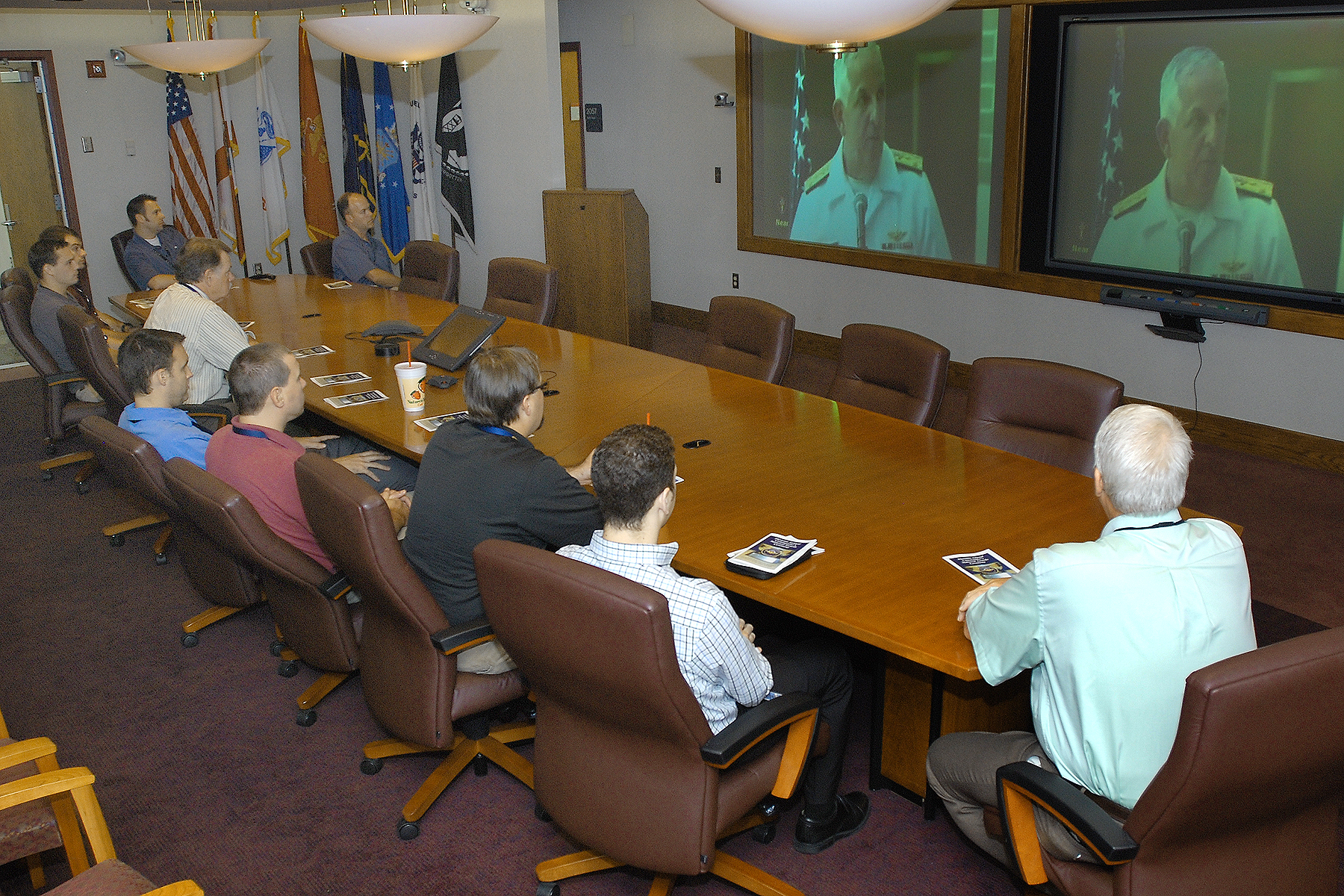
Members of NAWCTSD Orlando's P-3C Aircrew Tactical Team Trainer (PACT3) Integrated Product Team listen to Vice Adm. Architzel's remarks via a video teleconference feed as they prepare to receive the 2011 Commander's Award for Science & Technology.
NAWCTSD Orlando P-3C Aircrew Tactical Team Trainer (PACT3) Integrated Product Team earns NAVAIR Commander's Award in Science & Technology
ORLANDO, Fla. – The Naval Air Warfare Center Training Systems Division (NAWCTSD) Orlando P-3C Aircrew Tactical Team Trainer (PACT3) Integrated Product Team was presented with the 2011 Naval Air Systems (NAVAIR) Commander's Award in the Science and Technology Category, June 22.
Before the Commander's Awards were presented, NAVAIR Commander, Vice Adm. David Architzel explained the importance of recognizing employees. "It is a pleasure for me to be able to recognize members of the workforce across all of NAVAIR in support of the Navy and Marine Corps team," he said. "Whether you are formally recognized today or not, know you are appreciated, and in my mind doing a great job. Thank you one and all."
The Science & Technology Commander's Award was presented to PACT3 Project Manager, Jonathan Glass by Naval Air Warfare Center Aircraft Division Commander, Rear Adm. Randy Mahr on behalf of Architzel during a ceremony at NAVAIR Headquarters at NAS Patuxent River, Md.
Before presenting the award, Mahr explained the value of the training system, "the PACT3 team working with Navy and private industry partners built a low-cost, low-footprint, high-fidelity deployable training system which provides aircrew members with the means of practicing highly-perishable anti-submarine warfare skills from a deployed location," he said. "Last week I got an e-mail from the commodore who said (PACT3) is one of the most valuable things we have put out to the P-3 Fleet in the last few years."
In accepting the award, Glass thanked the team. "I'm so honored to accept this award on behalf of the team. I'm just the project lead," he said. "It was a big team effort. Your professionalism and dedication allowed us to build this device in two short years and get it to the fleet."
The PACT3 Integrated Product Team (IPT) is a multidisciplinary team composed of personnel from the NAWCTSD and commercial contractors. Its primary mission was the development of a system that provided integrated Anti-Submarine Warfare (ASW) training for deployed P-3 aircrews.
In response to this training need, the NAWCTSD IPT, in cooperation with the Chief of Naval Research, the Program Executive Officer Air ASW, Assault and Special Mission Programs PEO(A), PMA-290, PMA-205, Patrol Squadron Thirty (VP-30), NAWCTSD In-Service Engineering Office (ISEO) NAS Jacksonville, and private industry partners, developed the P-3C Aircrew Tactical Team Trainer (PACT3).
The PACT3 team maximized return on investments in Science and Technology (S&T) by successful innovations in four principal areas: (1) non-acoustics stimulation, signal, and display processing; (2) acoustics processing; (3) training system capacities, and (4) system interoperability. Leveraging NAWCTSD’s Mission Rehearsal Tactical Team Trainer (MRT3) and Effective Active Acoustic Simulation (EFAAS)-based technology baseline, the PACT3 provides innovative software implementations of active and passive sensing to include: Multi-static processing, Bottom Reverberation, Biologic Clutter, and Surface Scattering models as well as the RADAR, Magnetic Anomaly Detector (MAD), and Electronic Support Measures (ESM) non-acoustic sensors for the P-3C ASW tactical nucleus (Pilot, Tactical Coordinator, Sensor 1, Sensor 2, and Sensor 3).
The Navy’s P-3 Orion, originally commissioned as an anti-submarine warfare (ASW) patrol aircraft, joined the Fleet in 1969. Over 40 years later, thanks to extensive modifications -- including the latest electronics, communications, and weapons systems -- today’s P-3C still plays a critical role in national defense. In addition to their primary ASW role, P-3C squadrons now provide a wide variety of anti-surface and Command, Control, Communications, Computers, Intelligence, Surveillance, and Reconnaissance (C4ISR) capabilities for both Navy and joint force commanders.