
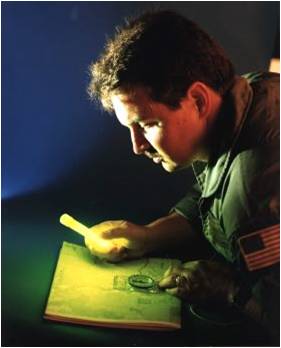
NAWCWD-Invented Chemiluminescent Lightstick. (U.S. Navy photo)
NAWCWD and MIT join forces to explore new technology opportunities
Massachusetts Institute of Technology (MIT) in Cambridge, Mass., was the location for a Multi-Use Technology Symposium May 2011, organized by the China Lake High Tech Consortium. Andy Corzine, Naval Air Warfare Center Weapons Division (NAWCWD)’s Innovation Team lead and deputy director for Research and Engineering, met with experts from NAWCWD and the Army’s Armament Research, Development and Engineering Center, MIT faculty, CEOs of emerging technology companies and equity investors to exchange ideas and explore technology opportunities.
The topic was innovative technology -- finding novel ways to use it, build revenue streams from it and license it for commercial use. NAWCWD’s focus was to fully leverage the unique expertise of its workforce with diverse groups of thinkers from around the country to help ensure that our warfighters have the decisive technological advantage.
Dynamic speakers shared their knowledge of technology development, technology transfer, and best-in-class processes for solving complex technical problems. Professors from MIT’s College of Engineering and the Sloan School of Management shared their insights with NAWCWD and other Consortium participants.
NAWCWD executive director, Scott O’Neil, opened the program with an overview of NAWCWD, its unique capabilities and exceptional people. NAWCWD Research and Engineering directorate deputy for Science and Technology, Mallory Boyd, presented NAWCWD’s strategic thrusts and provided several examples of ongoing technology development at China Lake, Calif. General counsel John McCollum, lead patent attorney Charlene Haley, and technology transfer director Mike Seltzer exchanged ideas with MIT’s technology transfer team.
Research chemist Dr. Mike Wright and Energy coordinator Mike Owens presented NAWCWD’s energy strategy, which included specific efforts related to bio-fuel production and ongoing partnerships with innovative companies such as Cobalt Technologies and PureVision Technology. Robin Nissan, head of NAWCWD Research and Intelligence, was interested in the presentations from CEO’s, venture capitalists, and MIT professors who lectured on advanced lasers, 360-degree imaging, pattern recognition, composite materials, and renewable energy.
The event concluded with a discussion led by a renowned Sloan professor of organization studies and sponsoring faculty, Dr. John Van Maanen. Van Maanen spoke of collaboration and the incredible power it has to enable innovation within and across organizations. He summarized the discussions and participants made plans to visit NAWCWD soon.
NAWCWD’s collaboration with the Consortium and MIT is one of many innovation initiatives being pursued this year. Roots in innovative thinking were established early in the NAWCWD’s rich history through Dr. William B. McLean’s creative approach to technology exploration and development. NAWCWD is actively building on that foundation today, and creating partnering opportunities with industry, academia and investors. The goal is to ensure that when the Navy, or our coalition forces, meets an enemy on the battlefield, it’s never a fair fight.