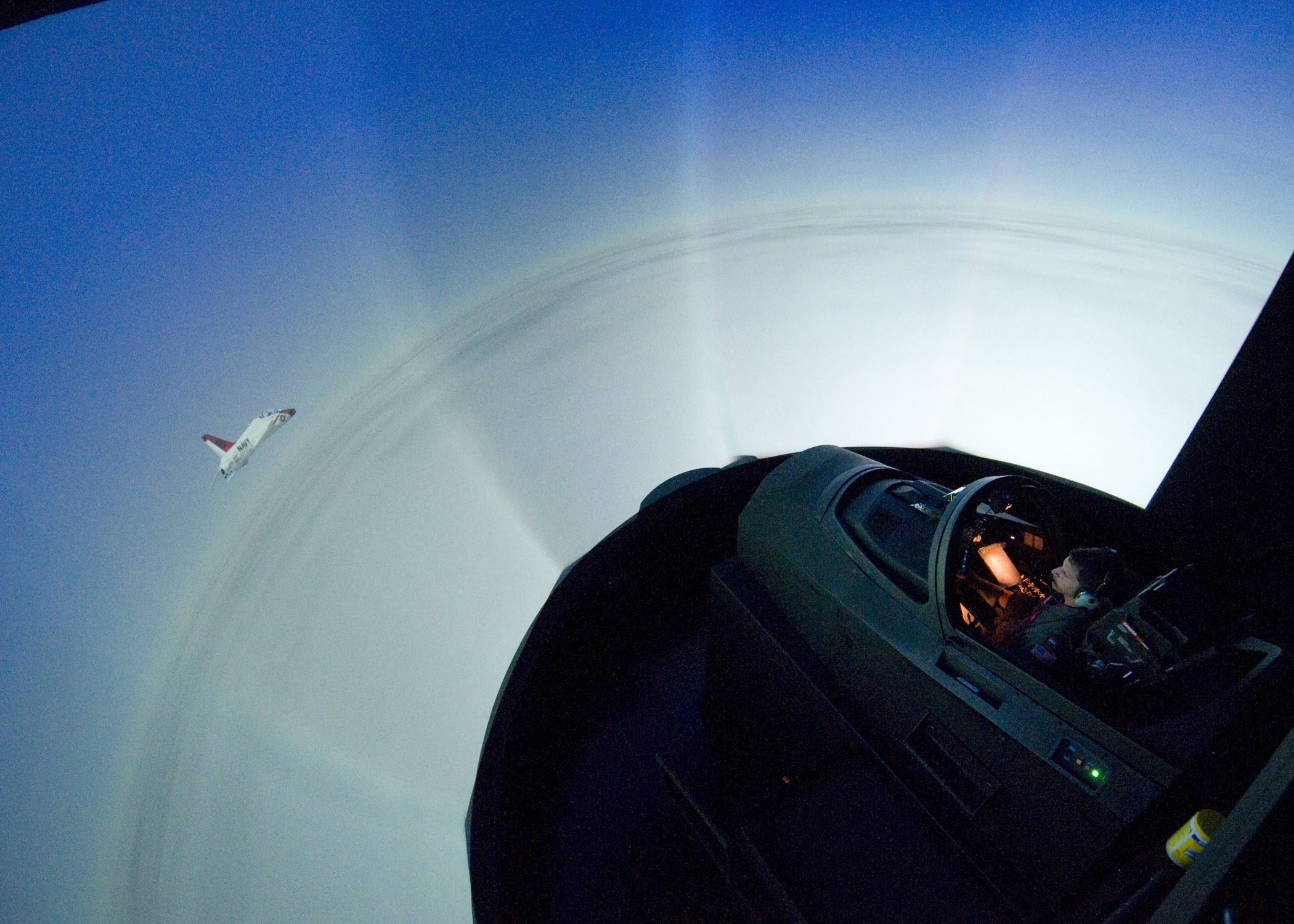
Naval aviation student Lt. j.g. Jon Michael Chombeau experiences the T-45C flight simulator, which provides 180-degree high fidelity video along with a host of state-of-the-art equipment. Here, Chombeau has the option of joining up with a simulated lead aircraft. Naval Aviation Training Systems program delivered a T-45C visual flight simulator to Naval Air Station Kingsville, Texas, March 1. (U.S. Navy photo)
Navy delivers T-45C trainer to NAS Kingsville
NAVAL AIR SYSTEMS COMMAND, PATUXENT RIVER, Md. — Naval Aviation Training Systems Program Office (PMA-205) in support of the Naval Undergraduate Flight Training Systems Program Office (PMA-273) delivered a T-45C high-fidelity, visual flight simulator to Naval Air Station (NAS) Kingsville, Texas, March 1.
"This simulator has the best high-fidelity graphics that I've seen in my career,” said Capt. Mark Brooks, commodore of Training Air Wing 2, NAS Kingsville, Texas.
The advanced jet trainer prepares pilots for the F-18C/D Hornet and F-18E/F Super Hornet, E-18G Growler, AV-8B Harrier, EA-6B Prowler, and F-35C Lightning II.
“We are excited to bring advanced jet trainers to trainees at NAS Kingsville,” said Capt. John Feeney, Naval Aviation Training Systems program manager, here. “We believe they will produce a more effective class of pilots. Our team worked hard to make this happen, and I’m proud that their efforts have paid off so abundantly.”
The delivery to NAS Kingsville is the third in a series of six; the next is scheduled for this fall.
“We’re at the halfway point [in delivering the trainers], which is good news,” said Joe Cooper, PMA-205 T-45 ground-based training systems integrated product team lead.
It’s also good news for the pilot trainees, other flight personnel and the leadership at NAS Kingsville, Cooper said. Before PMA-205 delivered the three T-45Cs, Kingsville had only two such simulators—not enough to handle all the required training. Until now, trainee pilots attended ground school to learn about the T-45A first and then returned to ground school to learn about the T-45C.
“Having enough T-45C simulators means the T-45 program can complete the process of converting the entire T-45 training system to the ‘C’ configuration,” Cooper said. Achieving this single configuration is a cornerstone of a long-term, cost-effective sustainment strategy, he said.
The trainees can fly 75 various scenarios using a visual database displaying airfields on the East Coast, West Coast or in Texas. They can fly a variety of navigation routes and can land on an aircraft carrier, which includes simulated flight directors.
Trainees can also use the simulator to prepare for carrier-qualification for daytime landings as well as follow a simulated lead aircraft to learn to fly in formation or perform section take-offs.
The two-seat T-45C trainers with front and rear cockpits not only have digital cockpits, but also head-up displays (HUDs), which means a student never has to look away from his flight path to see data readings; multifunction color displays similar to a computer display; global positioning system (GPS) navigation and a visual display system dome.
For the visual display system, the simulators use the new BARCO Sim 7 digital projectors, which provide a 180-degree field of view from five projectors—the first time digital projectors have been used in T-45 simulations, Cooper said.
“The T-45C is a state-of-the-art flight simulator designed to keep up with changes in the aircraft it trains pilots to fly,” said Capt. Hartigan, PMA-273 program manager. “The Navy will definitely benefit from the trainers in terms of efficiency, effectiveness and cost savings.”