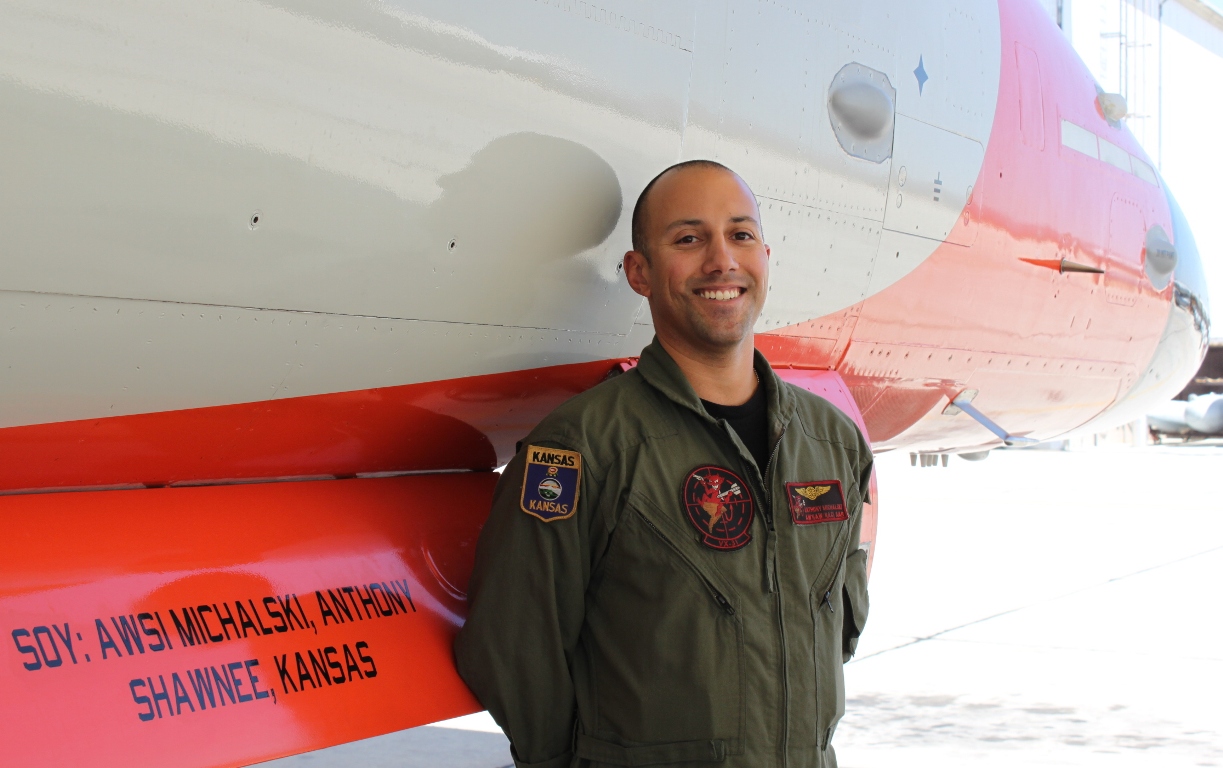
AWS1 Anthony Michalski stands next to COSO 101, the F/A-18C Hornet that bears the Centennial of Naval Aviation retro-theme paint scheme. He was chosen as VX-31’s Sailor of the Year (SOY) an honor that is proudly displayed on the nose landing gear access door of the jet. (U.S. Navy photo)
VX-31 Sailor of the Year AWS1 Anthony Michalski hails from Shawnee, Kan.
CHINA LAKE, Calif. — Air Test and Evaluation squadron (VX) 31 has a Search and Rescue (SAR) team that operates like a well-oiled machine. In fact, over the past 18 months, the squadron logged over 6,000 flight hours without a single Class A or B mishap. Part of this success comes from the workforce that includes AWS1 (AW/SW) Anthony J. Michalski.
In 2009, Michalski “checked in” to VX-31. As SAR LPO, he took charge of all aircrew qualifications, training and rescue equipment. He qualified as Utility Crewman, Helicopter Inland Rescue Air Crewman, and Rescue Crew chief. Continuing his college education between assignments, Michalski is working toward an Engineering Technology Associate’s Degree. He was chosen as VX-31's 2010 Sailor of the Year.
A quiet, confident leader and a proven performer in one of the Navy’s most demanding mission specialties, Michalski leads a team of 11 enlisted personnel. He mentored a junior, inexperienced crew and turned them into a highly efficient team, achieving maximum results. The squadron’s SAR mission availability increased under Michalski’s influence.
Since January 2010, VX-31’s SAR crew completed over 15 successful missions in some of the most challenging terrain in southern California and rescued 16 civilians. Michalski has personally flown over 400 mishap-free flight hours. His devotion to the SAR motto “That Others May Live” was recently highlighted by a successful rescue in the western part of Death Valley National Park. In January, Michalski took the lead as crew chief on a Death Valley National Park Service mission. Three adults traveling with a toddler failed to return the previous day from the Deadhorse Canyon area.
Michalski recalled, “When we found them, three adult men and a 17-month old baby, they were all severely dehydrated, hungry, and cold. They spent the night without water, food, or shelter. We noticed the water bottles they carried had twigs, dirt and debris in them from snow they had melted to drink.”
In addition to his SAR responsibilities, Michalski streamlined VX-31’s SH-60F Training and Personnel Qualifications Standards Instruction guidelines and he led VX-31’s all-hands Physical Training sessions.
Michalski stated, "What your body looks like has no bearing on what it is capable of, or how it performs. Endurance, perseverance, and agility are some of the most effective attributes that I strive for." His leadership paid off with over 70 sailors reaching a 100-percent pass rate on the spring 2011 physical readiness assessment cycle.
Mirroring his dedication to duty, Michalski devoted numerous off-duty hours supporting the community by helping frame a single family home through the Habitat for Humanity program and volunteering as a timekeeper for the Desert Sky League track finals.
"Leading others has been the most challenging, and the most rewarding, experience in my naval career,” Michalski said.
This unassuming sailor from Shawnee, Kan. quietly sets the standard while motivating and instilling confidence in his junior personnel. His positive results are a testament to his value to VX-31, the U.S. Navy and to the United States.
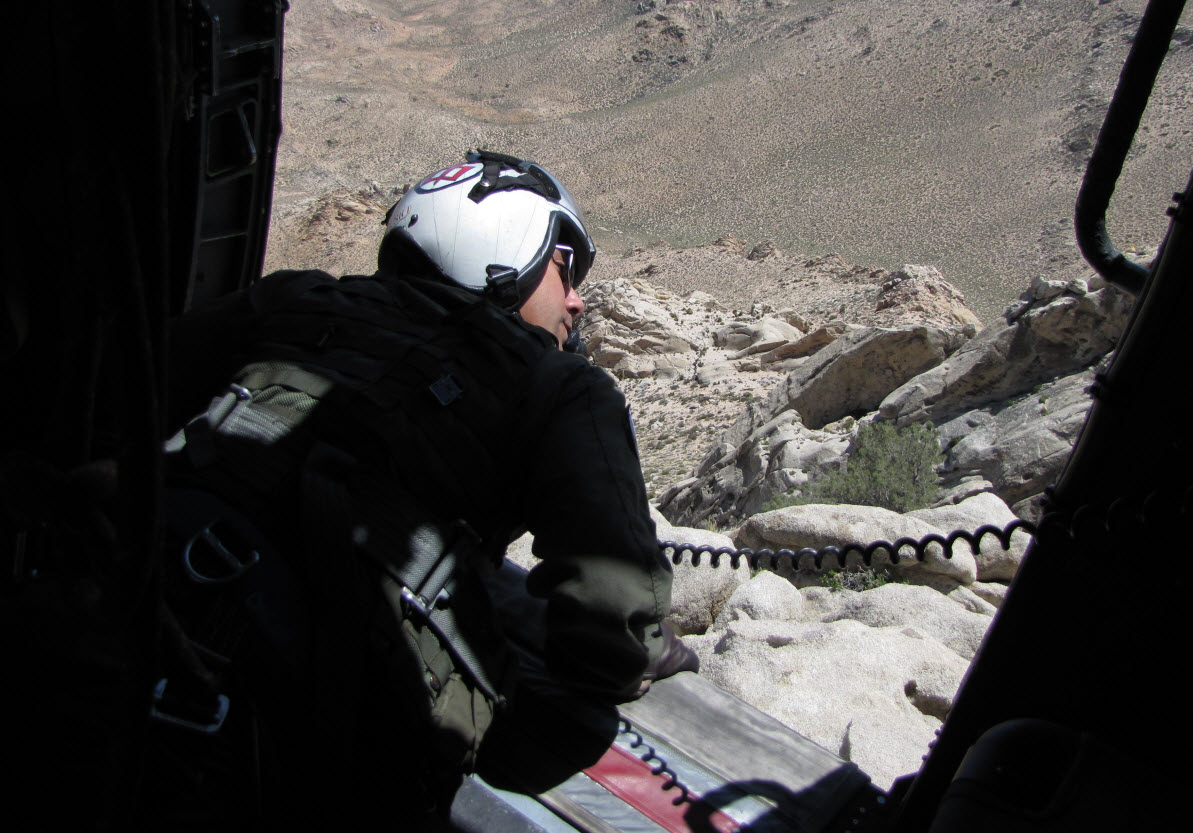
AWS1 Anthony Michalski peers outside and talks his pilots into a confined area landing at a high-altitude mountainous terrain training destination. SH-60F pilots cannot see beneath or behind the cockpit and rely completely on their air crewman to guide them around obstacles and position them for landing. (U.S. Navy photo)
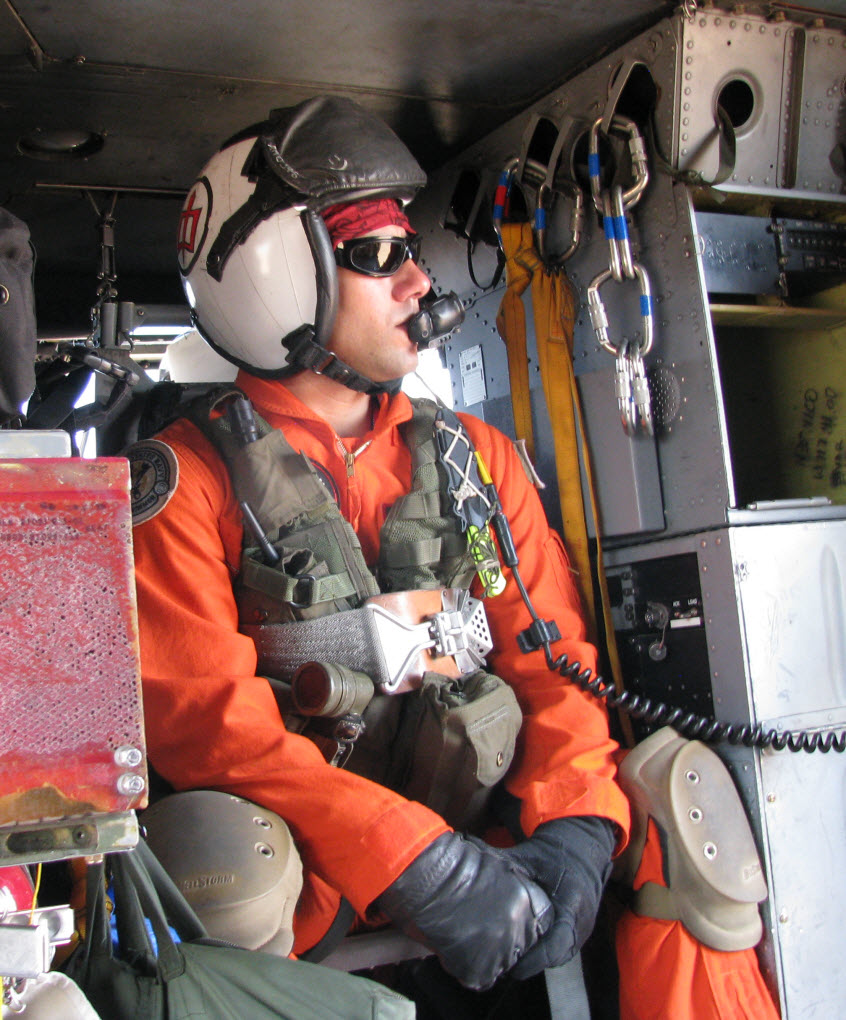
AWS1 Anthony Michalski scans the terrain from the open cabin door of Rescue 462, a VX-31 Dust Devils SH-60F helicopter, while searching for survivors. (U.S. Navy photo)