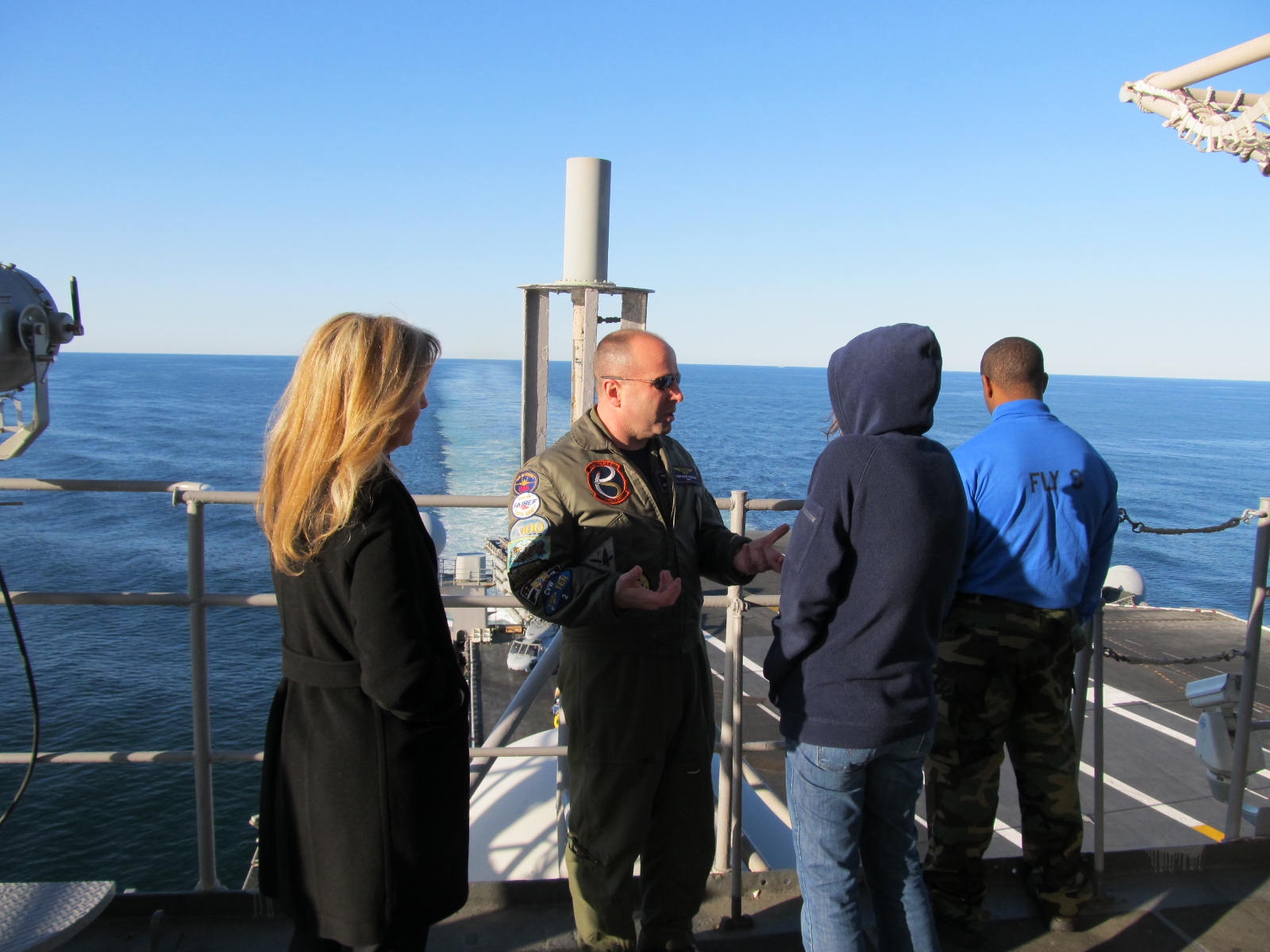
Joan Johnson, left, head of NAWCWD’s Systems Engineering Department, tours USS Enterprise while at sea for its final deployment. She said some of the most valuable time aboard was spent talking with the men and women who serve on the carrier. (U.S. Navy photo)
NAWCWD’s head of Systems Engineering connects with fleet on Big E’s last cruise
The head of Naval Air Warfare Center Weapons Division’s Systems Engineering Department and five other Naval Air Systems Command civilians recently spent two days aboard USS Enterprise (CVN 65) connecting with the fleet, and learning more about naval aviation, carrier operations and the role of the carrier supporting the warfare commanders.
“It was a phenomenal experience,” said Joan Johnson, who also serves as NAVAIR’s director of software. “It exceeded my expectations in the first eight hours.”
Cmdr. Dave Kindley, deputy program manager for NAVAIR’s F/A-18 Program Office (PMA-265), coordinated the trip in an effort to ensure NAVAIR stays focused on the warfighter.
“I wanted them to see with their own eyes what carrier operations are like,” said Kindley, who until recently had spent his entire career as a fleet operator. “As weapon systems become more complex, it is increasingly important that we have a dedicated, ongoing commitment to improve communications between NAVAIR and the fleet.”
Enterprise was pier side at Naval Station Norfolk, Va. waiting to get underway for its final deployment when Johnson and the group walked onto the ship. They catapulted off about 48 hours later. Wearing multiple leadership hats doesn’t give Johnson much time for hands-on engineering anymore but she plans to share what she learned from her carrier experience with as many people as possible.
“It was professionally and personally one of the most important and rewarding things I’ve done,” she said. “I hope there will be more opportunities like this in the future for other civilians. The perspective gained is immensely valuable.”
While Enterprise was more than 100 miles out at sea for carrier qualifications, Johnson observed as much activity above and below the deck as she could. She witnessed Super Hornets, Hawkeyes and Prowlers catapult and trap during both day and night operations.
One of Johnson’s priorities while on this historical voyage was to connect with the fleet, the users of many NAVAIR products.
One such product is RAIDER (Rapid Attack Information Dissemination Execution Relay), a system used on Enterprise that moves critical information between aircraft and the ship in real time to support multiple missions. NAWCWD developed RAIDER in 2007 as a rapid response to a critical warfighting gap and has been supporting that capability on carriers ever since. During work-ups, operators experienced a problem moving tactical information from the F/A-18 to the ship via RAIDER, an issue Johnson had been briefed on prior to arriving. She knew Weapons Division engineers had a solution.
“I wanted to make sure that we had the problem-solvers connected with the users before they deployed,” she said. That is precisely what happened. Within 24 hours of walking onto Enterprise, Johnson’s technical team was connected with their counterparts aboard the ship, and they were solving a mission-critical problem in real-time.
Johnson and the group also visited the Aircraft Carrier Intelligence Center, Pri-Fly, the engine shop and the Aircraft Intermediate Maintenance Department, the hangar bay, the flight deck, the Carrier Air Traffic Control Center, bomb buildup where she saw weapons including the Low Collateral Damage bomb, and the squadron Ready Rooms. She and the others stood on the deck with the shooter, between catapults, and witnessed EA-6B and E-2C launches and F/A-18E/F traps “up close and personal.”
“The entire experience was a great privilege,” Johnson said. “The opportunity to walk onto the carrier on the day it was leaving for its last deployment was really special.”
Enterprise, the world’s first nuclear-powered aircraft carrier, was commissioned in November 1961 and set out on its maiden voyage in January 1962. Big ‘E’ celebrated its 50th birthday in November 2011, making the carrier the oldest active duty ship in the U.S. naval fleet.
Some of Johnson’s most valuable time was spent talking with the men and women who serve on the carrier.
"To a number, the ship/airwing Sailors were passionate, competent and articulate in explaining the importance and complexities of their duties,” she said. “They were more than willing to give up some of their time to speak with us. Their pride in their work, their team, and their ship was evident across the board. I believe you can represent the person whom you are providing for – the Sailor and Marine – so much better if you understand the environment in which they work, and understand how they employ the systems that you give them.”
With about 5,000 people aboard Enterprise, there was plenty of opportunity for engagement.
“We talked to everybody from E-2s up to the commanding officer of Enterprise, Carrier Air Wing 1, and the Carrier Strike Group commander,” Johnson said. “The airwing/ship team welcomed NAVAIR engagement, and there were clear benefits to both sides.”
Rear Adm. Walter “Ted” Carter, Carrier Strike Group 12 commander, shared with Johnson and Kindley his perspective that the government civilians are part of the Navy team.
“We want to see more of our civilians out on our ships, connected with the operational forces, so they learn how we operate, how we use the capabilities and systems, and what we need to improve our capabilities,” Carter told them. “Then go back to the workplace and share those experiences with your teammates, keep them motivated and focused, and promote future opportunities to get more of the civilian workforce connected with the fleet.”
Johnson’s trip came full circle when the group boarded a C-2 and she experienced her first catapult. She said the group was thoroughly briefed and knew to expect that they would pull around two to three Gs instantly after takeoff. Sitting backward, strapped into a four-point harness, and instructed to brace her feet on the back of the seat in front of her and cross her arms, Johnson said she loved every second of it.
When she left Enterprise, Johnson said she was nearly overwhelmed with pride but felt lucky to be able to go home and share her experience and an even greater motivation to support the warfighter.
“We come to work because we believe the products and capabilities we provide equip our Sailors and Marines with what they need to win the day and come home safely,” she said. “I have always had a tremendous amount of respect for our armed forces but this experience has taken that feeling and put it on steroids.”
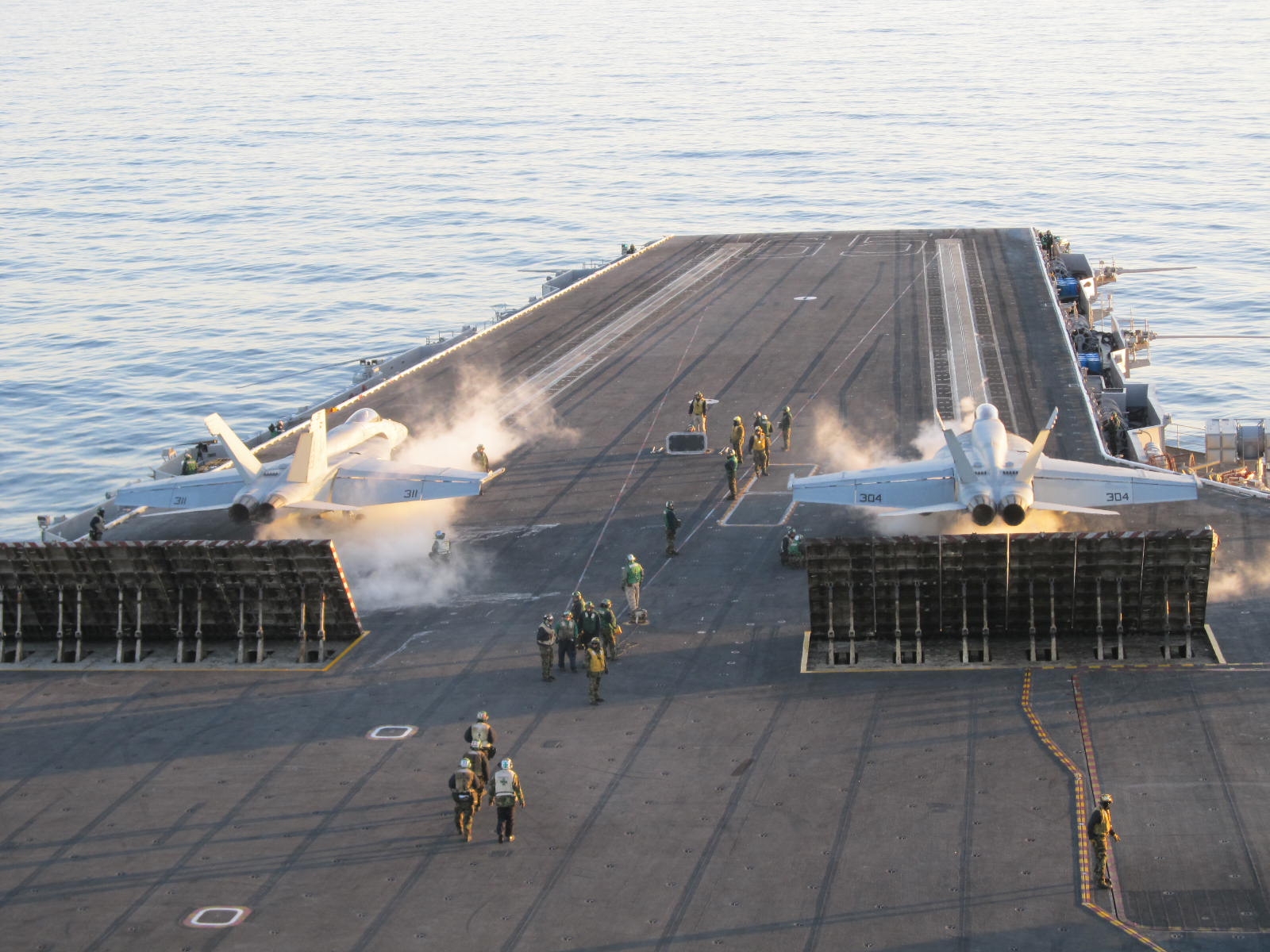
While aboard USS Enterprise recently, Joan Johnson, head of NAWCWD’s Systems Engineering Department, observes Super Hornets catapulting from the carrier deck. (U.S. Navy photo)
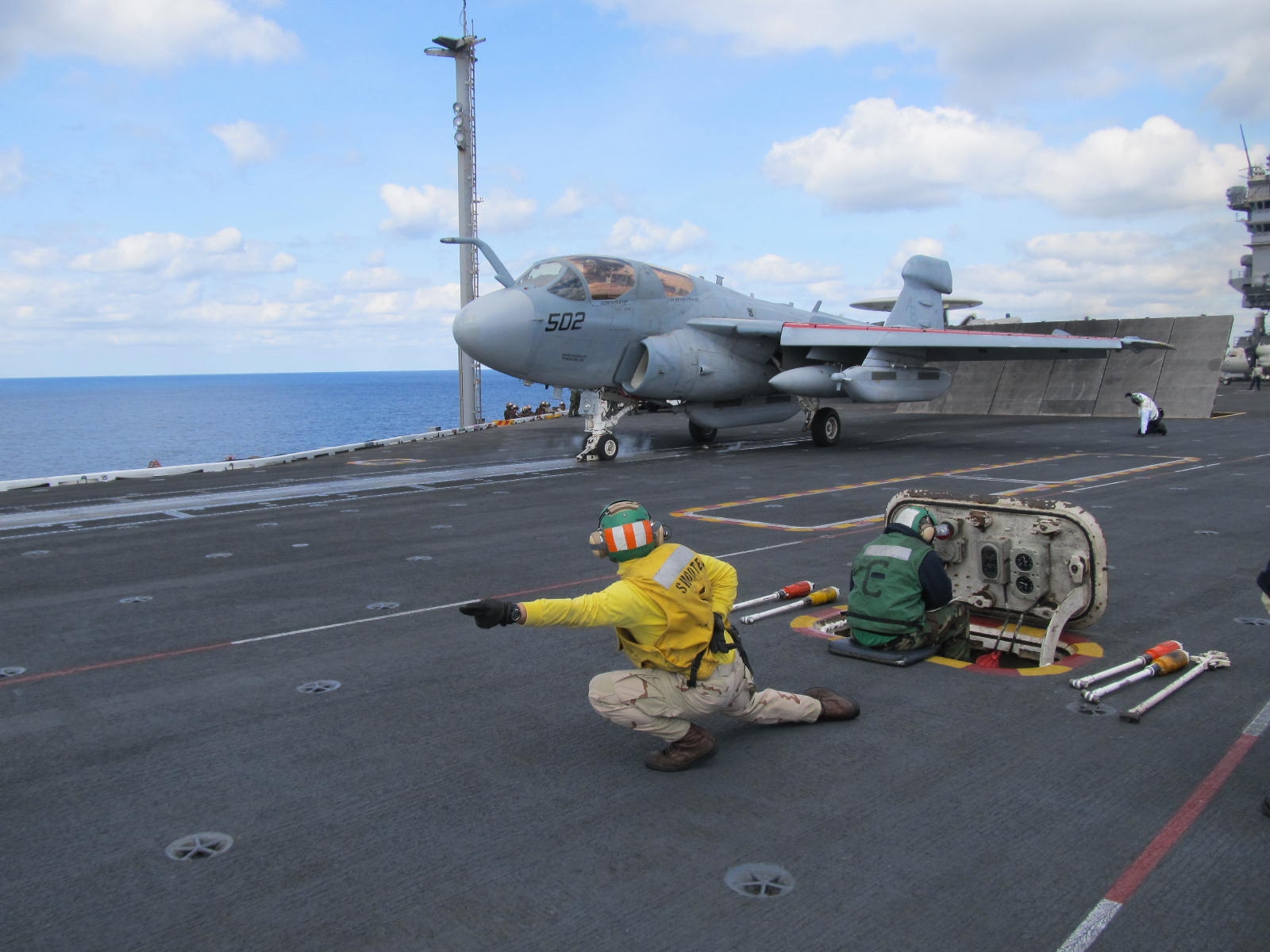
Joan Johnson, head of NAWCWD’s Systems Engineering Department, visits USS Enterprise while on its final deployment and gets an “up close and personal” view near the shooter as an EA-6B Prowler launches from the carrier deck. (U.S. Navy photo)