
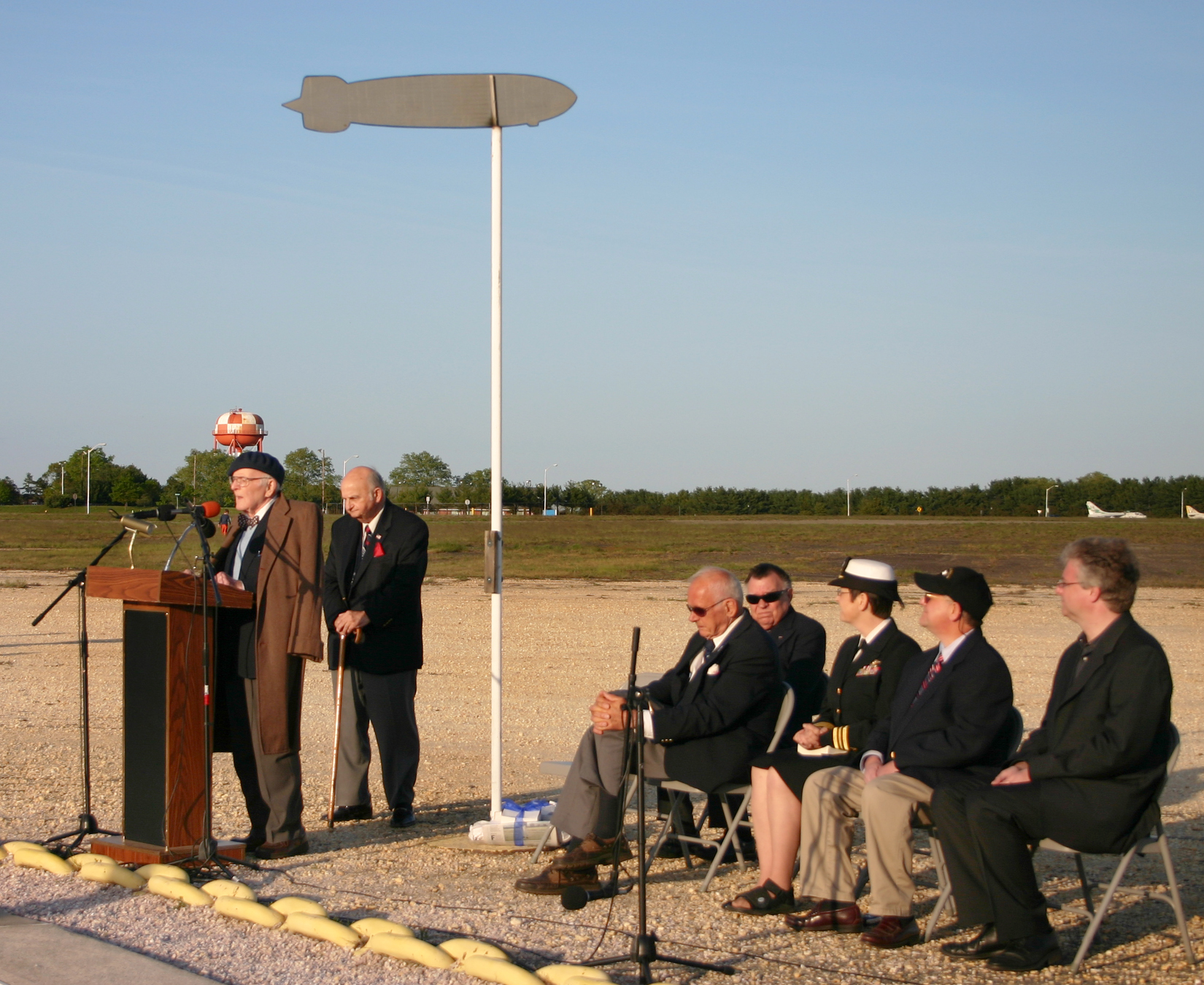
Robert Buchanan, surviving ground crew member of the 1937 Hindenburg crash at Naval Air Station, Lakehurst, N.J., addresses ceremony attendees at the site of the disaster during a memorial service May 6. In what was the first modern disaster to be captured live on motion-picture film and voice recording, the German airship LZ-129 Hindenburg burned in a horrific 34-second hydrogen gas fire, as it attempted to land at Lakehurst during the first of 18 scheduled voyages to the U.S. in 1937. (U.S. Navy photo by Larry Lyford)
Lakehurst marks 75th anniversary of Hindenburg crash
LAKEHURST, N.J. -- In an annual ceremony honoring the victims, survivors and heroes of the 1937 Hindenburg crash, the Navy Lakehurst Historical Society and Joint Base McGuire-Dix-Lakehurst marked the 75th anniversary of the event May 6 with a gathering of more than 500 guests at the site of the tragedy.
In what was the first modern disaster to be captured live on motion-picture film and voice recording, the German airship LZ-129 Hindenburg burned in a horrific 34-second hydrogen gas fire, as it attempted to land at Naval Station Lakehurst during the first of 18 scheduled voyages to the U.S. in 1937.
One of the few remaining survivors of the tragedy, 92-year-old, Robert Buchanan was 17 at the time of the crash. The line handler from Toms River, N.J., shared the heroic efforts of Navy Sailors and civilians who rescued 62 of the 97 passengers and crew. Along with the 35 victims aboard the Hindenburg, one civilian member of the ground crew was lost to the accident.
Dr. Horst Schirmer, son of one of the Hindenburg designers and Alexander Pruss, grandson of one of the surviving officers, Capt. Max Pruss also attended the ceremony.
More than 800 feet long and 135 feet wide, the German airship Hindenburg could cruise at a speed of 80 mph and cross the Atlantic in a little over two days. It had made 10 successful trips between Germany and Lakehurst in 1936, and was destined to become the preferred mode of transportation for rapid cross-continental flight. The Hindenburg could carry up to72 passengers, along with 40-60 crew members, in relaxed comfort only afforded to passengers of modern-day ocean liners.
Being the terminus for airship travel between the U.S. and Germany, NAS Lakehurst was deemed “America’s First International Airport.”
The spectacular film footage of the disaster and dramatic voice recording of news commentator Herb Morrison shattered public opinion and industry faith in airships and helped mark the end of the brief era of giant passenger airships.
The ground where the ceremony was held has been marked with a chain-outlined pad and bronze plaque where the airship's gondola landed.
Wreaths were presented by representatives from the Army, Navy, Marine Corps, Air Force, Coast Guard, Boy Scouts and Ocean County, N.J. to honor all those who lost their lives in military and civilian airship disasters throughout the years.
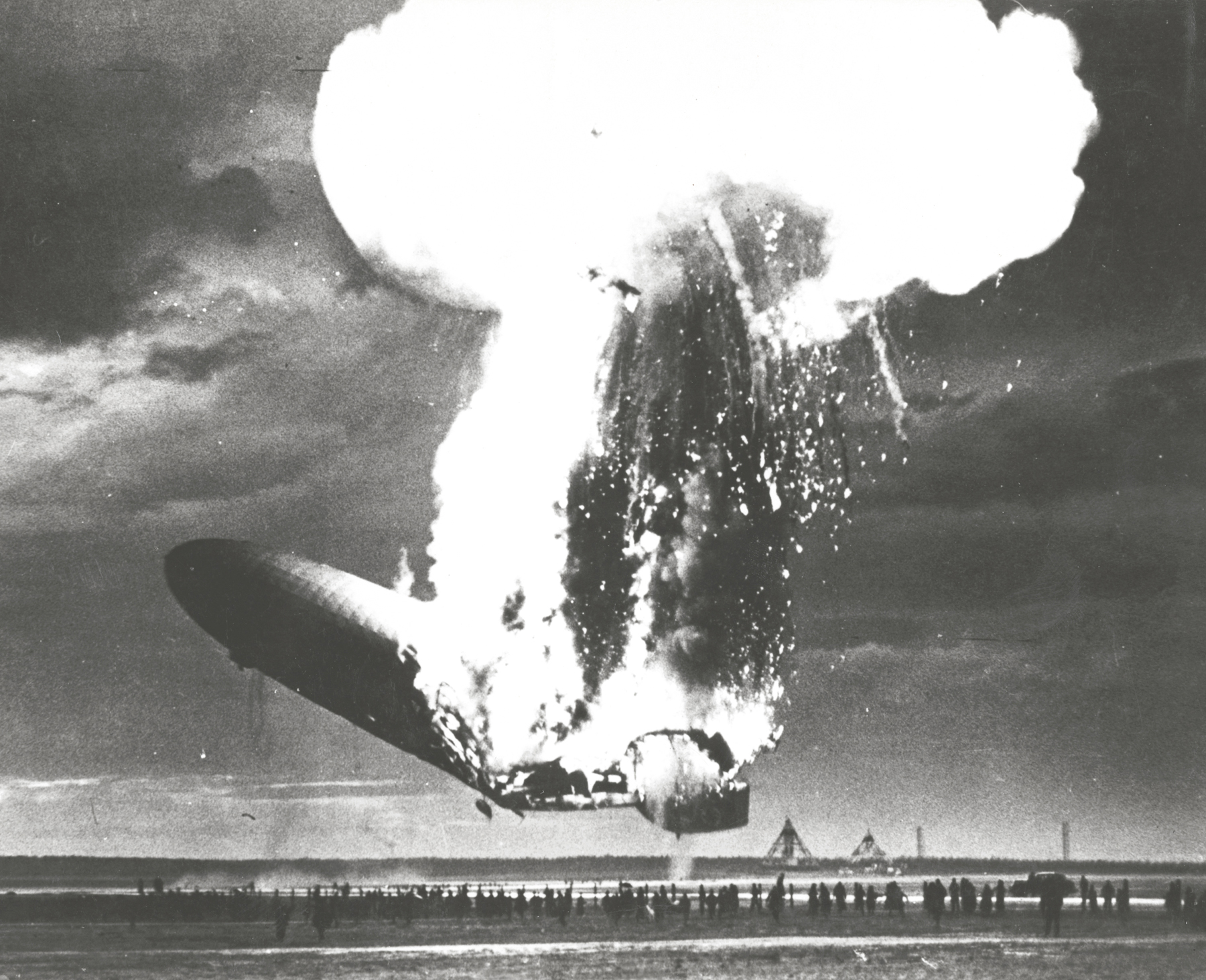
A photo captures the Hindenburg as it crashes in an airfield at NAS Lakehurst, N.J., at 7:25 p.m., May 6, 1937. (U.S. Navy file photo)

Military and civic representatives place wreaths May 6 at the site of the 1937 Hindenburg crash at JB MDL, Lakehurst, N.J., in honor of all lighter-than-air losses. (U.S. Navy photo by Larry Lyford)