
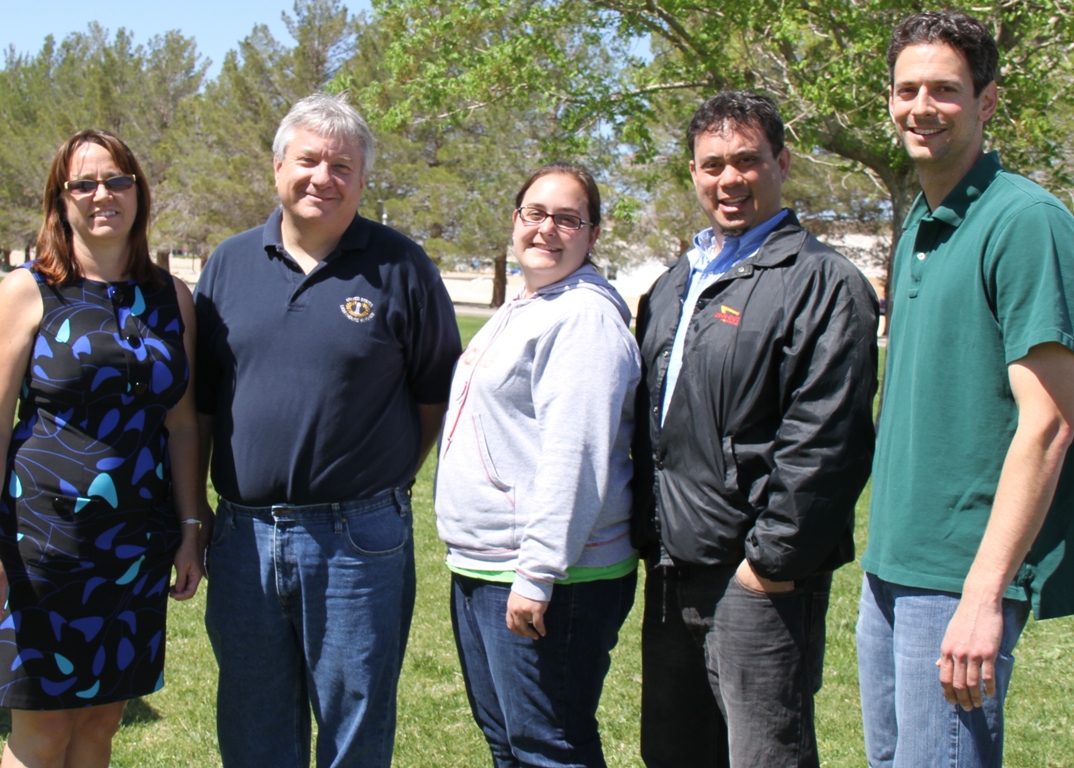
Members of the Naval Air Warfare Center Weapons Division Chemistry Division bio-fuel team educated their audience on the bio-fuels research and success at China Lake. Shown (L-R) are chemical engineer Cindy Weber, head of the Chemistry Division Steve Fallis, post-doctoral fellow Heather Meylemans, environment and energy coordinator Mike Owens, and research chemist Ben Harvey. (U.S. Navy photo)
First Annual Earth Day Fair held at China Lake
CHINA LAKE, Calif. - Employees from Naval Air Weapons Station (NAWS) and Naval Air Warfare Center Weapons Division (NAWCWD) gathered on the front lawn of the Administration Building for the first annual NAWS Earth Day Fair April 22. Guests tackled the climbing wall, played in a solar-powered fountain, met an endangered desert tortoise and practiced spear tossing at targets by using an ancient atlatl used by prehistoric Native Americans on China Lake ranges.
Members of the Station’s Utility Energy Management Group that managed the photovoltaic carport projects at Michelson Laboratory, the Range Control Center and the airfield brought their solar trailer display, and handed out information about China Lake’s photovoltaic history, future plans and other alternative energy initiatives.
Geothermal facility data management specialist Denise Bisaro explained the energy-producing process that has been in continuous service at the China Lake facility for over 15 years. This geothermal facility is the third largest in the United States and produces enough energy annually to power about 250 thousand homes. The Navy sells approximately 270 megawatts (MW) of energy per year to Southern California Energy (SCE) under a long-term power sales agreement. This arrangement helps to finance exploration and development of geothermal resources on government-controlled land.
Steve Alm from the Navy Geothermal Program Office explained the current exploration efforts that are actively being pursued on Department of Defense lands and brought granite core samples and rock samples from the ranges that included rhyolite, basalt, banded quartz, metamorphic schist, and volcanic “bombs.”
Employees of the NAWCWD Chemistry Division shared information about the work they are doing with cellulosic biobutanol that is currently being used as aviation fuel for the Navy’s “Green Hornet.” Research chemist Ben Harvey explained, “We take butanol all the way to jet fuel and more. We’re on the cutting edge of this technology, doing things that no one else does, worldwide.”
Archeologists explained some of the cultural resources located on NAWS, provided an interactive dig box that simulated an excavation, and demonstrated the atlatl (an Aztec word that is phonetically pronounced Atal-Atal -- slur the “T” to pronounce correctly). The atlatl is depicted on many petroglyphs in Little Petroglyph Canyon.
Several vendors including SCE, the Indian Wells Valley Water District, and the NAWS Environmental Department handed out helpful consumer items like low-flow shower heads, bags, booklets, stickers and posters. The Bureau of Land Management brought along an endangered desert tortoise and shared information on off-roading, desert wildflowers and many ways to enjoy the outdoors without harming the environment.
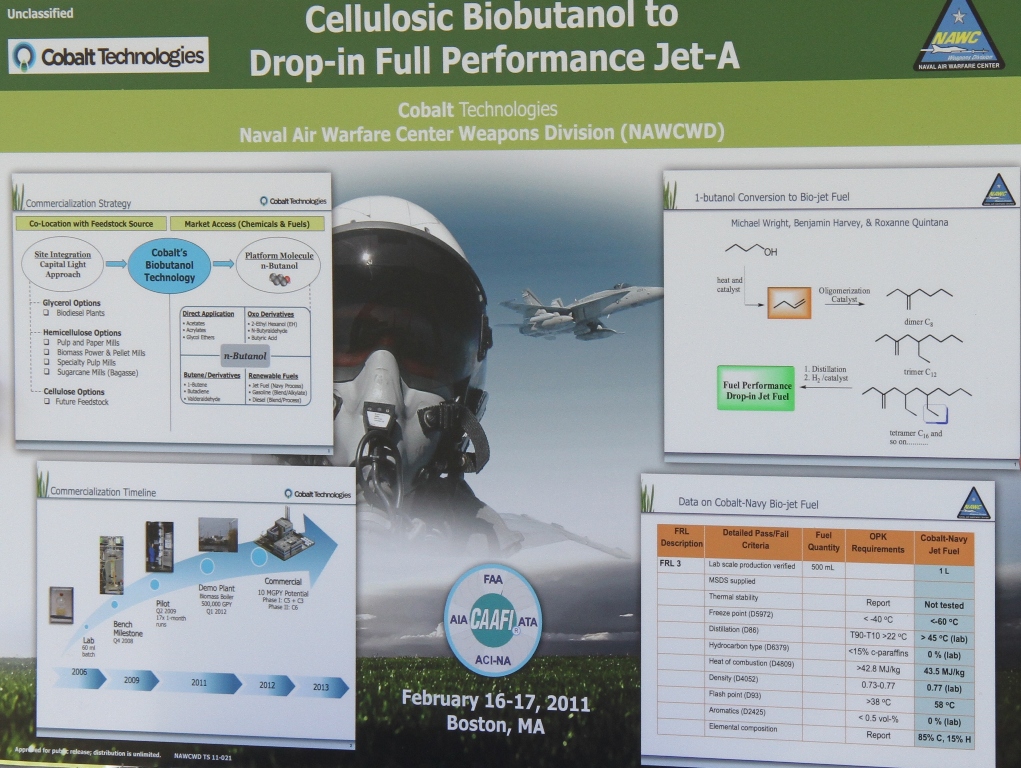
The Naval Air Weapons Station at China Lake hosted their first annual Earth Day Fair April 22. On display was this informational poster that describes cellulosic biobutanol that is used as jet fuel in the Navy’s “Green Hornet.” (U.S. Navy photo)
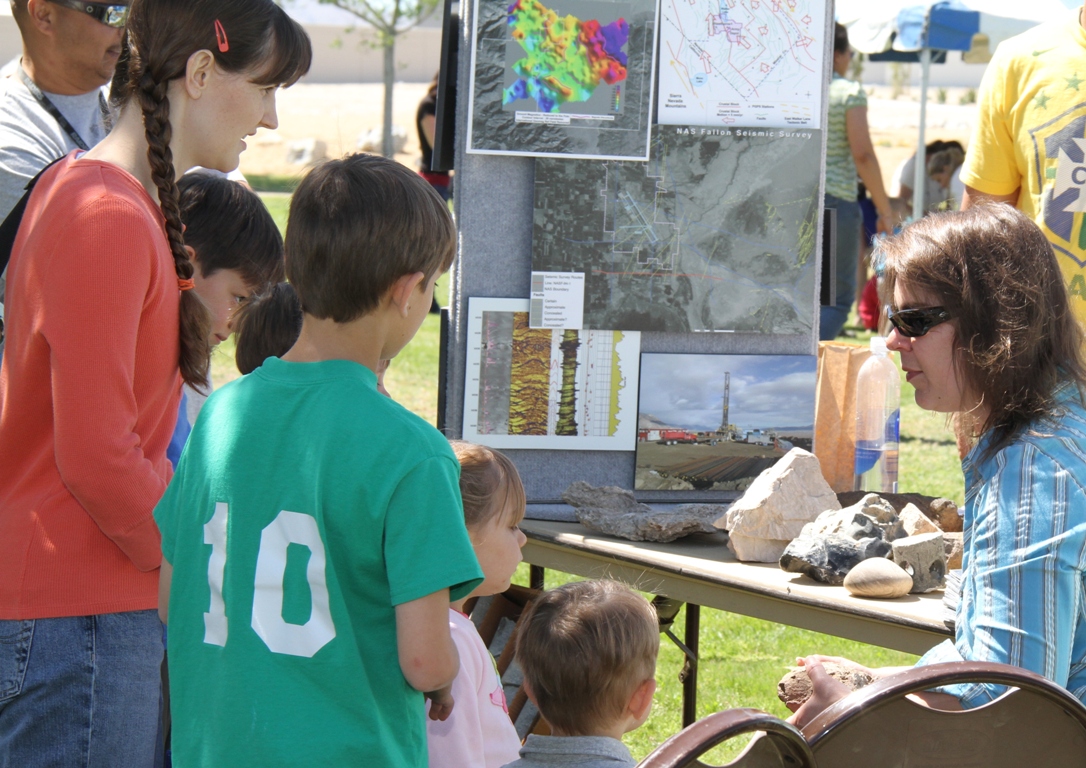
Denise Bisaro, data management specialist for the U.S. Navy Geothermal Program Office, explains exploration efforts associated with the geothermal facility at China Lake and shares rock samples from the China Lake ranges with an interested audience. (U.S. Navy photo)
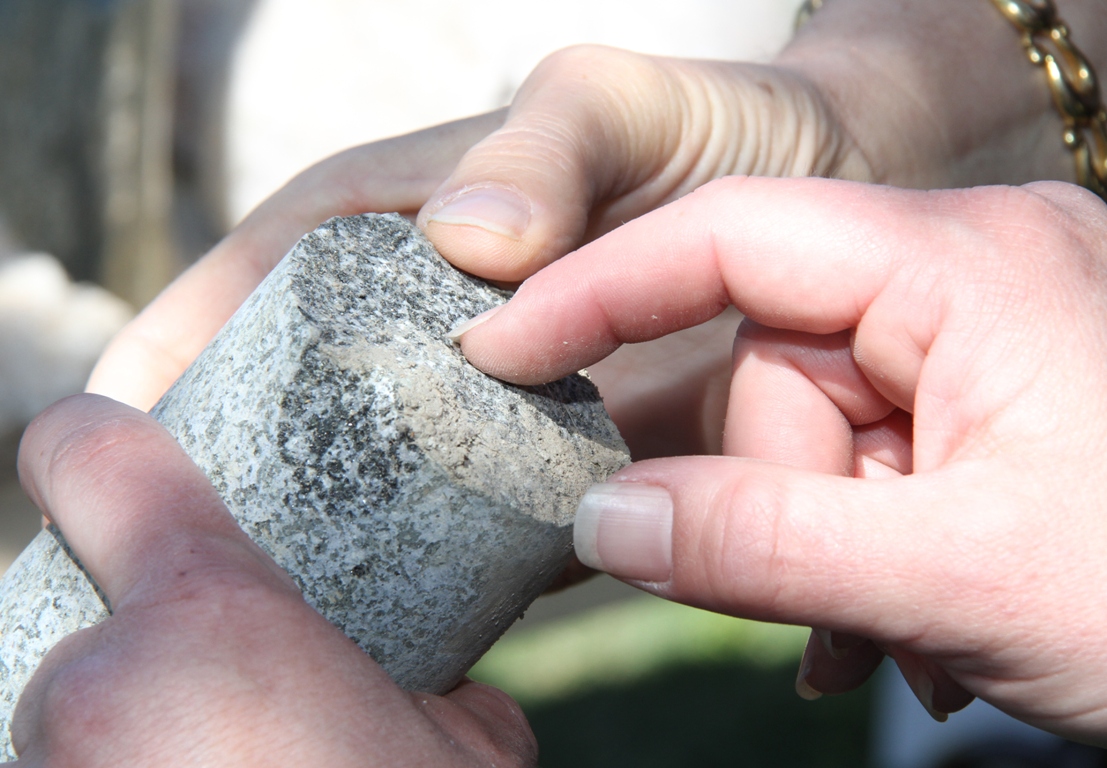
This granite core sample that contains flecks of mica, “fools gold” was drilled from the geothermal plant area at a depth of about 1,500 feet. It (U.S. Navy photo)
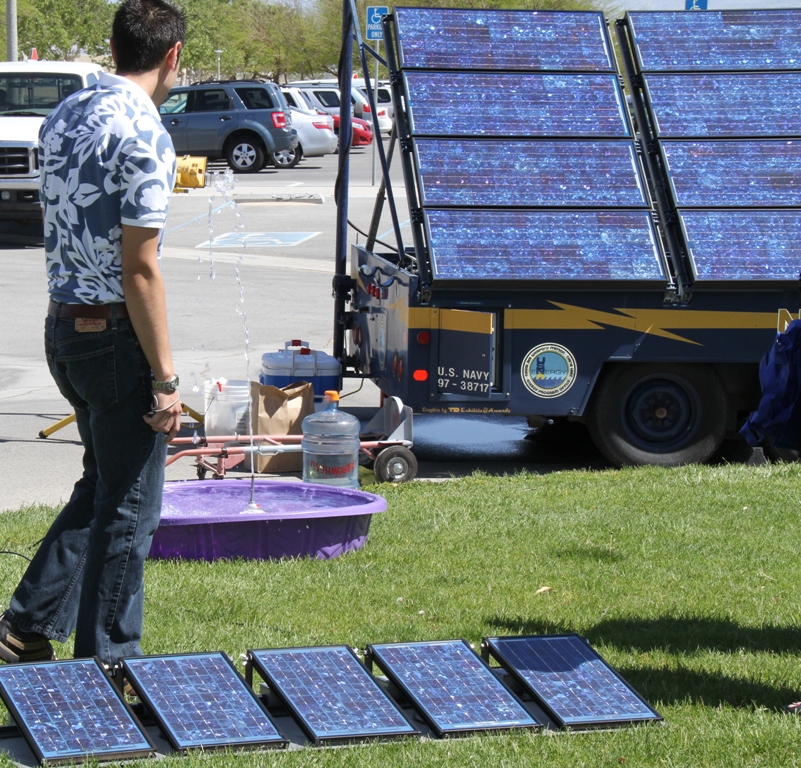
Members of the Naval Air Weapons Station Utility Energy Management Group shared information about China Lake’s photovoltaic history and other alternative energy initiatives. On display was their solar sample trailer and a solar-powered water pump. (U.S. Navy photo)
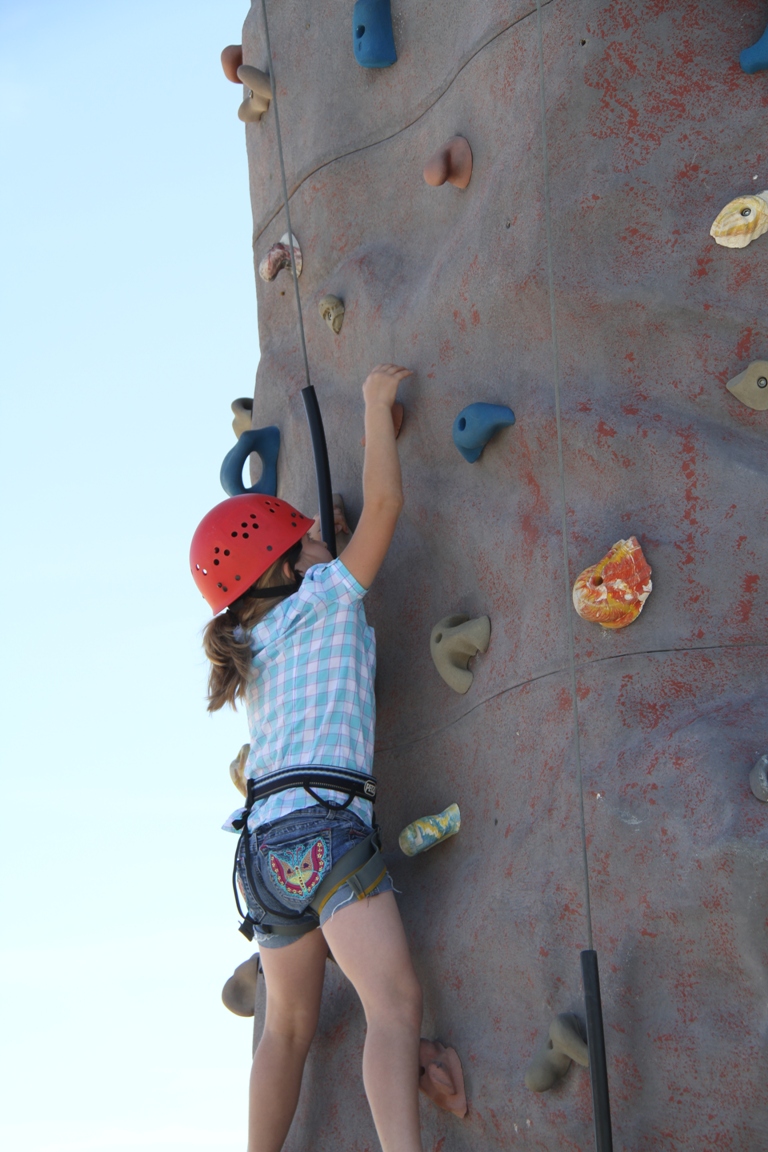
NAVAIR employees and guests expanded their horizons and tackled the climbing wall at the Earth Day event. (U.S. Navy photo)