
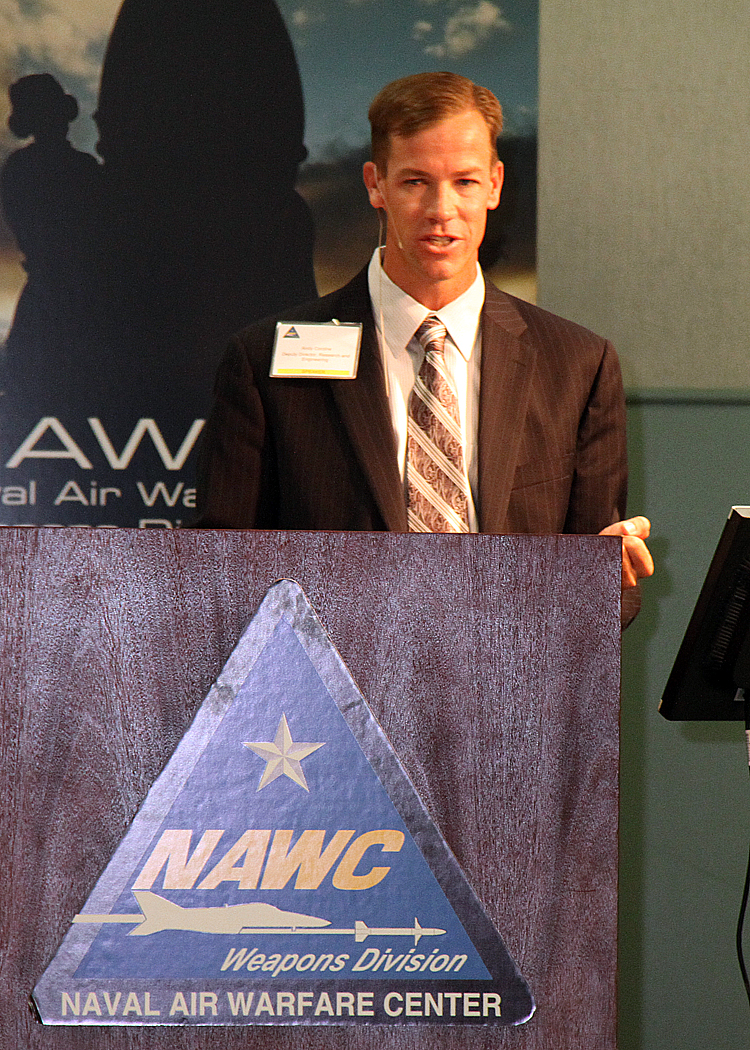
Andy Corzine, deputy director for Research and Engineering, speaks to the Industry Day audience about NAWCWD development goals and the China Lake High Tech Consortium. More than 300 guests representing 254 small and large businesses from sixteen states attended to learn about contract opportunities available through NAWCWD. (U.S. Navy photo)
The China Lake High Tech Consortium – Part of an innovative discussion at NAWCWD’s Industry Day
CHINA LAKE, Calif., –Naval Air Warfare Center Weapons Division (NAWCWD) hosted the first annual NAWCWD Industry Day June 29, at the Kerr McGee Center in Ridgecrest, Calif. More than 300 guests representing 254 small and large businesses from sixteen states attended to learn about contract opportunities available through NAWCWD.
Stressing the importance of collaboration between DoD, academia, industry and coalition networking for strategic vision, NAWCWD commander Rear Adm. Mat Winter stated, “A strong partnership between industry and the Navy is key to our mission success.”
NAWCWD’s mission is to execute full spectrum weapons and warfare systems research, development, acquisition, test and evaluation (RDAT&E) in ways that give our warfighers the decisive advantage. At a time when budgets are straining and the need for innovation in our country is rising, NAWCWD is leveraging networks, resources, research and technologies to solve complex problems. NAWCWD is doing what it takes to win.
In keeping with that vision, part of the packed agenda focusing on NAWCWD’s acquisition programs included an overview of the China Lake High Tech Consortium (CLHTC) presented by deputy director for Research and Engineering, Andy Corzine.
The consortium, which began as Corzine’s thesis topic in 2008 while attending the Sloan School of Management at MIT, has since grown into a bicoastal networking forum. Aligning with industry, academia, government agencies and venture capitalists, CLHTC addresses the current and future technology requirements of the military and commercial marketplace [“current” was already stated in this sentence].
Corzine said, “NAWCWD’s participation in The China Lake High Tech Consortium creates unique opportunities for NAWCWD to partner with innovative organizations from around the country to explore multiple uses for technology. As participants in that forum, we are exploring how the capabilities of the participants can best be utilized.”
One of the collaborations that directly supports [the subject, “one” is singular] Winter’s commitment to the Navy's energy vision is the increased use of alternative energy sources on both land and sea. Recently, a dynamic relationship grew between the U.S. Navy and CLHTC when NAWCWD research chemists Mike Wright and Ben Harvey invented a novel process that created jet fuel from butanol. Cobalt Technologies, a start-up company that is in the business of producing bio-butanol, discovered a journal article published by Wright and Harvey and realized there was a clear synergy between the two organizations.
At Industry Day, Stephen Fallis, NAWCWD chemist and head of the Chemistry and Materials Division said, "Biofuels have the potential to be less costly, more environmentally friendly, and perform comparably to traditional aviation fuels. Research and development on biomass utilization, biofuels, and other alternative energy sources is actively being pursued at NAWCWD."
Discussions led to the introduction of a second company, PureVision Technology, Inc. Collaboration between NAWCWD and these two companies led to a cooperative research agreement, joint proposals, and several innovative projects.
"We are proactively positioning the Navy as a leader in technology advancement and responsibly allowing mutually beneficial access to those advancements," Corzine stated.
One of the projects CLHTC is exploring includes building an infrastructure to naturally treat wastewater with plant life that can be used to produce jet fuels, provide natural gas to heat homes, and generate clean power. The concept is being considered as a possible wastewater treatment solution for China Lake and Ridgecrest, as well as part of a relief effort application in Japan.
Industry Day was created to offer private industry opportunities to work more closely with the Navy. The CLHTC was highlighted as one such opportunity for networking and potential partnerships. Nothing could be a better fit for advancement of Navy technology than a forum for innovation that harnesses the national brain trust of industry, academia and other government agencies, and is determined to blaze new trails of discovery one technology at a time.