
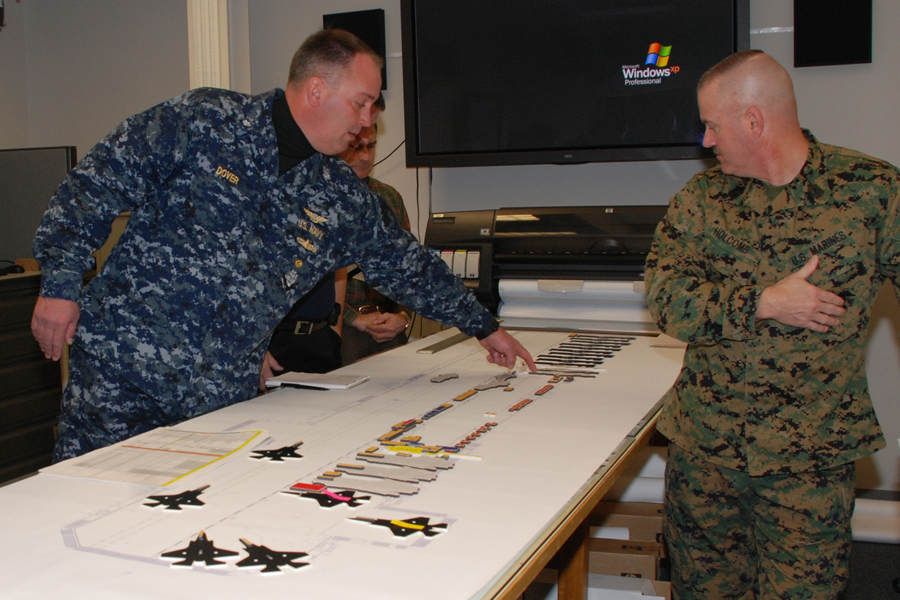
(Left) CDR Mark Dover (JSF JPO) and (Right) MGySgt Michael Holcomb (AIR 6.7.1.5) review L-Class ship footprint modeling at the Lakehurst Carrier Analysis Lab.
Carrier Analysis Lab Plots Jet Engine Change on L-Class Ships
In December, 2010 Navy and Marine Corps engineers and operational experts convened at Joint Base McGuire-Dix-Lakehurst (JB MDL) in Lakehurst, NJ at the Naval Air Systems Command (NAVAIR) Carrier Analysis Lab (CAL) to identify the impacts and begin developing processes to change an engine on an F-35B Joint Strike Fighter (JSF) aircraft while aboard an Amphibious Assault (L-Class) Ship.
In 2015, Marine Expeditionary Unit (MEU) Air Combat Element (ACE) fixed wing operations are anticipated to be performed by the F-35 Joint Strike Fighter, requiring that the full scope of supportability be performed aboard L-Class vessels deployed around the globe. The largest single maintenance evolution on the F-35 is the removal/replacement of the engine. Due to the size of the engine and space limitations aboard in-service ships, it was necessary for Navy engineers, aircraft handling officers and maintenance experts to meet to quantify the constraints and identify the steps necessary to solve this logistical puzzle.
The easiest place to determine the specifications and requirements for this configuration was at the CAL. The CAL facilities use Ouija board-like tables, scaled air vehicles/support equipment/aviation logistic items and an autonomous tracking system to automatically document the location and orientation of everything located on both carrier and L-Class flight and hangar decks. The CAL is the only facility, outside of actually being aboard ship, that operational deck flow efficiencies can be studied and manipulated.
During the December conference, three exercises were performed to depict the sequential removal, replacement and module change of an F-35B engine aboard two different classes of L-Class ships. According to Bill Mehl, Aviation/Ship Integration engineer at Lakehurst, “the exercise went extremely well and we were very happy with the data gathered. Working in this controlled environment certainly saves a lot of time, effort and money before actual shipboard operations ever take place.”
Capt Doug Pack, USMC Aviation and Ship Integration officer added, “through this effort, the logistical and operational constraints of performing an F-35 engine change aboard L-Class vessels have been quantified; and the groundwork has been laid for the overall way-ahead.”