
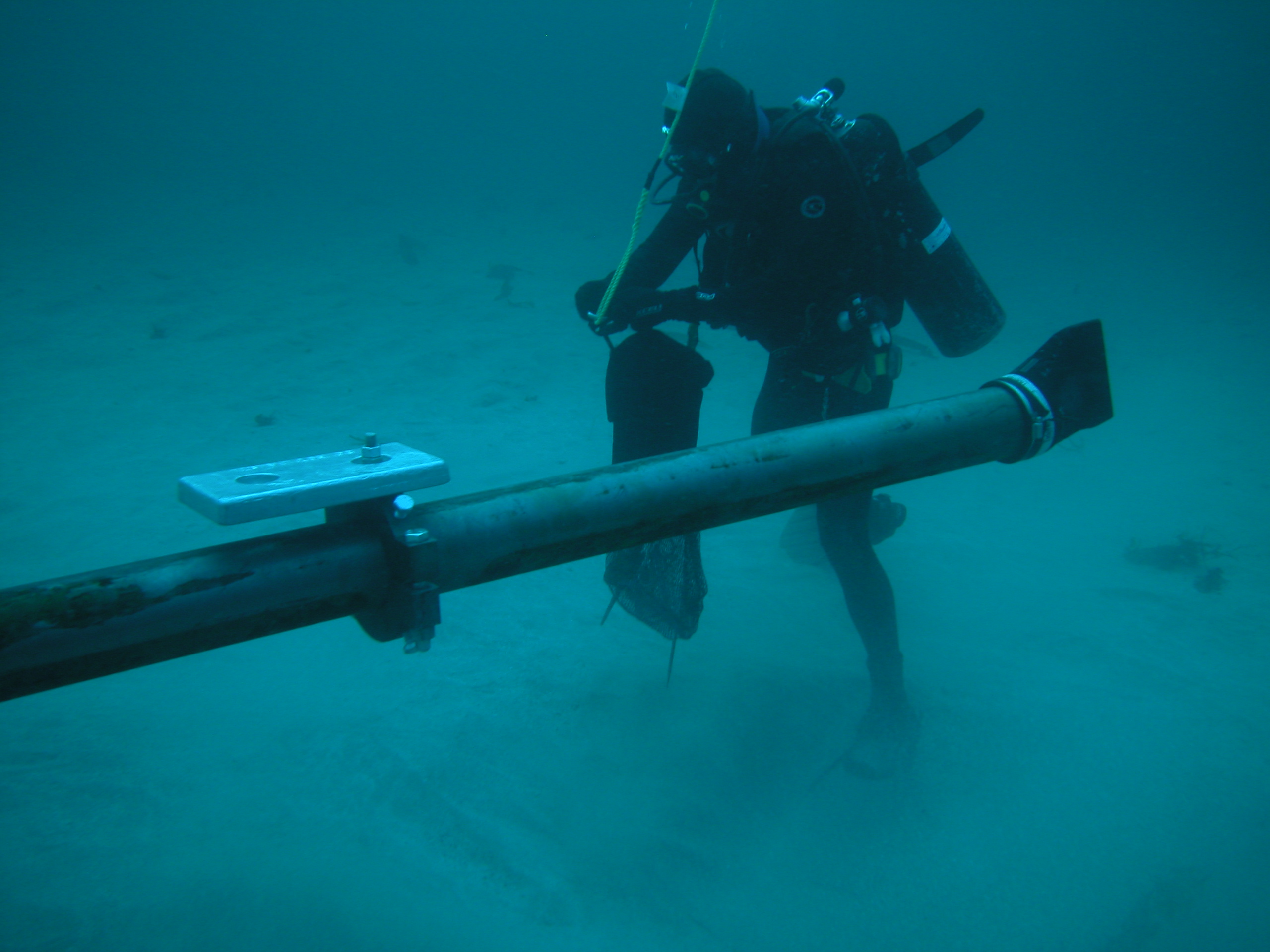
The Navy completed the Barking Sands Underwater Range Expansion (BSURE)refurbishment, located off the coast of Kauai, Hawaii, in November. (U.S. Navy photo)
Underwater Training Range Refurbishment Complete
NAVAL AIR SYSTEMS COMMAND, PATUXENT RIVER, Md. -- The Navy completed the Barking Sands Underwater Range Expansion (BSURE) refurbishment, located off the coast of Kauai, Hawaii, in November.
The Naval Aviation Training Systems Program Office (PMA-205), along with Naval Underwater Warfare Center Newport, R.I., Lockheed Martin and L3 Maripro, completed the project.
“The BSURE refurbishment enhances range capabilities by offering state-of-the-art acoustics and increased frequency bandwidth,” said Capt. John Feeney, PMA-205 program manager. He also said the range provides a safe and realistic environment for the warfighter to train.
The BSURE facilitates training, tactics development, and test and evaluation for air, surface, and subsurface weapon systems in deep water. As part of the Pacific Missile Range Facility (PMRF), it provides a full spectrum of range support, including; radar, underwater instrumentation, telemetry, electronic warfare, remote target command and control, communications, data display and processing, and target/weapon launching and recovery facilities.
Portions of the original system, installed more than 20 years ago, were degraded due to age and environmental effects. The refurbishment included new, advanced hardware and software instrumentation to both the in-water tracking and shore-based electronic systems.
The range is the deep water component of the PMRF. It provides underwater tracking and communications coverage throughout an area approximately 900 square nautical miles at water depths ranging from 6,000 to 15,000 feet. It is the largest portion of PMRF, comprising more than 80 percent of the total underwater tracking area.
The in-water tracking system consists of instrumentation dispersed throughout an area located between nine and 40 nautical miles from shore. When the acoustic sensors detect a sound, or “ping”, they send the information to shore via communication cables which are connected to a data processing facility.
The shore-based electronic system translates the raw data (ranging between 15 hertz and 45 kilohertz), identifies the ping source, determines the source location and communicates back to those using the range.
The refurbishment replaced the existing in-water system with new acoustic sensors multiplexed on fiber optic cables. In addition, the team replaced portions of the shore-based electronic system, integrated the new acoustic sensors with the existing underwater communication at PMRF and provided new tracking software at the facility.
“The installation was unique in that horizontal directional drilling installation was used, providing a conduit for cables to pass from the in-water system to the data processing facility,” said Lt. Cmdr. Charles Kubic, PMA-205 Ocean Systems Integrated Product Team lead. He also said the conduit shields the cables from surf zone damage, protects sea floor and coral reef habitats from harm due to cable trenching or drift and reduces the need for future cable maintenance.
BSURE is scheduled to be ready for training this spring.