
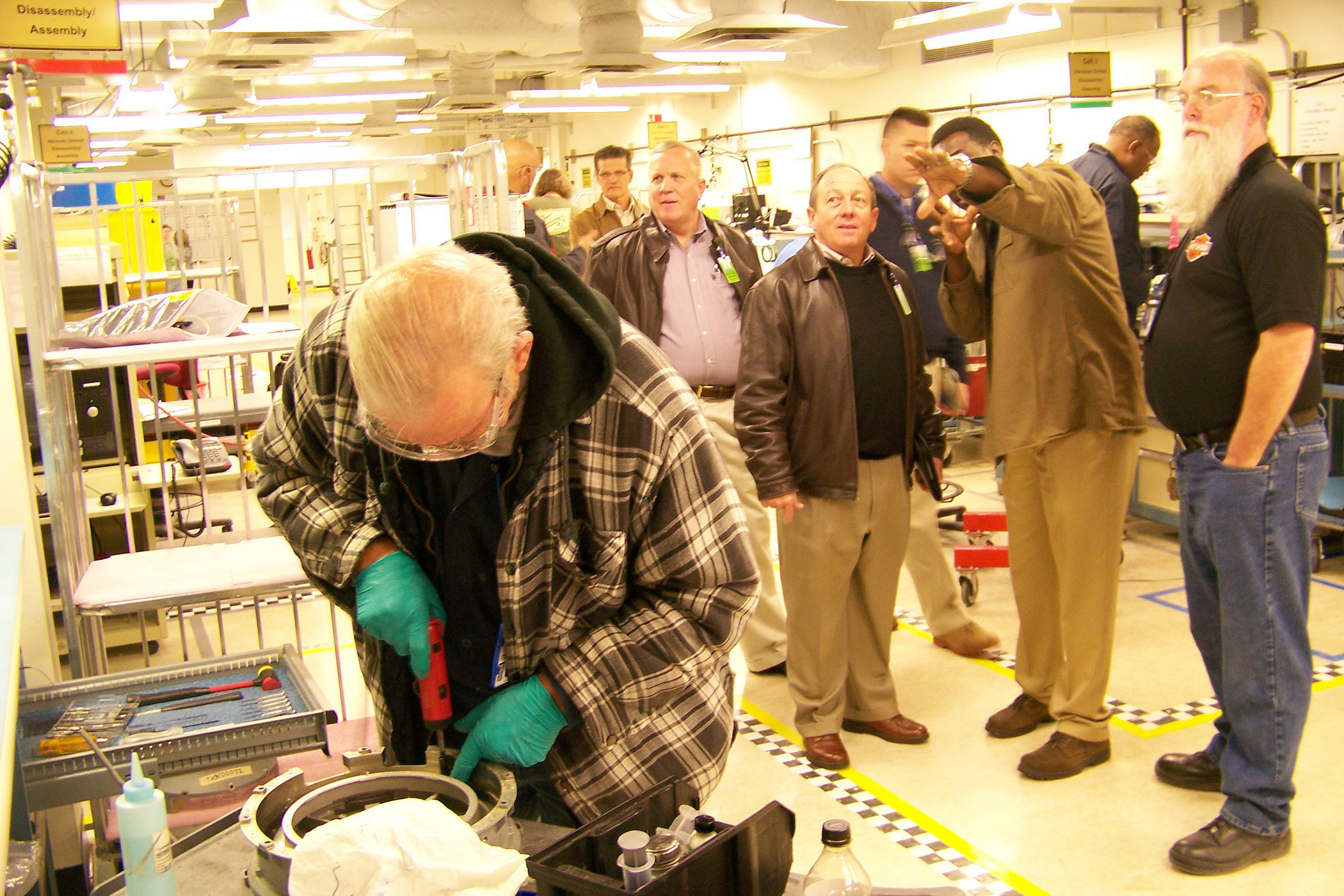
Industrial Unique Programs Deputy Product Manager Angello Evans (center right) points out a Forward Looking InfraRed (FLIR) turret workstation to Deputy Assistant Secretary of Defense for Logistics and Materiel Readiness Randy T. Fowler (center left) during a tour of Avionics at Fleet Readiness Center Southeast Dec. 17. The Code of Federal Regulations requires U.S. military depots to maintain and repair core weapons systems made by defense contractors, such as Raytheon, General Electric and Pratt Whitney if capacity is available. (U.S. Navy photo by Marsha Childs/Released)
SECDEF advisor visits FRCSE, reviews industry partnerships
JACKSONVILLE, Fla. – The Deputy Assistant Secretary of Defense for Logistics and Materiel Readiness visited Fleet Readiness Center Southeast (FRCSE) Dec. 17 to review private-sector partnerships with the military depot and learn how they bring value to the Warfighter.
Randy T. Fowler, the principal advisor to the Office of the Secretary of Defense leadership on materiel readiness of weapons and other systems, met with FRCSE leaders and industry partners to discuss the effectiveness and affordability of Performance Based Logistics (PBL) contracts.
FRCSE collaborates with defense contractors, such as Raytheon, Pratt Whitney, General Electric and Boeing to maintain, modify and repair aircraft engines, airframes, aeronautical components and weapons systems.
Fowler said the PBL partnerships are “alive and well on the factory floor.”
“It is really affirming to us that the artisans on the floor speak the same language that the policymakers are using,” he said. “I never would have expected the artisans talking about PBL.”
FRCSE artisans are providing the touch labor for defense contractors, as federal regulations require the U.S. government to provide depot-level maintenance and repair capabilities on Navy core weapons systems when capacity is available.
Fowler said the Department of Defense has funded military depots to sustain these critical weapons systems and quickly return quality products to the Warfighter for improved mission effectiveness.
FRCSE Business Management Specialist Michael Schoonover said the key to effective and efficient partnerships is to “level-load the work.” He said workload tempo varies with resources availability, the scope of work and the length of the PBL contract.
“We believe we are the trailblazers for the PBL,” said Schoonover. “It is a teaming concept.”
Raytheon Maritime and Littoral Systems PBL Program Manager Mark Schroeder said his company wanted “to have the capacity to produce products,” not to maintain or repair them.
“We were making a business decision,” said Schroeder. “The labor cost is not significantly different, but what makes it efficient and less expensive is you have people already working on benches.”
Schroeder said using the available capacity at FRCSE to repair the AAS-44(V) Infrared thermal imaging sensor was like finding “feed corn.” The initial collaboration provided a window of opportunity for creating additional business ventures.
FRCSE Industrial Business Operations Director Donald Nedresky said its industry partners contract with the depot for labor in compliance with the law, but they get much more in terms of quality, synergy and military readiness.
“A lot of new ideas are driven by the original equipment manufacturer,” said Nedresky. “We will go to the Naval Inventory Control Point (NAVICP) as a team to pitch an idea.”
NAVICP provides Navy, Marine Corps, Joint and Allied Forces support for the weapons systems that keep Naval forces mission ready according to its website.
As Fowler toured Avionics, Manufacturing, the F/A-18 Hornet Production Line and the Crinkley Engine Facility, he spoke with many of the skilled artisans and saw several examples of sustained engineering, and advanced manufacturing processes.
“We are a transformative institution,” said Fowler. “The visit is confirming to the leadership that we are moving toward the next generation of PBL contracts, and Jacksonville is doing just that.”