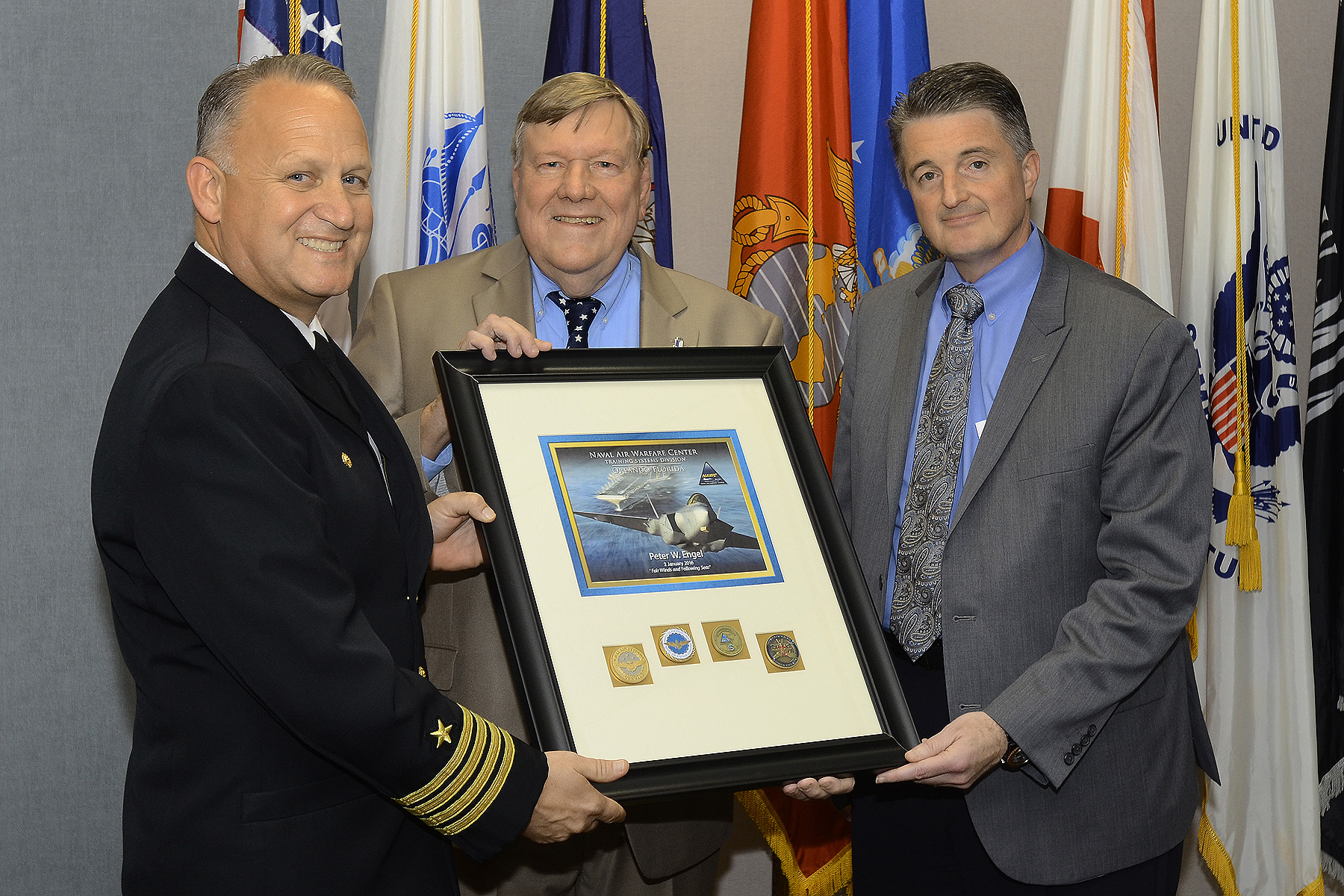
Peter Engel receives a retirement photograph and framed coins from NAWCTSD Commanding Officer, Capt. Wes Naylor and John Meyers, director, Human Systems Department (AIR 4.6).
After more than 50 years, Peter Engel retires from NAWCTSD
ORLANDO, Fla. - After more than 50 years with the same employer, electronics engineer Peter Engel said farewell to his coworkers during a retirement ceremony December 9.
Engel started working with the Naval Training Device Center (NTDC) - forerunner to today's Naval Air Warfare Center Training Systems Division on June 14, 1965 before the organization relocated from its prior home at the former Guggenheim Estate in Port Washington, New York. He was one of the first employees to relocate when the NTDC opened its Orlando, Florida detachment on September 7, 1965.
Maynard Zettler, NAWCTSD's director of Research and Engineering, hosted the ceremony that was attended by members of Engel's family and nearly 100 of his friends and coworkers.
During his remarks, Zettler joked about how much material he had to review to summarize Engel's career. "When I asked Pete for a summary of his career, he gave me a spreadsheet… There were over 600 entries."
Explaining how Engel's career spanned the entire history of modeling and simulation in Orlando, Zettler said, "I realized that this is our collective DNA."
Also attending the ceremony were former employees from throughout Engel's career including former Director of Research and Engineering, Henry "Hank" Okraski, who worked at the Center from 1962 until 1994. He reflected on being part of the first wave of employees to move to Orlando from Long Island. "We arrived in Orlando in 1965 before 'the mouse' arrived. This was them moment of the 'big bang' in the modeling and simulation industry," he said. "Before we arrived in Orlando, there was really no simulation industry here."
Okraski emphasized the value of modeling and simulation and impact of Engel's half-century of contributions to the Navy. Based upon the cost of equipment, aircraft and other factors Okraski estimates that there is "over $1 trillion in savings to the government attributed to Pete and his team."
Prior to presenting Engel with this retirement letters and gifts, John Meyers, director of Naval Air Systems Command, Human Systems Department (AIR 4.6), thanked him for his contributions. "Pete truly is the heartbeat of this organization. Over the years, NAWCTSD has gotten higher and higher on the rankings of the best places to work in Orlando," he said. "It's absolutely because of folks like Pete."
Echoing the sentiments of the other speakers, NAWCTSD Commanding Officer, Capt. Wes Naylor explained how Engel's contributions to the Navy may be greater than he could ever quantify. "You've enable people like me, and the sons and daughters of our nation to go out and do the nation's business and return to their families when their work was done," he said. "You'll never know the total number of lives you touched… You've had an amazing impact on this organization, you've had an amazing impact on the United States Navy and you've had an unfathomable impact on lives and families that you'll never fully appreciate. Thank you for that."
Upon reaching his fiftieth employment anniversary, Engel said that federal employment initially appealed to him because it would have been possible for him to retire by the age of 55. Now at 73, he credits job satisfaction, and his coworkers as reasons he continued to work for so many years. "So long as I'm able to help the Navy and Sailors, I enjoy my work," he said. "Plus NAWCTSD is an amazing place to work."
Engel - who was born in Brooklyn, New York and raised Dumont, New Jersey - decided to accept an electronics engineer position with NTDC after visiting with recruiters at a job fair at Newark College of Engineering during his senior year. "Recruiters came over to the school and interviewed me, and a couple of weeks later they came back and offered me a GS-5 position," Engel said.
Engel is the longest-serving employee at NAWCTSD, and the last who also worked at the Port Washington, New York location. He reported to his new job at NTDC, which was then aligned under the Office of Naval Research, on June 14, 1965.
His first day at work was significant not only because he was about to start a career, but also because it's the day he met his soon-to-be wife Alexanderia, who was the secretary for the Submarine Branch.
"(The guards) had me go over to the Admin Building, where the personnel people were that got you signed in," he said. "From there my (future) wife came and met me, and she took me from Admin over to Engineering, so I can tie everything to that first day." They fell in love and were married the following March.
On his first day at work, one of the main topics of conversation among his co-workers in the basement of the Guggenheim Estate's "castle" was the planned move to Orlando. "Everyone was talking about moving to Florida, or not moving to Florida," he said. "The people who were going to Florida were excited about it."
Only a few months after starting his new job with NTDC's Fleet Tactics Group, Engel was among the first wave of employees to move to Orlando. "We all came down -- 80 people or so -- that first Labor Day weekend," he said. "We did a lot down here for a small group, I mean we got the contracts awarded, we got things tested, and we got the claims settled. We did the work."
He explained the working conditions at the newly-established NTDC Florida Detachment in the old pre-World War II buildings at Orlando AFB in 1965 were not quite as nice as they were used to in New York. "It was a change, it was kind of primitive," he said, explaining that the Air Force was preparing to leave and turn the base over to the Navy. "It was kind of run down. We didn't have air conditioning, but we got a lot of work done surprisingly."
The first jobs performed by NTDC in Orlando included Undersea and Antisubmarine Warfare (ASW) training systems. One of Engel's first projects was working on the ASW Coordinated Tactics Trainer, which provided training for decision-making personnel in coordinated, multi-platform ASW tactical situations.
While technically complicated and capable, the trainer did not have the technological advantage of computer-based team trainers in use today. Engel explained that the trainer had rooms representing various warfare specialties, including submarines, aircraft, and destroyers. Navy personnel from all warfare areas would do ASW exercises to coordinate their tactics. "There were simple sonar scopes and simple radar scopes, but what they would do is show a target and show a friendly ship, so you'd know to where to prosecute the enemy. We would get these guys together to practice their tactics so they wouldn't kill each other before they got the enemy," he said.
From mechanical and analog computer-based trainers, to the digital computer-based training systems of today, Engel worked his way through a half century of technological growth. While many recognize significance of computers, Engel credits the transistor as being the most significant technological advancement of his electrical engineering career. "When I went to school I learned vacuum tubes," he said. "The idea of pushing electrons through sand opened up the whole gambit of integrated circuits."
Smaller circuits led to advancements in digital computers, which led to improvements in the capabilities of the Navy's training systems.
"If you want to get a feel for what I've experienced, as far as technology goes… all of these wires," Engel said pointing at a photo a floor completely covered in wires before being installed in a trainer. "We can now put all of those signals on one Ethernet cable now. Of course the software is immense now."
He explained how reliable today's computers are compared to the mainframe and analog computers that he used in the early 1970's. "In 1970 one of the issues was these computers were difficult to keep online because of all the analog components. There were limits on how much computation capability they could do."
Engel credits one of his mentors, Vince Amico with moving the organization toward increased use of digital computers. "Vince Amico was our program manager and the idea was that we would replace all of these computers with a mainframe. We had two issues to look at, one was to get these trainers delivered (one in Norfolk and one in San Diego), and the other was to look at upgrading them into the new system. So for those first five years I was involved in going to the sites and testing them, and working on the upgrades."
Over the years Engel worked on a variety of other projects, including a training system for the HU-25A Coast Guard Falcon Jet search and rescue aircraft, which he says was his most memorable project. "Their knowledge of aviation was equal to any of the Navy guys. I couldn't believe some of the stuff the Coast Guard guys would do," he said reflecting on some of the real-life search and rescue stories told by Coast Guard personnel. "Their demands on training were fairly strenuous, but they treated me royally, and they respected my advice (while developing the trainer)."
Even though he was in the first wave of employees to relocate to Orlando, he didn't spend all fifty years here. With family still in the Northeast, New York remained an important part of life for Engel and his wife. "We were always running back and forth to New York, whether it was Thanksgiving, Christmas, or going up to Lockheed on a business trip"
In 1972, their fondness of New York inspired him to take an opportunity to move temporarily to Bethpage, New York working on the original F-14A Tomcat trainer at Grumman Aerospace. "I knew very little about aircraft, but it was an opportunity to go to New York," he said. "It was one of the early digital flight trainers that took advantage of the current technology of the time - an off the shelf computer," he said.
He explained that his experience on the F-14A project allowed him to grow as an engineer. "I really got involved with what we were doing. We got to go out and see what the cockpit actually looked like and see how the paper translated into the trainer," Engel said. "It was a growth thing for me… I learned an awful lot about engineering; it was like being back in a lab at school. We were building something, and this is what engineers do."
Engel reflected fondly on the assignment in New York. While temporarily living there, his wife gave birth to their son, and he enjoyed working alongside of the contractor's engineers. "It was just an interesting place to work," he said.
Following the F-14 project, Engel, his wife and returned to Orlando in 1977.
"Sometimes I wonder if I regretted actually coming back (to Orlando) because (Alex) might have been happier in New York," Engel said. "But she came with me. She was the best thing that ever happened to me. The best thing I ever got out of this place. On the first day I met my wife -- the best thing I ever got -- forget the job, forget the 50 years, forget everything else, it was just that."
In 1993, Engel was getting close to retirement eligibility, and his world changed unexpectedly. "She had a brain hemorrhage," he said about his wife, Alex. "She was young. When she died I was getting close to retirement - I was 51 and I could have retired at 55. I probably would have retired, but all of a sudden, she's gone. My son was 18 and ready to go off and get a job, so I decided to just keep working. Looking back, I was lucky to have her. We had almost 27 years together."
Engel said that his co-workers and the nice working conditions are what keep him going. "I'm a people guy. I enjoy working with the people; I enjoy walking down the halls here and saying 'hi' to people," he said.
He also praised the work modern facilities that the command has called home since 1988. When the center moved from its home at the Naval Training Center to the de Florez Complex in the Central Florida Research Park, the working conditions, and opportunities for collaboration improved. "This is really nice building to work in; you've got a cafeteria downstairs," he said.
Engel experienced many changes over the years, including NTDC changing its name to the Naval Training Systems Center in 1985, but he said the most significant change was when the command re-aligned under Naval Air Systems Command to become NAWCTSD on October 1, 1993. He explained that the training systems developed by the command always supported all warfare areas of the fleet, "we're like a purple building here," he said. "When I came to Orlando it was with the submarine group, then the surface group came down and my projects knew nothing about aircraft."
He said that at the time NAWCTSD aligned under NAVAIR there was a lot of discussion as to where training systems should fit in the Navy organization. "A lot of people said 'we really belong back under ONR, we're a research group' or 'we really belong under CNATRA' and some of the original people said, 'no you are really part of Naval Supply Systems'. When I first came here it was Training Devices, and that was treated like spare parts and publications… training was a logistics item."
He explained that in the past there wasn't always an appreciation for the complexity of training devices. "We started to realize that training systems is really a bigger thing than just a piece of logistics support. We became more aware of the needs of the simulation community. In the end NAVAIR came down and tried to help us out. It was probably the best for the organization."
He also enjoys sharing knowledge with coworkers, pointing out that he's had mentors at every stage of his career. "It's kind of why I still enjoy coming to work. You learn something new every day," he said. "To me, no matter where you turn the corner here, you can learn something from somebody."
When asked if he had advice for anyone entering the workforce today he said, "Listen a lot. Listen to everything anyone tells you. Ask a lot of questions. That's the way you learn what's going on."
"I just like it here. It's become my social life almost," he said when asked about his future plans. "I come here and I know the people, I like driving back and forth to work, I like getting dressed in the morning, I like putting on a clean shirt, I like doing the work I'm doing. But it looks like I'm going to retire."
Engel explained that NAWCTSD, which is currently ranked fifth on the Orlando Sentinel's list of Top 100 Places for Working Families, is the kind of place where people want to work. "This is a nice place to work," he said. "You'll see a lot of families that encouraged their children to work here, and that speaks a lot for the organization."
Engel's last official day as a civil service employee will be Jan. 2, 2016. He plans to spend his at least some of his retirement time working on his two Triumph automobiles and he may look for some opportunities to volunteer his time.
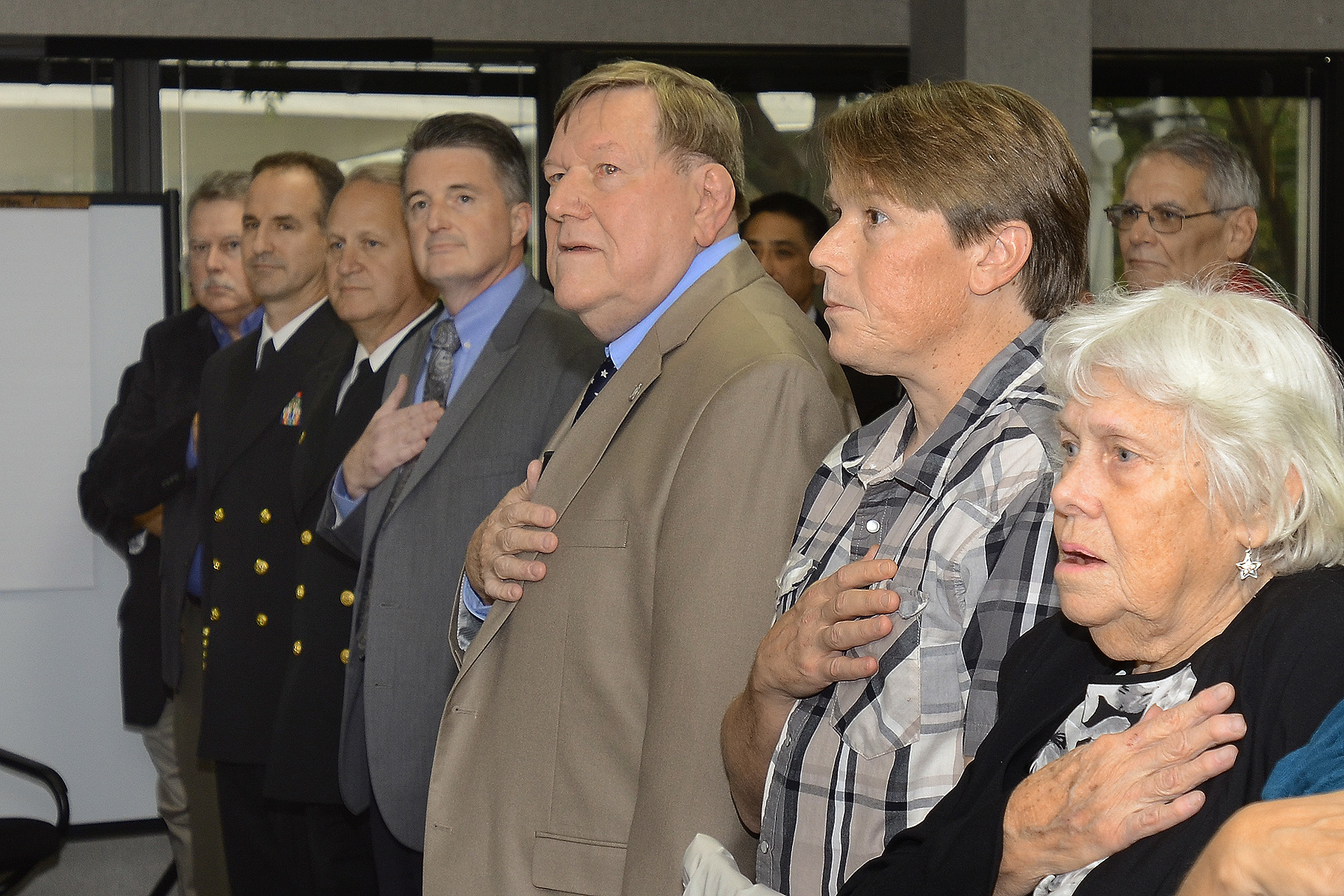
Guests stand for the National Anthem during a retirement ceremony for Peter Engel (center).
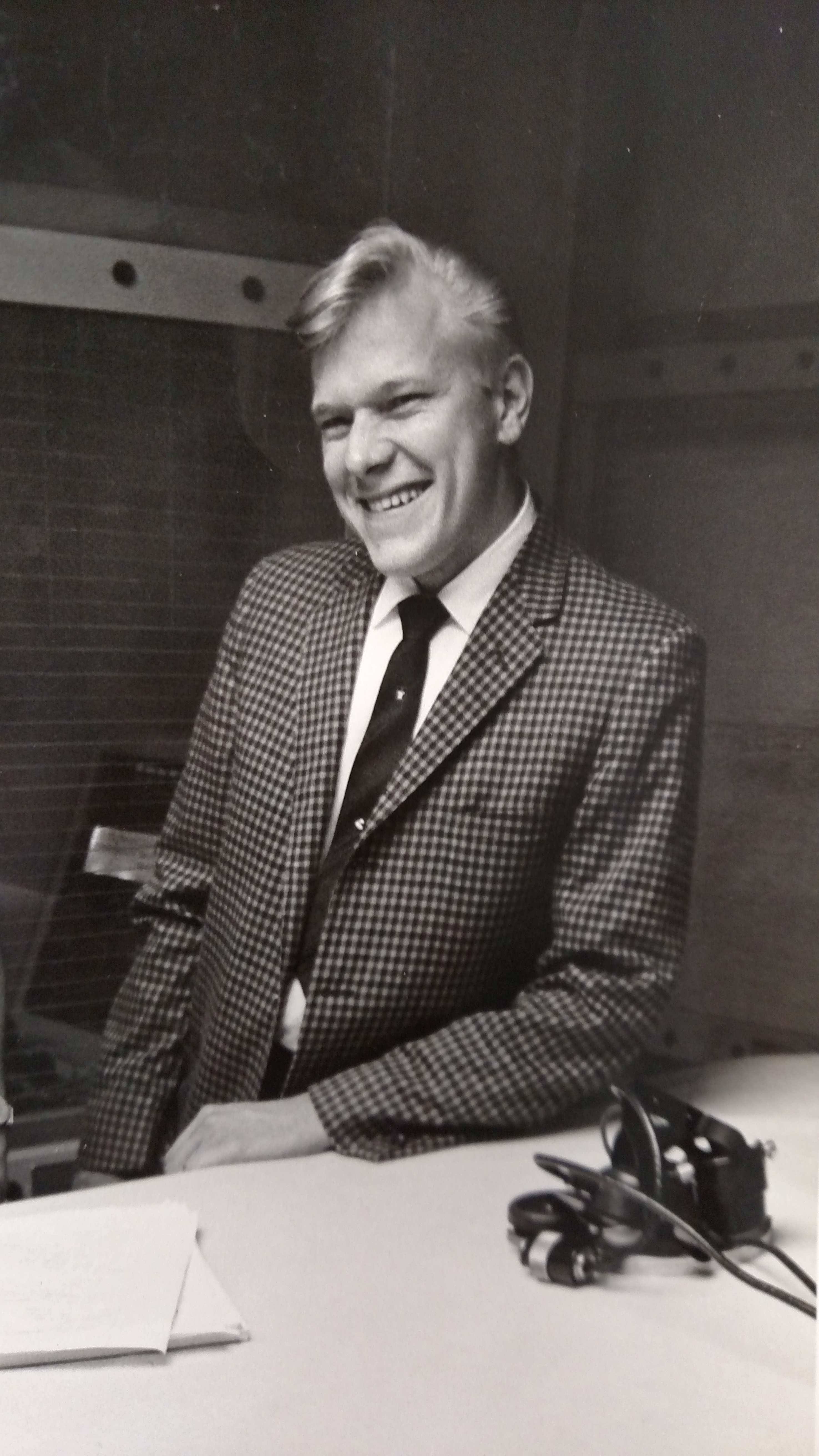
Peter Engel at work the 1960's.