
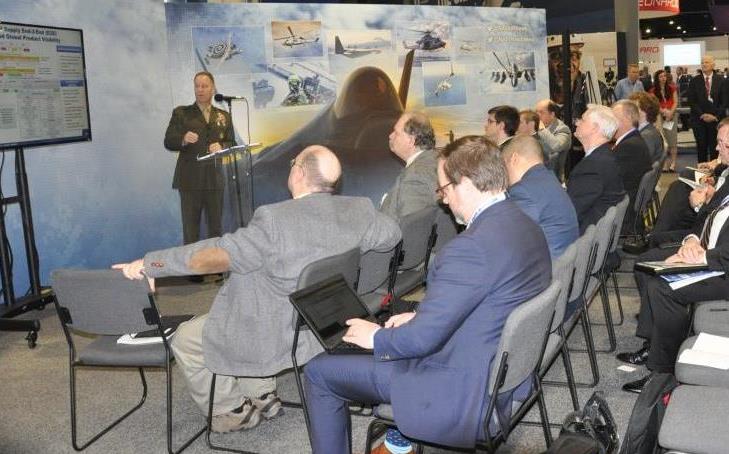
Brig. Gen. Greg Masiello (standing, far left) describes how the Maintenance and End-to-End Supply tools are integrated to provide users with in-depth visibility and the capability to identify indicators that are interdependent and warrant investigation.
AIR 6.0: Maturing digital products gives system visibility to fleet, providers
NAVAL AIR SYSTEMS COMMAND, PATUXENT RIVER, Md. – Digital products developed in support of the next generation warfighter are now in the hands of the fleet, according to Naval Air Systems Command (NAVAIR) Assistant Commander for Logistics and Industrial Operations Brig. Gen. Greg Masiello during a Sea-Air-Space (SAS) Exposition presentation at National Harbor, Maryland, April 9.
Sponsored by the Navy League, SAS is the key annual venue for military, government and industry leaders to gather information about the current defense industry environment.
“Last year, I spoke to you about some of the digital tools Naval Aviation was developing to go from being reactive to predictive,” he said. “Now we are putting that information into the hands of the users.”
Today, all stakeholders—from admirals to the flight line Sailor and Marine—have access to multiple information systems containing near real time information using intuitive graphics to enable in-depth analyses. Users can drill down into maintenance and supply requests and cross reference with other databases.
Another advantage to the increased accessibility of data is its traceability and potential to improve collaboration throughout Naval Aviation. “When I look at the data, I know what the source is—the same is true of the flight line Sailor and Marine,” Masiello said. “I no longer have to ask where the numbers came from. Data is now the common denominator of discussion.”
One such product is the Aircraft Management Dashboard (AMDB). Developed organically, AMDB warehouses and formats large volumes of aircraft sustainment data generated by sources throughout Naval Aviation. AMDB provides data analysts with near real time material condition status of each aircraft, as well as supply requisitions, maintenance work orders, inventory statuses and other information for all aircraft in one web-enabled set of graphics. Anyone with a common access card and permissions can access the data.
AMDB also indicates the strong relationship between the supply system and maintenance, and their impact on readiness. “In the past, we’ve asked ourselves, ‘Is it just supply?’ AMBD tells us no. If you look at the gripes for supply, every one of them comes with multiple maintenance grips as well,” Masiello said. “When you talk supply, you talk maintenance.”
Another product is the End-to-End Supply Tool that collects and integrates supply chain data from the flight line through the wholesale system to provide a comprehensive picture of supply chain performance. “When users click on a maintenance action or search by type/model/series, they can see whether or not an item is undergoing organic or commercial component repair or if it is an [Aviation Consolidated Allowance List] or [Shore Consolidated Allowance List item]. They will be able to determine if there is a part in the system, where it is and who to contact if there is a lag in delivery,” Masiello said.
Digital products depend on the right inputs. That what winners of NAVAIR’s latest Data Challenge—the Jacksonville Analysis Group (JAG)—recently discovered as they traced the network of support links to aircraft availability. “When team JAG compared how many parts the fleet ordered with the number met by DLA, they discovered that DLA filled almost 100 percent of what was requested. We were not ordering according to the demand signal,” Masiello said. The team developed a tool that pulls the appropriate information to ensure that an accurate demand signal would be sent to providers.
Vector, he said, is another digital product used by the fleet whose capabilities are being significantly improved in 2018. The web-based digital product, originally released in 2015, provides holistic views of readiness and costs drivers by aggregating millions of records each month from more than 20 separate transactional data sources into metrics and data-driven dashboards. Vector now sends out alerts to users when they log in on systems/sub-systems and components that could degrade readiness. Technicians are working on tying in the Aviation Weapons Information System and tracking airborne armament equipment.
Masiello said in the previous business environment, Naval Aviation data systems indicated problems before decision makers could make sense of the information even though they produced late and latent data. “They gave us a thumbprint, but by the time we discovered problems, the issues impacted other areas. The challenge going forward is to see and act on problems before they manifest.”
Currently, AIR 6.0 is working on a “digital data baseline” for aircraft from inception to disposal that will be connected to the entire logistics enterprise called the Digital Thread. Enabling Digital Thread is the Aviation Logistics Environment (ALE), a shared data environment created to house and maintain legacy and emergent digital solutions and to serve as the cohering element. Shore-based, afloat and expeditionary operations will have access to the same information for better decision making. A series of apps will provide users with easy access to the digital products.
Masiello responded to a question about how AIR 6.0’s digital products will support Naval Aviation’s future fleet of F-35 Lightning IIs and integrate with the Autonomic Logistics Information System (ALIS)—the platform’s information infrastructure that transmits aircraft health and maintenance action information to technicians worldwide on a globally-distributed network.
“We’ve designed an interface that processes ALIS into the databases,” Masiello said. “We are also working with the [F-35 Joint Program Office] and Lockheed Martin on improving the system to integrate the data.”
Additive Manufacturing (AM) in the fleet is maturing as well. “AM is now real-time authorized,” he said. “This means flight line Sailors and Marines can print out approximately 135 select parts without seeking prior engineering approval,” he said. To accelerate speed to the fleet on the production of safety critical parts, AIR 6.0 partnered with NAVAIR Research and Engineering (AIR 4.0) to establish a team that can give quick approval to the fleet.
“Our improvements will be incremental,” he said. “In 2018, I expect 1,000 items across the fleet to be authorized for print. That, in part, will meet the [Commandant of the Marine Corps Gen. Robert Neller’s] call to get printers into the hands of the Marines. They will drive the demand and process.”
With more than 20 lines of efforts, AIR 6.0 is working with NAVAIR’s Digital Integration Office to ensure alignment across business units. AIR 6.0 also took part in the creation of the Naval Aviation Sustainment Center where comprehensive data sets on aviation asset health are aggregated in one place. This improves the visibility of data, enabling all users to better understand the causes and results of actions and decisions across the fleet. A prototype was stood up at Naval Air Station Patuxent River, Maryland, in the fall of 2017.
The vision to become predictive in Naval Aviation is becoming a reality, Masiello said. “Last year, it was aspirational,” he said. “Now, with the access digital products give them, decision makers can see where Naval Aviation stands today and take timely action.”