
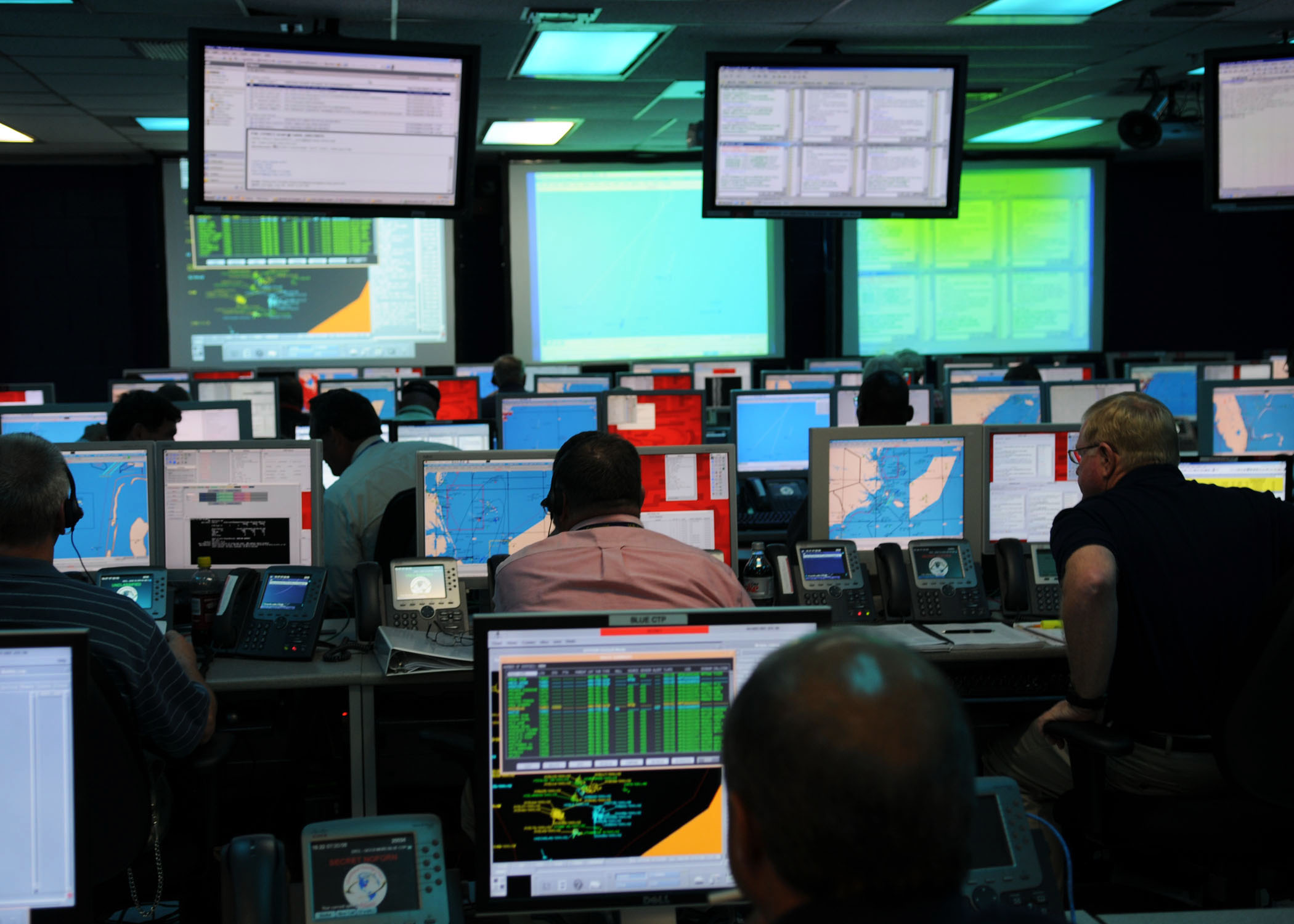
Cutline: Staff members of the Distributed Training Center, Atlantic located at the Naval Air Station Oceana, Dam Neck Annex, Va. participate in a Fleet Synthetic Training event. There are currently 41 major FST events and 303 smaller support events scheduled within the next 12 months. U.S. Navy photo.
Interoperability “Connects” Military in Training
NAVAL AIR SYSTEMS COMMAND, PATUXENT RIVER, Md. - The U.S. Navy will be utilizing a unique type of simulation training during two upcoming exercises.
Implementation of interoperable hardware and software allows multiple training devices to “connect” and replicate real world situations.
Interoperability, sometimes referred to as distributed training, affords military personnel across the globe participation in realistic training using connected synthetic environments.
The Naval Aviation Training Systems program, PMA-205, is at the forefront of this evolution, integrating the air component by configuring simulators with the latest software and training aircrew to operate in these advanced networks.
“The goal is to have all Navy and Marine Corps aviation training on an interactive flight simulator network” said Capt. John Feeney, PMA-205 program manager. Additionally, Feeney said some anticipated results of this robust training environment are improvements in an aviator’s flexibility and adaptation to warfare scenarios, along with enhancements in human interaction to include radio communication.
Previously, each training event centered around a single training device with crew members and an instructor. With Fleet Synthetic Training events, also known as FST, military personnel can train in their own respective training systems with crews in other locations.
The P-3C Orion Tactical Operational Readiness Trainer, or TORT, is one example of an interoperable training system. Recently, all anti-submarine warfare TORTs received hardware and software upgrades in order to connect into the virtual arena. The air crew will be able to link with other P-3C TORTs worldwide and participate in FST events.
These virtual exercises, endorsed by United States Fleet Forces Command, can be orchestrated around a single battlegroup simulating large-scale sea exercises. Every component of the group to include all ships and the air wing are “plugged in”, thus offering participation in anti-submarine warfare, air-to-air and air-to sea simulation and weapons practices leading to major combat operations certification for participating battlegroups.
“By integrating our aircraft simulators with embedded shipboard training devices and submarine simulators into an interoperable network, we are providing innovative training for our deploying forces,” said Sondra Even, PMA-205 deputy program manager.
With interoperable training devices, the U.S. Navy can conduct continuation and mission qualification training, execute mission rehearsal operations, develop warfighting tactics, and participate in large force exercises in a realistic environment at a fraction of live-fly costs.
There are currently 41 major FST events and 303 smaller support events scheduled within the next 12 months.
Submitted by Naval Aviation Training Systems program (PMA-205)
Cutline: Staff members of the Distributed Training Center, Atlantic located at the Naval Air Station Oceana, Dam Neck Annex, Va. participate in a Fleet Synthetic Training event. There are currently 41 major FST events and 303 smaller support events scheduled within the next 12 months. U.S. Navy photo.