
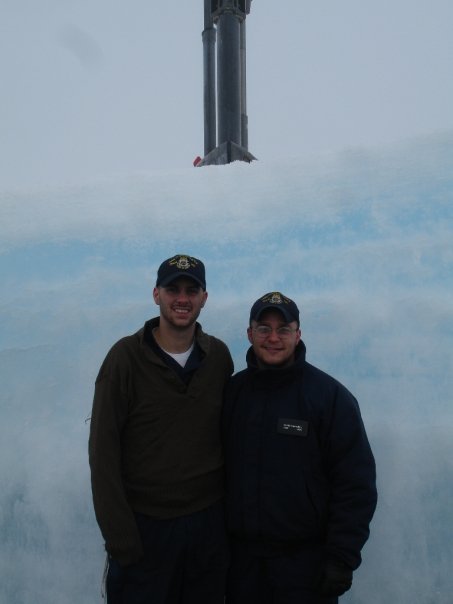
Thomas Farrell, left, poses with Christian Abel, a shipmate from the attack submarine, USS Connecticut (SSN 22) when their submarine paid a visit to the North Pole in August 2007. Farrell is now a value management analyst in the V-22 Joint Program Office (PMA 275), he spent six years in the Navy, three of those on USS Connecticut.
From oceans deep to skies blue, former submariners contribute to NAVAIR mission
It seems like a natural progression for former naval aviation servicemembers to continue their professions at NAVAIR, but for a small number of employees their careers didn’t begin on the flightline, but below it — fathoms below.
NAVAL AIR SYSTEMS COMMAND, PATUXENT RIVER, Md. — U.S. Navy submarines and their Sailor volunteers have patrolled the world’s oceans for nearly 113 years. When the Navy marks the birthday of the Submarine Force April 11 several employees of the Naval Air Systems Command (NAVAIR) will be celebrating their contribution to that legacy.
Veteran Tom Farrell is a value management analyst with the V-22 Joint Program Office (PMA-275). He spent six years in the Navy, three of those on the attack submarine USS Connecticut (SSN 22).
Farrell, who left the Navy in 2008, used the GI Bill to attend Frostburg State University where he earned a Bachelor of Science degree in mathematics, which led him to NAVAIR.
“I went to college after getting out of the Navy and figured my military service and degree would allow me to perform well in the civil service, and began searching for federal jobs,” Farrell said.
He was a nuclear-trained electrician’s mate, one of the three nuclear-engineering ratings that work in the engine room of nuclear-powered submarines. “Nukes,” as they are affectionately called, are considered to have one of the hardest jobs on a submarine.
“Serving onboard submarines allowed me to develop the ability to function on limited sleep,” Farrell said, “[to] work well in a teamwork environment and the ability to trust others; also the value of standards and procedures and maintaining a questioning attitude.”
Building Trust
Submarine duty paid positive dividends for others at NAVAIR as well.
Serving on submarines gave me the “ability to handle stressful situations,” said Jason Morris, an engineer for the Air Combat Electronics Program Office (PMA-209). Morris served on the Blue crew of USS Tennessee (SSBN 734).
The Tennessee is an Ohio-class nuclear-powered ballistic missile submarine and part of the United States nuclear deterrence triad. Ohio-class SSBNs can carry up to 24 submarine-launched ballistic missiles. On average, these submarines spend 77 days at sea followed by 35 days in-port for maintenance. Each SSBN has two crews, Blue and Gold, which alternate supporting the submarines, maximizing the SSBN’s strategic availability.
“When you work on a boat, your life is in the hands of the 100 to 150 crew members, Morris said. “You must trust them with your life as they trust you with theirs. Stress is always around you, but all the training in school and on the job helped me work through stress effectively.”
Dolphins on a Leatherneck
Surprisingly, submarine service is not exclusive to former servicemembers.
Marine Lt. Col. Eric Ropella, PMA-275’s Inservice Readiness Team lead, is a member of an even smaller NAVAIR minority, a Marine with “dolphins.”
Dolphins are the warfare designation pins all submariners work toward earning from their first day onboard their submarine. It’s a crew qualification process to show fellow shipmates they have an understanding of all of the systems onboard the boat, and can be relied upon to do their part in a crisis.
Ropella earned his pin in 1990 on USS Cavalla (SSN-684) where he was assigned for his Naval Academy “Youngster Cruise” during summer vacation between his freshman and sophomore years. An occurrence not uncommon for many Academy underclassmen but Ropella’s name was already well known on the submarine, his father, Senior Chief Corpsman (retired) John Ropella was already a member of the crew.
“After about a month and a half aboard the Cavalla [both in port and underway],” Ropella said, “I was able to earn my enlisted dolphins, which I wore with pride during my remaining time at the Naval Academy and up until my commissioning in the Marine Corps in 1993.” But you won’t find the pin on his current uniform.
“Marine Corps uniform regulations don’t allow me to wear my dolphins, but I do have them prominently displayed in my home office,” Ropella said.
Ropella, a CH-46E helicopter pilot, said he understands the allure and camaraderie present on submarines.
“I have always been intrigued by the submarine force and admired those who have chosen that career path,” Ropella said. “Because of its small size and mission, they are able to pick the best and brightest and tend to have a tighter bond than those in the surface Navy... in some respects, this mirrors the Marine Corps.”
Indelible impressions
It has been almost 30 years since Robert Bartsch, a team lead in PMA-275 earned his dolphins onboard USS Honolulu (SSN 718). Bartsch left the Navy in 1990 after 8½ years but his journey to NAVAIR was a little bit circuitous.
“I spent 15 years at Calvert Cliffs Nuclear Plant (CCNP) where I was in Operations, Maintenance and finally Program Management. I came to the government initially in 2005,” Bartsch said. He credits submarine duty with teaching him attention to detail, procedural adherence, accountability and most importantly responsibility, traits that have served him well as a civilian, especially at NAVAIR.
“When I look back on it,” Bartsch said, “I was a 22 year-old qualified engineering watch supervisor, a watch station normally manned by a chief petty officer, which essentially made me responsible for the operation of an engine room on a more than $1 billion nuclear submarine.”
Former submariner, Randy Lewis, is a schedule development expert at NAVAIR, and like Bartsch a Calvert Cliffs Nuclear Power Plant alumni.
“The nuclear power training pipeline led me back to Calvert County [where I am from] to CCNPP,” said the former nuclear-trained machinist mate, who left the Navy in 1997. He worked at CCNPP for 11 years, where he said he held a number of positions and learned scheduling and project management skills, which led him to NAVAIR’s Research and Engineering Cost Department.
“Being onboard submarines, along with being a Navy diver, remind me often that I’ve accomplished much more difficult tasks than typically faced with in everyday life,” said Lewis, who served on USS City of Corpus Christi (SSN 705) from 1993 to 1997. “[Submarine duty] also taught me the true meaning of teamwork, trust and integrity. I still consider some of my shipmates my lifelong best friends.”
Although Lewis hasn’t visited his boat since he left the Navy, he said his submarine past did “surface” at a meeting during one of his first NAVAIR assignments supporting the Air Anti-Submarine Warfare Systems Program Office (PMA 264).
“I waited until the end of that meeting and jokingly told them that working for them was sort of ‘a conflict of interest.’ When I told them I was an ex-submariner, one of the leads threw his hands in the hair and leaned back in disgust. He was a former P-3 Orion anti-submarine aircraft crew member.
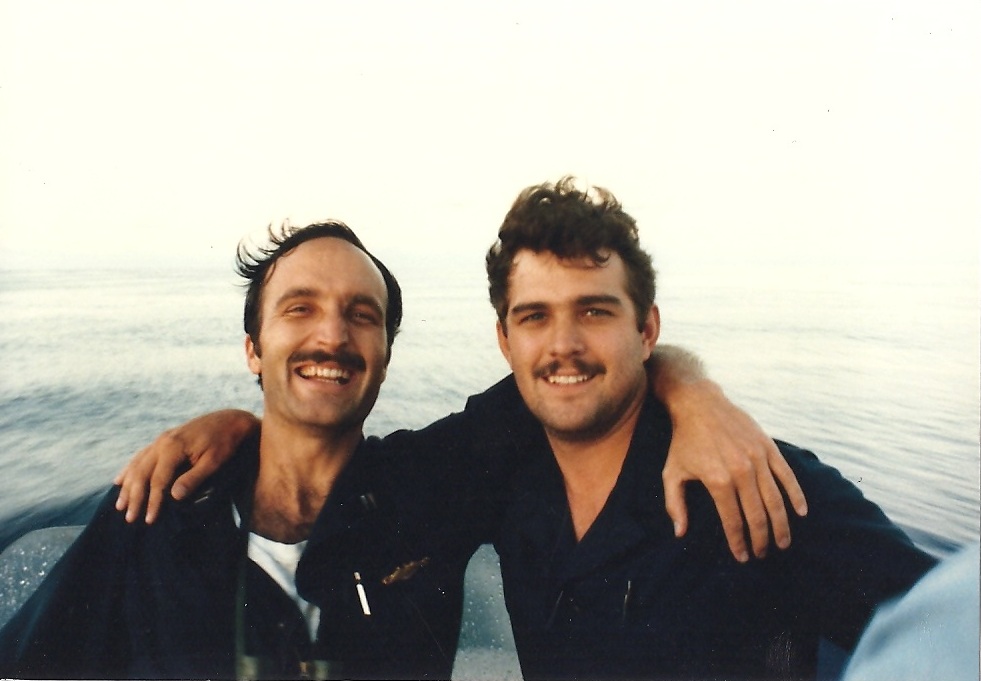
Robert Bartsch, right, poses with a friend from the USS Honolulu (SSN 718) while the submarine transits off the coast of St. Thomas in June 1985. Bartsch, a team lead in the V-22 Joint Program Office (PMA 275) spent 8 1/2 years in the Navy.
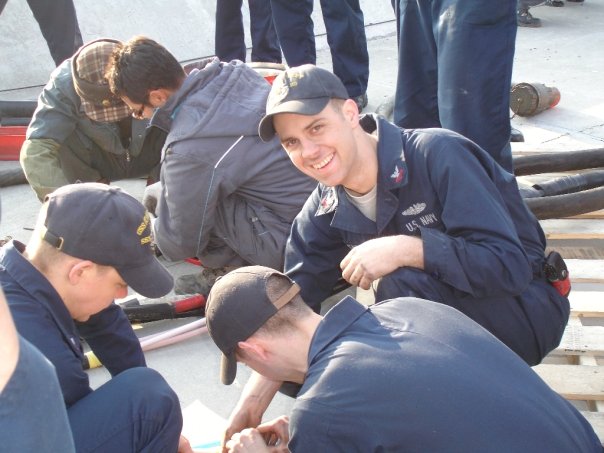
Thomas Farrell assists his fellow engineers in hooking up shore power during a port visit. Farrell is now a value management analyst in the V-22 Joint Program Office (PMA 275), he spent six years in the Navy, three of those on USS Connecticut (SSN 22).