Celebrating fifty years of Hawkeyes in the sky
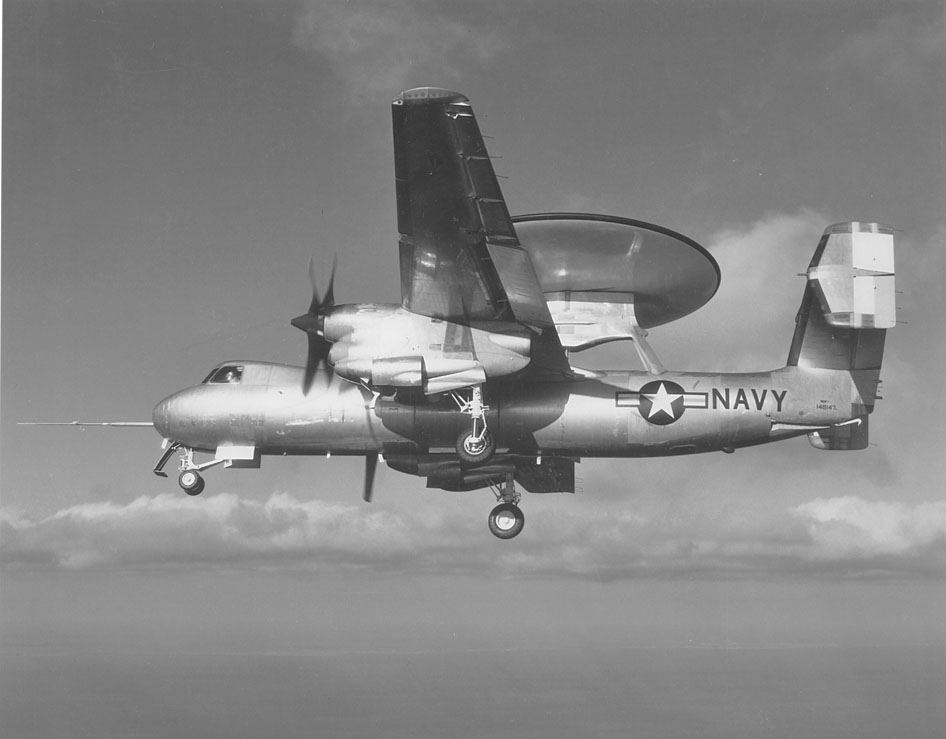
NAVAL AIR SYSTEMS COMMAND, PATUXENT RIVER, Md. -- Fifty years ago today, the Navy’s first specifically designed carrier-based airborne command-and-control aircraft, the E-2A Hawkeye, took to the skies for its maiden flight over Bethpage, N.Y.
The Navy, after determining that it had a requirement for enhanced Advanced Early Warning, selected Grumman to build an aircraft to produce better detection capabilities.
From that requirement, the development of the E-2A Hawkeye took place in the late 1950s.
Unlike its predecessors, the E-2A Hawkeye was the only aircraft to have a rotating dome with a redesigned radar and a crew of five aviators. Its primary mission: long-range detection.
The E-2A Hawkeye introduced the ability to “see” through weather and sea clutter with its APS-96 radar. Before the E-2A Hawkeye, aircrews traced each individual track. The newer technology available in the E-2A Hawkeye generated automatic course and speed information on all tracks allowing naval flight officers to focus on engaging the enemy.
“The back end of the E-2 was like a Buck Rogers wonder,” said retired Navy Cmdr. Frank Miley, E-2A NFO. “It had so many capabilities that the controllers that worked the back could not use all of its capabilities.”
In 1964, Grumman delivered the first of 59 E-2A Hawkeyes to the fleet. Since then, the E-2A Hawkeye became a regular part of the fleet’s defensive and offensive forces.
In 1966, the first Hawkeye squadron, Carrier Airborne Early Warning Squadron (VAW) 11, went to sea for the first time aboard the USS Kitty Hawk.
“Many admirals that were in charge of the battle group would not launch other aircraft until they knew that the E-2 was up and working,” Miley said.
The E-2A Hawkeye patrolled the skies over Vietnam detecting hostile forces. It also provided strike and traffic control, search and rescue guidance, and communications relay.
“Being in the Hawkeye community, we learned command and control and saw "the big picture" that many in other aviation communities and shipboard just didn't see,” said retired Navy Cmdr. Mike Ungerman, E-2A NFO. “We had to know all aspects of intelligence including the surface threat. We had to know the sub-surface threat. We had to know the aviation threat, and we had to know the land order of battle in the areas we deployed to.”
Through the years, the E-2 has undergone several configuration upgrades. In 1969, the E-2A Hawkeye aircraft were modified into E-2Bs offering a newer general purpose computer capable of tracking 300 targets both in the air and on the ground. E-2B Hawkeye aircraft remained operational in the Navy until 1986.
The E-2C Hawkeye, which had its first production delivery in 1973, was equipped with the early warning APS-120 – now the APS-145 – radar capable of detecting targets anywhere within a 6 million cubic mile surveillance envelope, while simultaneously tracking more than 2,000 targets and controlling more than 20 airborne intercepts.
The Navy operated four configurations of the E-2C Group II aircraft, which saw significant improvements over their years of operation. In fiscal 2004, the Navy commenced fleet delivery of a robust Group II replacement mission computer effort and flat-panel displays.
The E-2C+ Hawkeye variant included the NP2000 composite eight-bladed propeller, currently used on all fleet E-2C Hawkeyes.
In 2002, the Navy introduced the last variant of the E-2C Hawkeye, known as Hawkeye 2000. This variant includes an improved commercial, off-the-shelf based mission computer upgrade, a new operator display, improved satellite communications and the USG-3 Cooperative Engagement Capability system.
Hawkeye 2000 aircraft equipped with CEC deployed for the first time in 2002, in support of Operation Enduring Freedom in Afghanistan.
The Navy continued procurement of the Hawkeye 2000 through 2007 and delivered the last E-2C Hawkeye aircraft Sept. 30, 2009 to VAW-120.
“Being in the E-2C was an incredible experience as a young lieutenant,” said retired Navy Lt. Cmdr. Mark Smith, E-2C Hawkeye flight test NFO. “If you think about it, you influence a multi-million dollar battle group in the pursuit of national policy, and there is no other aircraft that you could possibly do that in as a junior officer.”
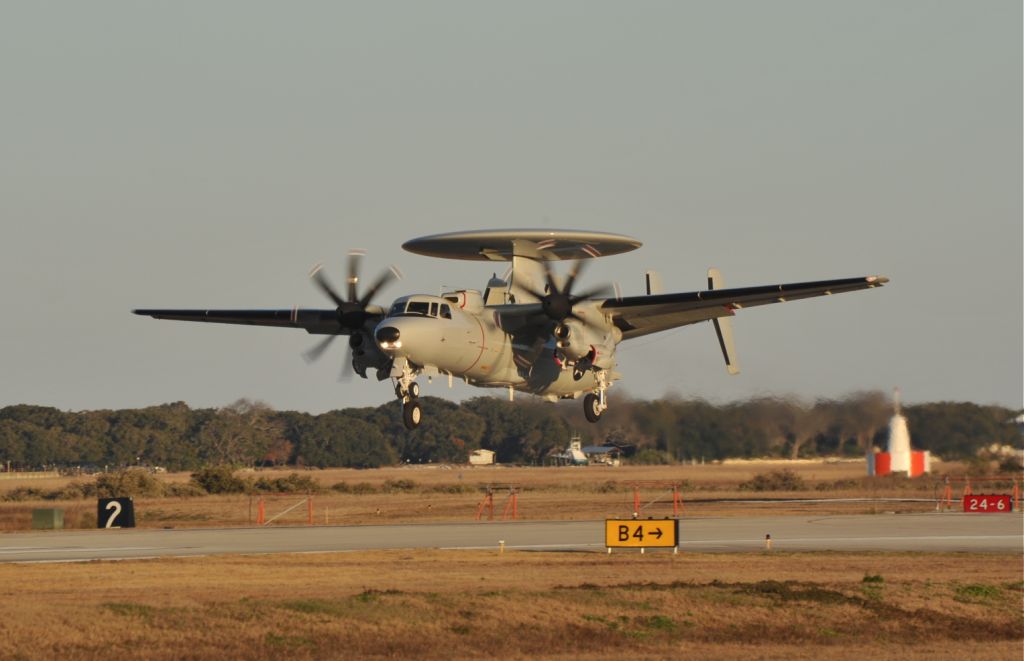
Currently, the Navy is in the testing phase of the latest iteration of the Hawkeye, which began development in 2003. The E-2D Advanced Hawkeye features upgraded aircraft systems and a state-of-the-art APY-9 radar with a two-generation leap in capability.
The E-2D Advanced Hawkeye continues the Navy’s integrated warfighting legacy by providing broad-area coverage, resulting in a wider range of capabilities, and an enhanced ability to work in the littoral and over land.
These systems, completely redesigned to provide a seamless stream of information between the key players of the strike team, include a new glass cockpit. The 17-inch liquid crystal display panels provide the co-pilot with the ability to become a fourth tactical operator — when not actively engaged in flying the aircraft — to give the crew more flexibility in performing its diverse missions.
The E-2D Advanced Hawkeye program completed first flight Aug. 3, 2007. Three aircraft continue flight testing here. Initial Operational Test and Evaluation is scheduled for 2013 and Initial Operations Capability in 2015.
“For five decades, the E-2 community has served our great nation not only during times of conflict but also in times of great necessity,” said Capt. Shane Gahagan, Hawkeye Greyhound program manager. “As we move forward, we look to the E-2D Advanced Hawkeye to watch our skies.”
The Navy’s active inventory includes 66 Hawkeye aircraft, two of which are pilot trainers, and four E-2D Advanced Hawkeye aircraft.
“The Hawkeye has operated as the Navy’s prime provider of organic AEW and battle management for the Carrier Strike Group for the past 50 years. The addition of the E-2D Advanced Hawkeye will ensure the continuance of the Hawkeye’s role of leading the way well into the middle of this century,” said Gahagan.
-- 30 --