China Lakers help study renewable energy in Africa
NAVAL AIR WARFARE CENTER WEAPONS DIVISION CHINA LAKE, Calif. - Three China Lake employees recently traveled to Djibouti, Africa, to install the first renewable energy system at Camp Lemonnier.
Hugh Edwards, of the Renewable Energy Office in NAWCWD’s Infrastructure Business Operations (IBO) Department, was the technical lead for this effort. He and Matthew Malone, of NAWCWD’s Research and Engineering, Steve Bjornstadt, of NAVFAC China Lake, and Bruce Holden, of NAVFAC’s Engineering Service Center in Port Hueneme, spent two weeks in May installing a small stationary photovoltaic (PV) system at Camp Lemonnier.
Camp Lemonnier is a U.S. Naval Expeditionary Base located at the Djibouti-Ambouli International Airport. It serves as the location from which U.S. and coalition forces are operating in the Horn of Africa.
To track the PV system’s output over time, a monitor was installed on Chief Petty Officer Matthew Robison’s containerized living unit (CLU). As the utilities director for the camp, he said it made sense for his CLU to be the one where the data is collected. “It could also impact the future of my job here,” he said, as the camp currently uses diesel for power.”
Data files from the monitoring system are emailed to Edwards at China Lake for analyzing. Depending on the results, the Navy team will recommend future PV systems for Camp Lemonnier.
One issue that Edwards will pay close attention to is the possible accumulation of soil on the array. To produce the maximum annual energy, stationary PV systems are installed at an angle relative to the latitude of their location. Since the latitude in Djibouti is just more than 11 degrees north of the equator, the PV system needs to be installed at a low angle, which would mean any soil that lands on the array would likely accumulate rather than be washed off by rains or sloughed off by gravity.
This was the first PV system on the camp and the first grid-connected PV system in Djibouti. Edwards and the team trained local personnel on how to operate and troubleshoot the system.
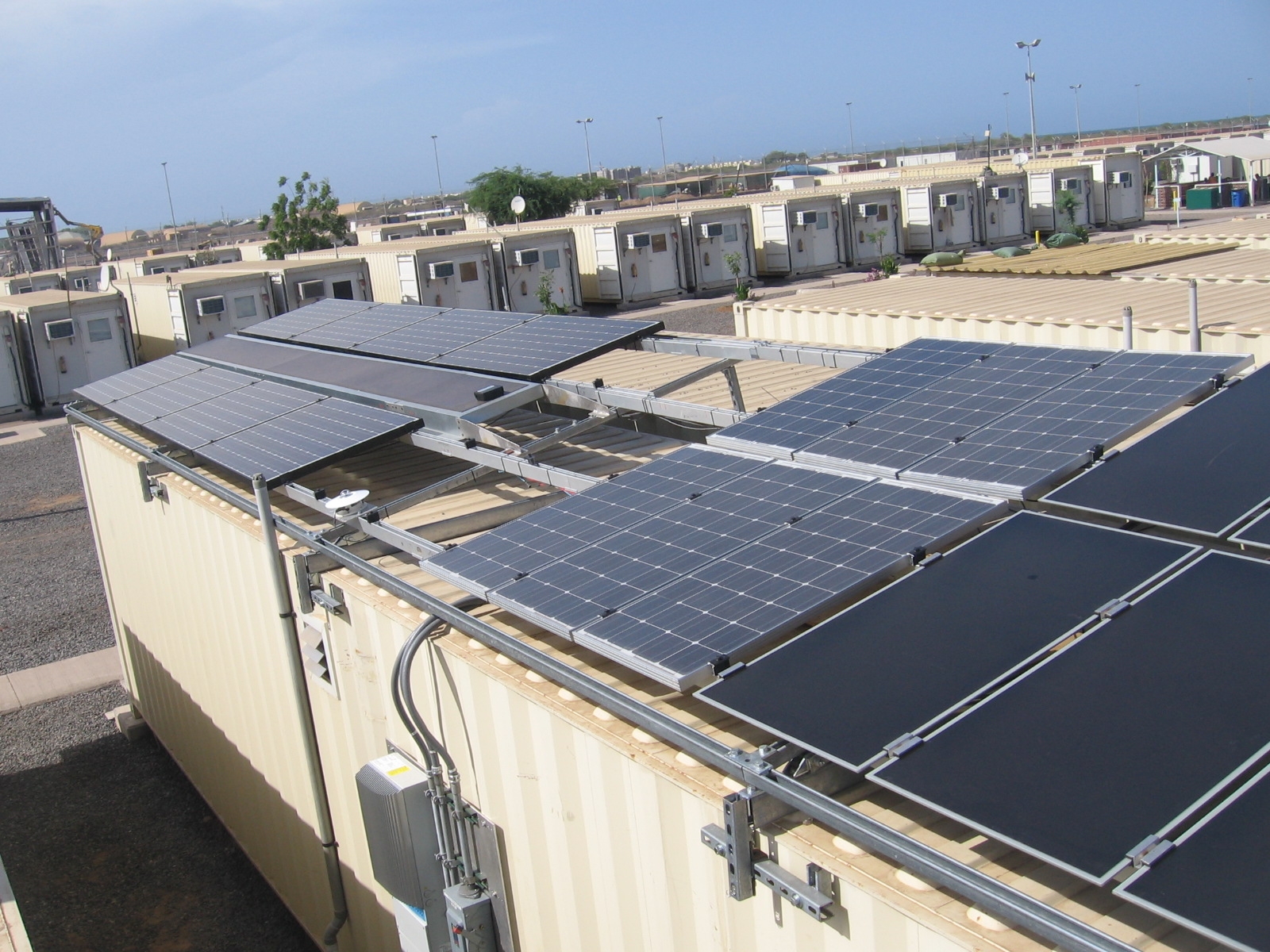
There are two types of panels installed on Robison’s CLU, as well as some data-gathering equipment inside. While he said the panels keep his CLU “noticeably cooler” than his neighbor’s CLUs, Robison said that he sees where dust has built up.
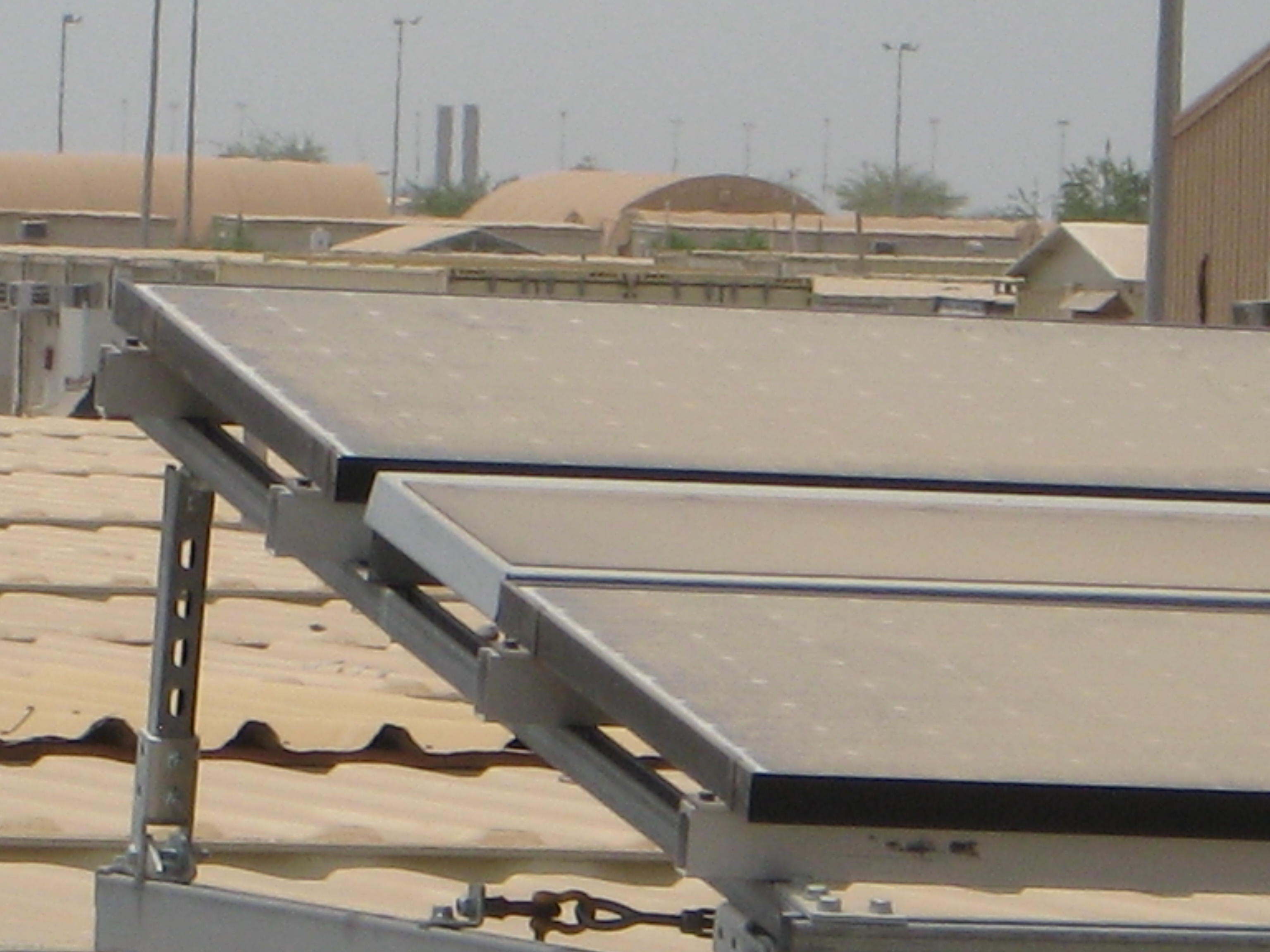
“The array accumulated a significant layer of dirt in 45 days which has caused the output to decrease,” Edwards said.
The final report on the six-month project will describe solar power opportunities at the camp, the cost of installing and cleaning them, and the benefit of less diesel fuel consumption. The Navy will weigh the cost of cleaning the systems and the benefits provided and proceed accordingly. Edwards and his team will return to Camp Lemonnier later this year to retrieve the monitoring system.
Edwards and Wayne Taylor provide support to multiple Navy and DoD customers. They participate on the Navy Energy Project Team, Navy photovoltaic research teams, the DoD Renewable Energy Assessment Solar Technical Assessment industry team and the Tri-Service Renewable Energy Committee.
“They are recognized as national and DoD Renewable Energy experts,” said Renee Lesniak, deputy for the IBO Department.
PHOTO CUTLINES
U.S. Navy photo
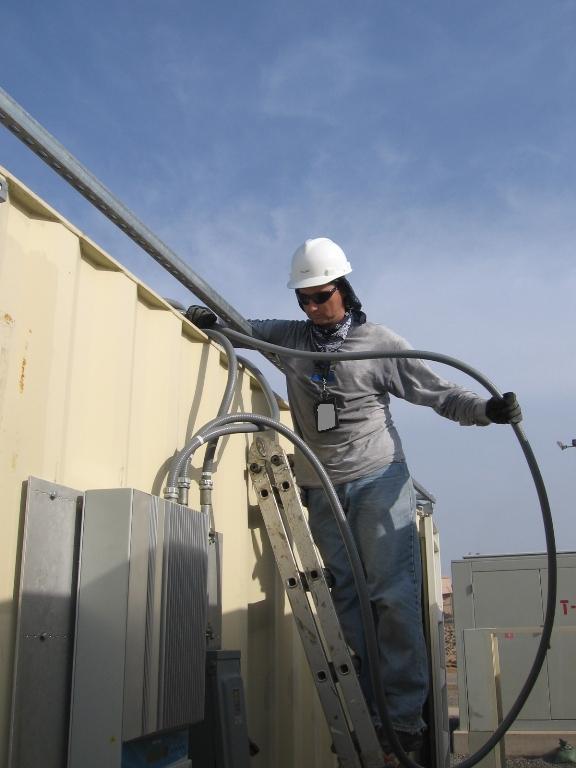
Matthew Malone, of NAWCWD’s Research and Engineering, runs wiring for a photovoltaic system at Camp Lemonnier in Djibouti, Africa.
U.S. Navy photo
The photovoltaic system at Camp Lemonnier in Djibouti, Africa is monitored from China Lake by NAWCWD’s Renewable Energy Office.
U.S. Navy photo
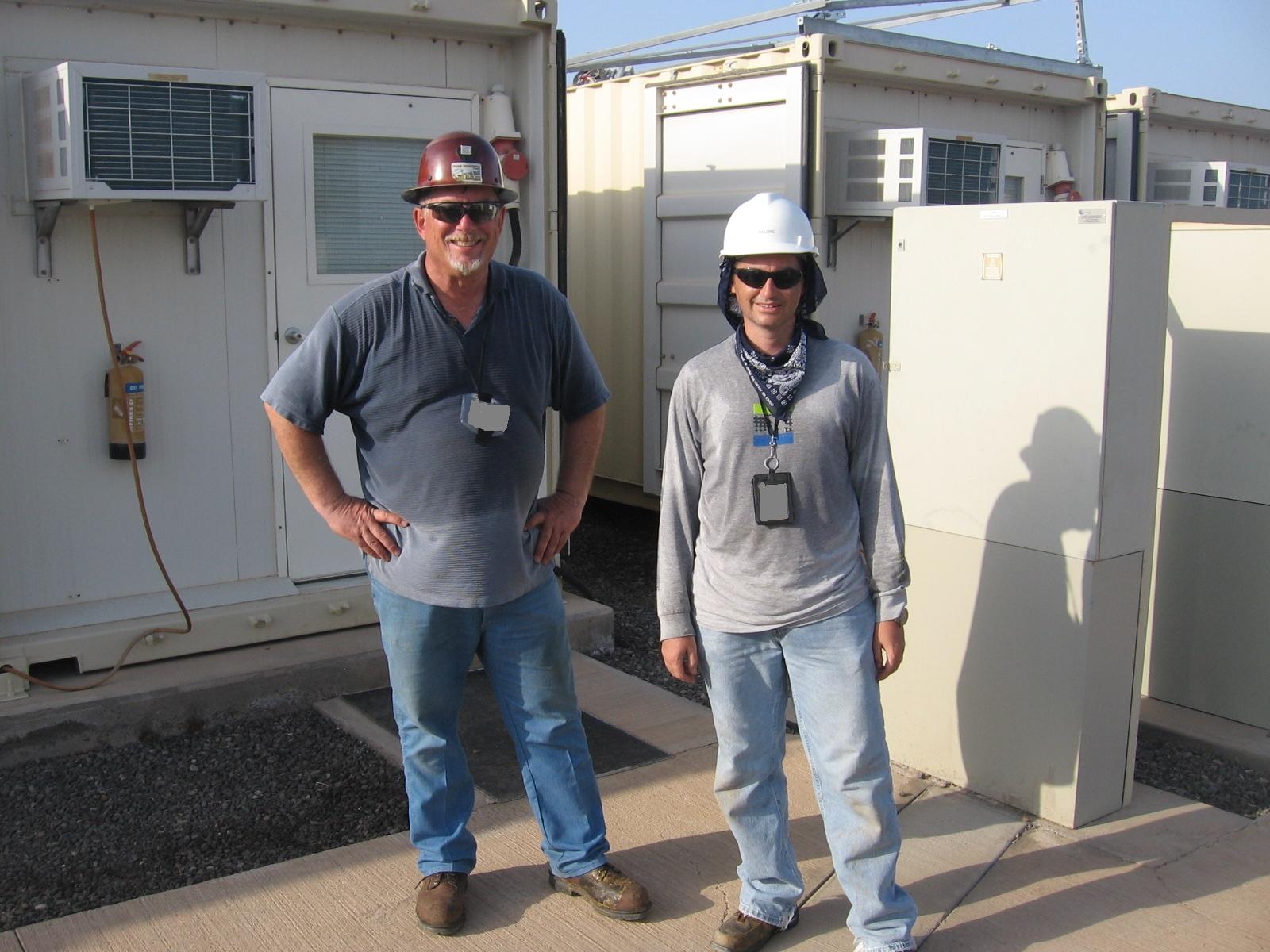
Hugh Edwards, of the Renewable Energy Office in NAWCWD’s Infrastructure Business Operations Department, and Matthew Malone, of NAWCWD’s Research and Engineering, press through 100-degree temperatures with 80 percent humidity to install the first photovoltaic system at Camp Lemonnier in Djibouti, Africa.
U.S. Navy photo
The PV system is covered with a layer of dirt just 45 days after installation.