Aging Aircraft Boss named Navy’s Small Business Program Manager of the Year
By Jim Jenkins
Aging Aircraft Public Affairs
Bob Ernst, the Naval Air Systems Command (NAVAIR) Aging Aircraft Integrated Product Team (AAIPT) head, was named the Navy 2005 Small Business Program Manager of the Year.
Given to program managers who demonstrate initiative and innovatively expand opportunities for growth and success for small business, this award is a reflection of Ernst’s commitment to the quest for parts manufacturers, during which he and his team discovered that small business partnerships are the fountain-of-youth equivalent for the Navy’s forward-deployed aging aircraft.
“It isn't just about using small businesses as a quick way to get a contract,” Ernst said. “It’s a way to use a flexible commodity that allows us to quickly reach into its product lines and research and development potential for quicker solutions to the problems of aging aircraft.”
Under Ernst’s leadership, the AAIPT pioneered a modern approach in sustaining the Defense Department’s aging legacy aircraft fleet by optimizing the diverse and specialized capabilities presented by the small business community.
“Mr. Ernst spearheaded an innovative performance-based contract to consolidate disparate, small, labor intensive contracts actions, and refocus traditional ‘Level of Effort’ contractor support to a product-focused, metric-driven, performance-based, hybrid contract,” said Emily Harman, NAVAIR Small Business Program Office associate director, in her nomination letter.
“This award recognizes what the team has done,” Ernst said. “It’s not a Bob Ernst award, it’s a team award, and it recognizes that I’ve got a group of people that are really willing to sit down and work in a fair competitive environment and make sure that our small businesses get a chance to compete on some of the Navy’s aging aircraft requirements.”
Leveraging the success of ongoing AAIPT Small Business Initiatives (SBI), the team initiated two additional SBIs focused on government/industry partnerships in North Carolina and Texas. The AAIPT’s agility in replicating and employing knowledge gained through working with the small businesses at the Global TransPark in Kinston, N.C. has created approximately 350 jobs and $70 million worth of revenue in that state alone.
Ernst said that the work the AAIPT is doing with the Global TransPark is changing the course of American industry.
Instead of the government providing a data package for a part to one company, and that company bidding the work out to yet another company, the streamlined omnibus contract provides a vehicle to which parts can be produced faster using small businesses.
There is a backlog of parts needed for forward deployed aircraft, but the original manufacturers for these parts no longer exist. Companies like WorkHorse Aviation at the Global TransPark work with NAVAIR’s reverse engineering laboratories and AAIPT’s FastTrack team to produce these small amounts of parts at an economically feasible price.
According to Harman, at least 30 percent of the AAIPT’s work targeted small business support, exceeding the NAVAIR’s 23 percent goal outlined in their Small Business Initiative while ensuring all performance and cycle-time requirements are met.
“Mr. Ernst’s efforts,” Harman said, “working with state and local governments in support of SBIs, have established the AAIPT and NAVAIR as valuable partners and beneficiaries of revitalization efforts in selected regions and cities.”
Looking for ways to combat aging issues, the AAIPT realized that most of the truly innovative solutions come from small businesses, which are able to specialize in specific technological areas of interest. The AAIPT mentored a few small businesses finding success and innovative solutions dealing with obsolescence and wiring issues.
The large companies like what the AAIPT is doing with the small businesses as well, Ernst said. The Aging Aircraft team is taking the time to work with and mentor the smaller companies so that their products are not a costly risk for the program teams at NAVAIR, or for the larger companies that may pick up and adopt the product.
“I think we have a very good track record of successfully mentoring and transitioning small business efforts,” Ernst said. “You have to have the culture that doesn’t view small businesses as a pork project, but as a chance to be innovative. That’s what the Aging Aircraft team is all about – taking some of those risks and taking some of those chances so we can truly bring promising technology up to the right level so our program teams can incorporate them into their products.”
Innovation is never without risk. The main risk of working with the smaller companies is that while they have the technical expertise, they don’t always have a long history of experience. The AAIPT assumes the risks and takes the chances on the smaller companies to bring promising technology to NAVAIR programs and ultimately to the war fighter.
Receiving the Navy’s 2005 Small Business Program Manager of the Year proved that for Ernst, the AAIPT, and the entire NAVAIR organization.
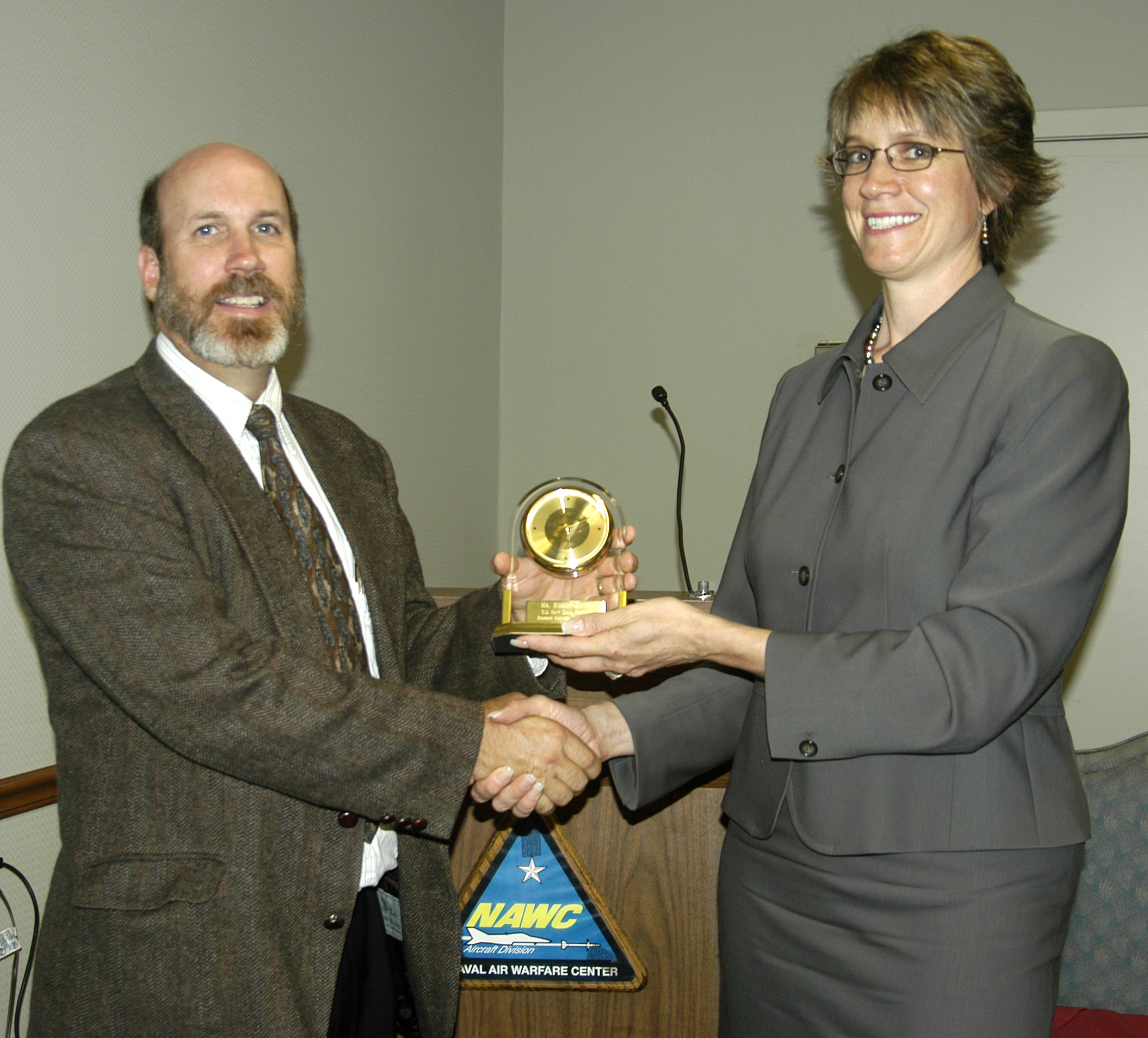
CAPTION:
Bob Ernst, NAVAIR Aging Aircraft IPT head, accepts the 2005 Navy Small Business Program Manager of the Year Award from Emily Harman, NAVAIR Small Business Program Office associate director.