Yuma offsite is off the ground; Harriers on their way back to the fleet
Yuma cuts
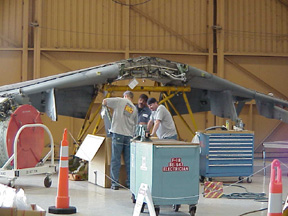
Yuma 1: Artisans tag parts removed from a Harrier.
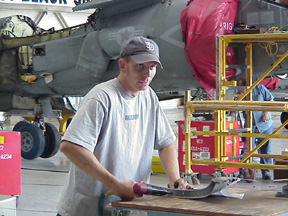
Yuma 2: Ken Ausdemore bucks rivets on a panel.
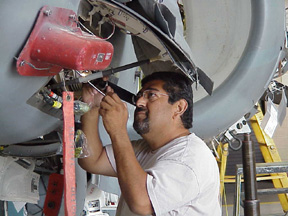
Yuma 3: Sheet metal examiner and evaluator Johnny Diaz inspects a Harrier.
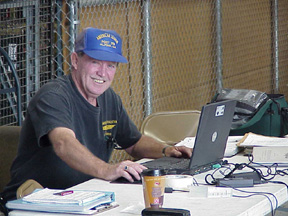
Yuma 4: Jim Coleman, a sheet metal examiner and evaluator, writes a discrepancy.
Yuma offsite is off the ground; Harriers on their way back to the fleet
By Bill Bartkus
NAVAIR Depot North Island
NAS NORTH ISLAND, Calif. – NAVAIR Depot North Island – in particular Field Service – has expanded its horizons with the addition of the Integrated Maintenance Program (IMP) at Marine Corps Air Station Yuma, Ariz. Artisans there are working side by side with Marine Air Group 13 on the Corps’ AV-8B Harrier.
“It all started when we received a request about a year ago to assess the Integrated Maintenance Program at Marine Corps Air Station Yuma,” said Davy Chavarria, with the Depot Industrial Business Operations Department (6.1) who had the lead in organizing the Yuma offsite, his second such task in a year. Chavarria lead the establishment of an offsite for the E-2C Hawkeye Integrated Maintenance Concept at Naval Air Station Point Mugu, Calif.
Chavarria said that the Aircraft Program Manager for Logistics (APML) had asked the Depot if it was interested in supporting an Integrated Maintenance Program (IMP) and installing modifications concurrent with an IMP.
Representatives from the Business Operations Office and Field Service performed an initial assessment in September and they reported back to the Program Manager’s (Air) office that the Depot was interested. “The APML received a follow on detailed assessment – in the form of an Integrated Logistics Support (ILS) plan – that identified the setup tasks that the Depot needed to perform along with the funding requirements to support those tasks,” Chavarria noted.
He said that funding was a union between NAVAIR 6.0, PMA-257 APML, and the Depot commanding officer. “Portions of the dollar amount supported vital on-the-job training for Depot artisans and over-the-shoulder confidence from our sister Depot at Cherry Point (N.C.) for when we worked our first prototype aircraft,” said Chavarria.
The Production and Engineering competencies published recruitments to support the incoming workload. Structures engineer Jonathan Hickle (4.3.3) volunteered for a permanent assignment to Yuma to support the Harrier. Hickle was a member of the F/A-18 Fleet Support Team Liaison Engineering Group.
The Industrial Business Office had lots of help setting up the Yuma plan and getting it off the ground. Roel Ramos, Eugene Tolbert, Rick Marinez, Juan Guerrero, and Nils Nilsson (all 6.2.1.18) were heavily involved in getting the project up and running.
Chavarria noted that the IMP setup was not without adversity. “A centralized location (hangar) to work on all of the processing requirements of all IMP aircraft in flow is an important factor that minimizes the time it takes to process IMP,” he said. “Everything is close by.”
He mentioned that facilities support would be in stages. “A van complex is currently setup to house personnel and material, and the aircraft work is being performed at a distance in the squadron’s hangar,” said Chavarria. “However, the PMA’s office, NAVAIR and Yuma station facilities are working on both mid- and long-term facility solutions,” he added.
Chavarria noted that a steel siding structure is taking the place of an initial tension fabric structure and is planned to be installed and ready for fiscal year 06 workload. “This enclosure will support four aircraft Work In Progress (WIP) aircraft and will be next to the van complex.”
The Harrier workload at Yuma has been scheduled out to the year 2020 “when the Joint Strike Fighter (JSF) will take its place. We should see a dedicated military construction hangar being built by the year 2010,” said Chavarria.
By definition, IMP is an integration of fleet and depot personnel working jointly to produce a product. “At Yuma, Boeing Co. contractors support the fleet by performing the disassembly and reassembly operations of IMP, and the company has been working with NAVAIR Cherry Point (N.C.) up until North Island came into the picture,” Chavarria stated.
“We inducted out first aircraft May 2, and Boeing is seeing a slight change to the processing. We have incorporated Manufacturing Resource Planning II (MRP II) routers to document the work accomplished, and Boeing is tagging parts with Removal Identity Cards (RIC),” said Chavarria.
“It is something new to them, and they have welcomed it and MAG-13 looks forward to any process improvement.”
According to Field Service Program Manager Roel Ramos, work at Yuma is progressing with the first Harrier PMI induction. “The aircraft is tracking to cost and schedule. Our teammates there inducted and finished the first airframe change 450 modification on time and within cost,” Ramos said.
There are 18 people working at Yuma, according to Eugene Tolbert, Ramos’ deputy. “We have sheet metal workers, aircraft mechanics and aircraft electricians, an examiner and evaluator, a planner and estimator, and one site manager. Five people volunteered to work in Yuma,” Tolbert said.
NAVAIR provides cost-wise readiness and dominant maritime combat power to make a great Navy and Marine Corps team better.