
New Scientists Experience Life and Work Aboard USS Abraham Lincoln
Released by the Naval Air Warfare Center Weapons Division, China Lake Public Affairs Office ----
By Will Heermann, ESDP
Ten Engineer and Scientist Development Program (ESDP) members from the Naval Air Warfare Center Weapons Division (NAWCWD) China Lake, California recently embarked on the aircraft carrier USS Abraham Lincoln (CVN-72) to experience how projects and weapons developed by civilians such as themselves are implemented in their intended environment. The ESDPs spent a little over four days on the carrier to learn about project implementation, protocol, safety, and daily life aboard a naval vessel.
On the first day of the visit, Lieutenant Commander Witt of Ordnance Control briefed the scientists and engineers on safety and emergency procedures. Following the brief, the visitors quickly located their assigned berthing and then navigated down to the hangar bay for an overview of the ordnance elevators. These elevators are used to move ordnance from the hangar to the magazines several decks below. Since many of the ESDPs work on developing and testing weapons, the group spent much of their time with Senior Chief Welch, who is in charge of the build-up of aviation ordnance. The group was able to witness multiple air-to-ground bombs being assembled with proper quality assurance techniques used in the confines of an aircraft carrier.
The next day, the group awoke to find the USNS Bridge 150 feet away on the starboard side of the carrier. The Bridge was there to transfer ordnance and supplies to the Lincoln. The transfer was initiated by firing a rope to the Bridge as a link in order to bring wires and cables between the two ships. Once the cables were properly placed, ordnance was transferred between the two ships by means of gravity-assisted pulleys. Overhead, SH-60 Seahawks were also transferring loads to the flight deck of the Lincoln. Simultaneously, as loads were being placed on both the hangar deck and flight deck, forklifts were moving the loads to the elevators to make room for more supplies.
One of the best views on the carrier looking out to the flight deck and ocean is that of Vulture’s Row. Flight operations, including catapult launches and arrested landings, can be observed from there. Many of the ESDPs were impressed by the efficiency, synchronization, and coordination of the flight deck crew as they assisted the Airwings during flight operations. As soon as one aircraft landed, the crew immediately directed the plane off to the side, retracted the arresting wire, and prepared to bring in the next plane. Later, members of Fighter Attack Squadron VFA-151, the Vigilantes, described the skill and practice required from the flight deck, control room, and the cockpit to coordinate a carrier landing.
The group also enjoyed a briefing at the Carrier Air Traffic Control Center (CATCC), where they were able to witness how the Precision Approach Landing System (PALS) directs incoming and outgoing aircraft in order to avoid collision and confusion.
The ESDPs said farewell to the Lincoln by boarding the Carrier On-board Delivery (COD) C-2 Greyhound aircraft bound for Naval Air Station North Island. Before leaving the carrier, the group was instructed on the proper placement of hands and feet in order to prepare for a catapult-assisted take-off. Wearing cranial and ear protection and a float coat, each ESDP strapped themselves to the seat using a four-point harness. The seats in the C-2 face the aft end of the aircraft, so when the plane is launched off a carrier, the passengers are thrown forward in the seat for a mere second and a half at nearly five times the force of gravity. The plane then calmly starts climbing to gain altitude. The ride is unlike any rollercoaster in existence.
Other notable experiences were the general quarters and “man overboard” drills, underway fuel transfer and aviation intermediate maintenance. The ESDPs from the Weapons Division came away from the trip with a better understanding of how weapons are handled in a carrier environment, and a greater appreciation for the dedicated men and women in uniform who serve aboard these vessels.
PHOTO CUTLINE######
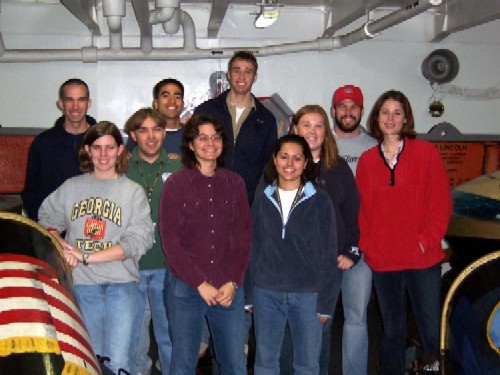
NAWCWD Engineering and Scientist Development Program members who recently visited the USS Abraham Lincoln include front row (l-r) Meghan Baronowski, Cassie Gorish, Patricia Pfahl; middle row (l-r) John Baronowski, Janelle Peterson, Kim Creaser; back row (l-r) Jeff Hosto, Steve Ortiz, Will Heermann and Shaun Blair.