
OSPREY PROGRAM MARINE RETURNS FROM IRAQ
By Ward Carroll, NAVAIR (V-22) PAO
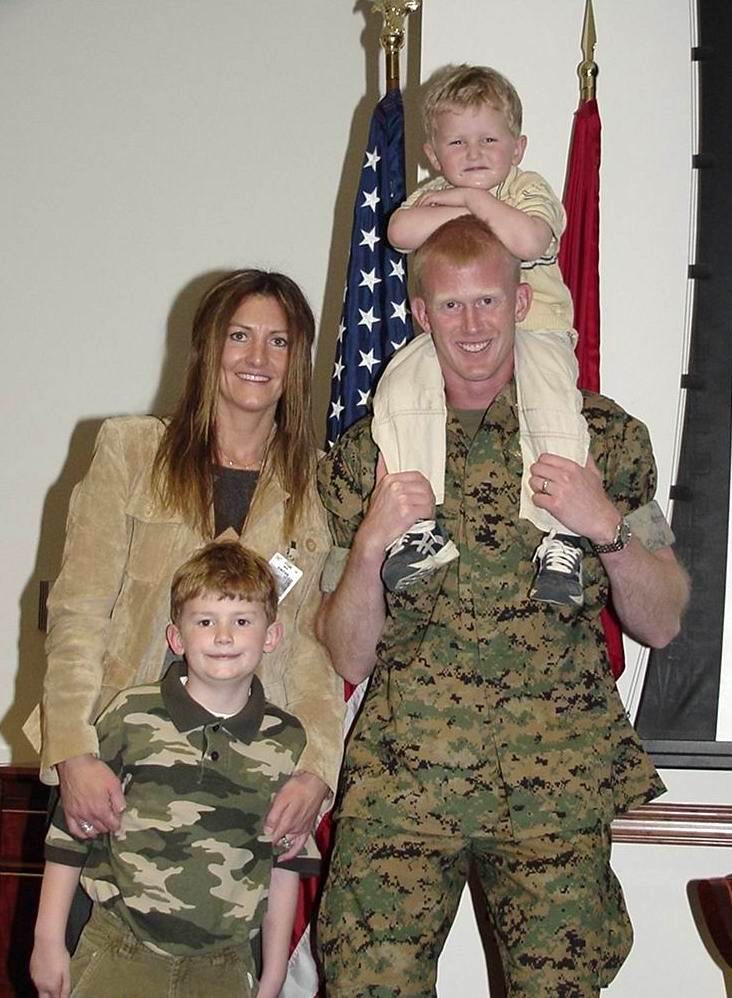
Just back to the office after six months in Iraq, Maj. Shawn McKee, an acquisitions manager in the MV-22 Development IPT, wasn’t sure what to think when news of a recent no-notice meeting late on a Friday afternoon reached his cubicle, but when he walked into the program’s main conference room he wasn’t greeted by the normal cohort but a standing room only crowd that included his wife and two young sons.
“We’ve gathered to salute your service in support of the Global War on Terror,” explained Col. Craig Olson, USAF, V-22 Joint Program Manager. “Through your selfless actions you’ve shown us firsthand what supporting the warfighter is all about.”
Last fall, Maj. McKee got word that Headquarters Marine Corps was looking for officers with aviation experience to man a staff in Iraq. “Since the conflict first began a few years ago, I’ve wanted to get involved,” the Spokane, Washington native and Naval Academy graduate said. “I volunteered and was gone the next week, which was good in the fact that my wife didn’t really have time to react. We’ve been married for eleven years, and I’ve deployed many times before, but this was the first time with kids.”
After drawing the required gear from the supply depot in Quantico, including body armor and a nine millimeter pistol, McKee flew to San Diego. “Originally they told me I was going to be a MCAS Miramar for a month, so I flew my family out. But I was out of there in five days.” During the flight to Kuwait, he still had little idea what he was getting into or even what job he was going to fill. The few hours he spent in a tent city north of Kuwait City didn’t help answer many of his questions. “They showed us a couple of video tapes about general awareness and safety and that was it,” he said. “I was on a C-130 headed into Iraq the next day.”
Maj. McKee landed at Al Assad, the main Marine Corps air base in Iraq, in the middle of the night. “Nobody knew I was coming,” he said. “Fortunately, the guys on duty that night were old friends from my days as a squadron Cobra pilot; they helped me figure things out.”
McKee was pleasantly surprised to discover he would be living in a fixed structure and not a tent. “Living conditions weren’t that bad,” he said. “The toilet worked most of the time. The shower worked sometimes. The chow hall had good food.” He went on to explain that the food workers were all from Sri Lanka because the locals who had worked there became targets for insurgents.
McKee worked as the air group’s aviation safety officer, solving airspace de-confliction issues and assisting with basic logistics matters like ensuring the medevac pad was properly lit and marked. He also came up with course rules for helicopters. And unlike stateside safety concerns, he always had to think about the possibility of an attack. While he was there rockets hit Al Assad every few weeks and a suicide bomber rammed into the front gate, killing several Iraqi policemen.
Among the big events during McKee’s six months in country were the Fallujah campaign and the Iraqi national elections. The operational tempo, never low, was markedly higher during those times. “We had a couple of Cobras shot down during the battle for Fallujah. Fortunately all the aircrews were recovered uninjured.”
A few weeks later, an H-53 crew was not as lucky. Thirty-one Marines died in a crash just west of the base. Maj. McKee was part of the mishap investigation team, which got to the crash site via a convoy. “That was my one convoy,” he said. “Before we started to roll, the driver briefed us to fire at any attacking vehicle’s engine block, which was laughable because we were hunkered down in the back with nothing but pistols with twelve rounds each.”
But the one image that sticks with him more than any other is that of Iraqi Army troops boarding an H-46 he happened to be on. “We were re-routed to pick them up along with their Marine advisors,” McKee said. “None of the Iraqi’s cammies matched. They were carrying their belongings in plastic bags. They certainly weren’t physically imposing, but each of them had a certain look of determination. I was very moved by their presence and hit with an image of George Washington’s forces during the Revolutionary War – ill-equipped but resolute.”
Maj. McKee flew back to the United States just over six months after he’d left. He walked into his Breton Bay home at one in the morning. “That was kind of nice because my sons were asleep and I was afforded some quiet time with my wife. When the boys woke up the next morning it was like Christmas.”
As he looked back on the experience, Maj. McKee offered this impression: “The Marines over there feel like they’re making a difference. There is a sense of purpose, and guys are proud of what they’re doing. Morale is high.”
And while he was glad to be home, he appreciated the experience and the context it provided as he continued his work in support of the MV-22. “This is great work we’re doing here,” he said, “but at the same time I was more than happy to spend some time around Marines. I should be thanking them for the opportunity.”
Caption for photo:
MAJ Shawn McKee poses with his wife, Donna, and sons Cole and Michael during the recent welcome home celebration at PMA-275. (Photo by Randy Tuefel)