Artisans Breathe New Life into LM2500 Engines
LM 2500 CUTLINE
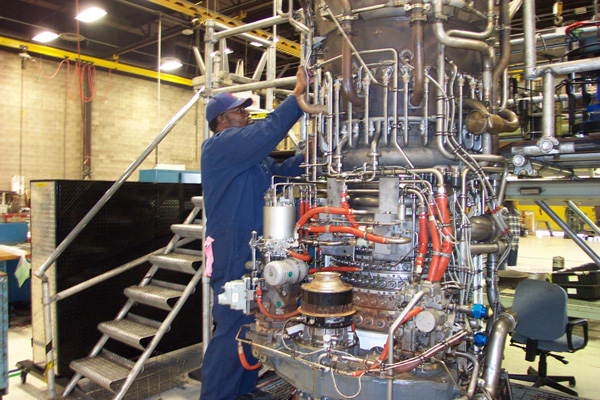
Aircraft engine mechanic Jesse Beverly works on an LM2500 engine in Building 472. FRCSW recently received an LM2500 engine that artisans had last repaired in 1986, which had operated within specifications for more than 35,000 hours – almost three times the normal. Jim Markle
Artisans Breathe New Life into LM2500 Engines
By Jim Markle
FRCSW Public Affairs Office
NAS NORTH ISLAND, Calif. – In December 1986, Naval Air Depot North Island (now Fleet Readiness Center Southwest) here, received shipment of a General Electric-built LM2500 engine, serial number GGA 042, from the guided missile frigate USS Jarrett (FFG 33) that had 9,000 hours of usage and a high vibration problem.
“We did a typical overhaul to GGA 042. We did the gas turbine changes and we took it all the way down – everything was completely stripped on it. The rotor was completely disassembled, remanufactured to new, and rebuilt,” said LM2500 project coordinator Jim Hansen. This type of work was not unusual since LM2500s typically operate between 10,000 and 20,000 hours before a major failure, Hansen noted.
Now, 20 years and 26,000 hours of usage later, GGA 042 returned to Fleet Readiness Center Southwest in May with a v-sump oil leak (similar to a car engine’s oil pan).
With 35,000 total hours logged, the GGA 042 is a noteworthy exception to the typical maintenance interval. “If it hadn’t been for that sump leak, it’d still be out there running,” Hansen commented.
First used to power the Spruance- and Kidd-class destroyers in the 1970s, LM2500 production began in 1969. The engines proved so versatile and reliable, their use expanded in the 1980s to include Oliver Hazard Perry-class frigates, Ticonderoga-class cruisers and today’s Arleigh Burke-class destroyers. The gas turbine engine also powers oil platforms and pipeline pumping stations.
FRCSW began servicing LM2500 engines in 1976, and Hansen has been with the program from its inception, starting as a mechanic.
“GE warranties their engines for one year when they sell them to the Navy. But when there was a minor malfunction years ago, GE would contact us and send one of us out to do the repairs on the ship. I worked Field Service for about five or six years,” he said.
Field work ended more than 10 years ago and is now performed by Shore Intermediate Maintenance Activity (SIMA). Because engine removal is a costly, three-day process, SIMA only refers work to FRCSW when repairs exceed their capabilities, Hansen stated.
FRCSW customers include Naval Sea Systems Command, the Portuguese and New Zealand navies, and other foreign navies who have purchased U.S. destroyers, frigates and cruisers powered by the engines.
The 20 artisans in the FRCSW engine program service up to 12 engines annually. Engines are repaired for significant cause and not regular maintenance cycles.
“After we repair them, we run them through a complete test. We run them at 9,000 rpm. We’ll get horsepower and oil consumption readings, and check all vibrations and make sure everything is copasetic before it leaves here,” Hansen said.
New twin-shank and single-shank LM2500 engines cost $2.5 million and $3.5 million, respectively. FRCSW charges approximately $800,000 per overhaul and averages 3,300 manhours or 155 days per job, Hansen stated.
“Our competitors charge about $1.5 million per overhaul. And that’s the reason why the customer keeps coming back to us, we give them a quality product at low-cost,” added LM2500 Department Program Manager JB Thurmond Jr.
FRCSW contracts some engine work to civilian companies. One local company, Chromalloy, with a branch in El Cajon, Calif., handles heterojunction bipolar transistor blades, first stage compressor blades, and the engine’s first and second stage nozzles. Other companies like Woodward, based in Rockford, Ill., work on compressor inlet temperature sensors and fuel controls, Hansen added.
In program history only three engines have been irreparable. Two were due to foreign object damage, or debris entering the engine, and the third had an excessive vibration problem.
“We sent it (the third) to GE and they put their best people on it, and still to this day, they can’t find out what the problem was,” Thurmond said.
Completion of the GGA 042 overhaul is projected for October, when it will rejoin the fleet inventory.