
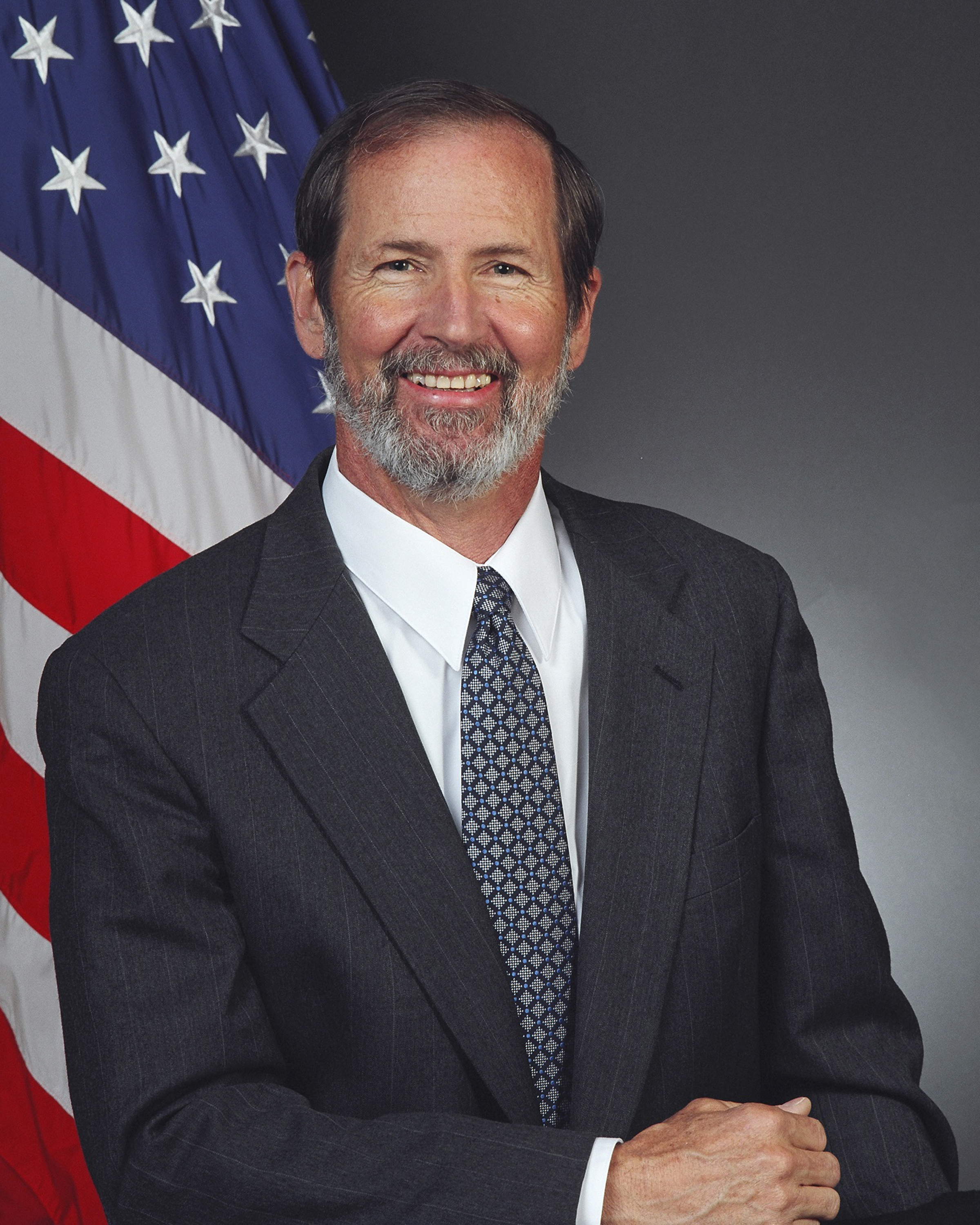
Navy Undersecretary Confirms O'Neil as Weapons Division's Executive Director
Released by the Naval Air Warfare Center (NAWC) Weapons Division China Lake Public Affairs Office--
Undersecretary of the Navy, the Honorable Dionel Aviles, approved the selection and reassignment of Scott O'Neil as Executive Director and the Director of Research and Engineering for NAWC Weapons Division on May 16.
After the retirement of his predecessor, Dr. Karen Higgins, in December 2005, O’Neil, then Director of Integrated Battlespace Simulation and Test, temporarily assumed the executive director duties.
Now that his two-fold position is confirmed, O’Neil’s responsibilities include business strategy planning and execution for the Center’s $900 million business base. He also oversees a workforce made up of 4,200 military and civilians serving at China Lake and Point Mugu.
“As executive director, my focus is on the business of NAWCWD; integrating our people, processes, and facilities to achieve our mission in serving our warfighters,” O’Neil said. “Commonality of processes across the Center and NAVAIR is also a goal. As the Navy moves to recapitalize its capabilities there will be continuing pressure to create value at reduced cost. I am confident that our leadership at NAWCWD can achieve this by finding ways to improve our processes and find efficiencies across the Command.”
As Director of Research and Engineering, O’Neil says, “the mission in R&E is two-fold. First we must continue to support the development, acquisition, and sustainment of the weapons currently used by our warfighters to ensure they work as intended. By maintaining around-the-clock direct contact with the Fleet, we are ready to help employ these weapons in new ways to address a quickly adapting threat. Secondly, we develop science and technology that can be directly translated into new weapons. We have a rich history of generating new ideas, applying advanced technologies, and rapidly formulating innovative weapons to address emerging warfighter needs. This is still a critical mission area and we are making a difference with some of our innovations in Iraq today.”
O’Neil added, “Today we face a special challenge, that being the implementation of the BRAC law. This will mean a big change for China Lake and the Ridgecrest community; but, it also means a big change for our friends and colleagues at Point Mugu. BRAC has resulted in some turbulent water between our two major campuses. One of the special challenges we have is to reunite our communities and to work toward building a strong future for both sites. The Navy of today and tomorrow needs NAWCWD and there is a strong role our workforce at both China Lake and Point Mugu must play to ensure our warfighters have the most capable weapons systems in the world.”
O’Neil began work at the Naval Weapons Center (NWC), now NAWCWD, in 1972. Over his 34 year career, he gained hands-on experience in missile technologies as well as program management, weapons systems cost analysis, information systems management, test and evaluation, and modeling and simulation. In 1998, he was also appointed to the Senior Executive Service as head of NAVAIR’s Weapons and Targets Department. There he managed 1,200 people performing research and development, acquisition support, test and evaluation (RDAT&E), and in-service engineering for weapons and targets.
From 2002 to 2004, O’Neil served as lead of the NAVAIR Atlantic Ranges and Facilities Department (AR&F) in Patuxent River, MD. The AR&F laboratories provide specification compliance and life-cycle tests for aircraft, aircraft subsystems, and fuels. It supports RDAT&E and fleet training for naval systems.
In 2004, O’Neil assumed the position as Director, Integrated Battlespace Simulation and Test (IBST) Department at Patuxent River, MD.
Though O’Neil considers his past experience valuable, he credits the true success of the Weapons Division to the people. “I’ve lived in this community long enough and worked at NAWCWD long enough to understand the drive and dedication of the people we are fortunate to have supporting our warfighters. They’re just hardworking, honest folks who know what it means to think locally and act globally. We’ve got a lot of people counting on us to get the job done and I’m just thrilled to be shoulder to shoulder with the people of NAWCWD because they know how to get it done.”
-End-